Two models built on the same underlying system, differing only in safeguards.
Fable 5.1: generally available.
Mythos 5.1: restricted to trusted access programs; its safeguards are designed to support cybersecurity and life-sciences work.
Positioned as the leading models for coding and knowledge work, with research capabilities framed as an early sign of AI contributing to scientific progress.
Customer-facing changes
Price: roughly 25% cheaper than Fable 5 for typical token-billed workloads, driven by lower cache-read pricing; up to ~45% cheaper for highly agentic work.
Data retention: new Enterprise Frontier Safeguards (EFS) store data in customer-controlled cloud infrastructure, giving privacy equivalent to zero data retention while still preventing adversarial use. Rolling out to enterprise customers in phases starting later this fall; eligible customers get zero data retention with Fable 5.1 in the interim.
Safeguards: fewer false positives — 60% fewer in cybersecurity. Fable 5.1 may now be used to discover software vulnerabilities, but not to develop exploits. A biology access program developed with the US government will open enrollment for scientists soon.
Performance
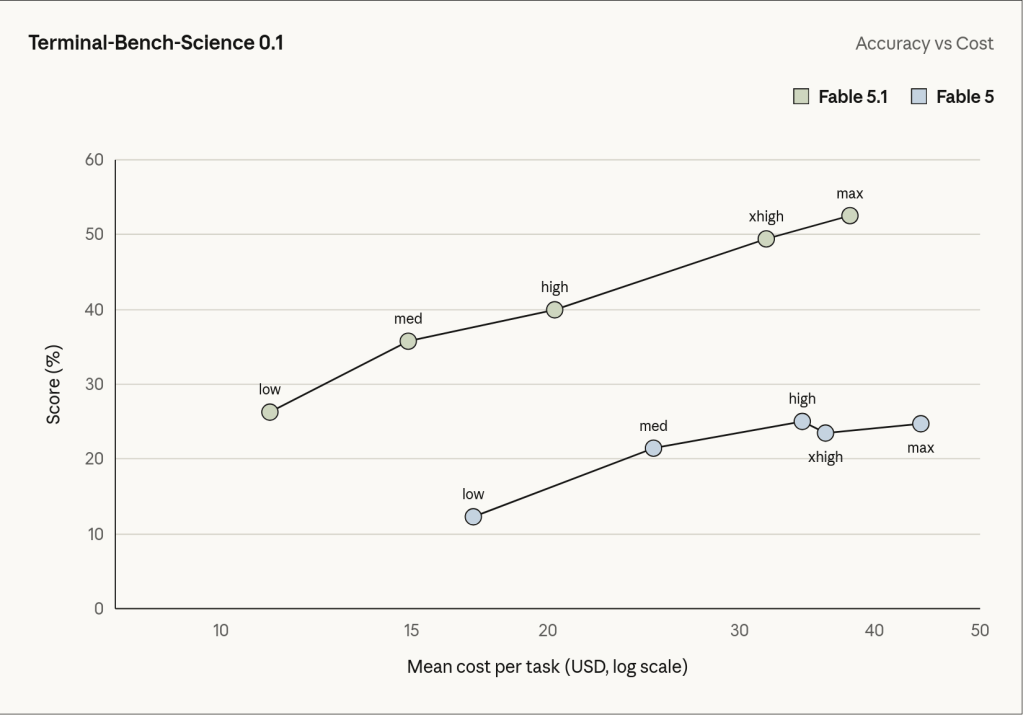
Effort levels are configurable; Low or Medium effort matches or beats Fable 5 at much lower cost. Defaults: High in Claude Code, Medium in Claude Cowork and on Claude.ai.
Humanity’s Last Exam (no tools): 60.9% / 57.8% / 56.6% / —
AutomationBench: 31.4% / 17.1% / 26.9% / 19.6%
CursorBench 3.2.0: 73.4% / 70.5% / 70.0% / 67.2%
Benchmarks were run with production safeguards on; safeguard interventions scored zero on some tasks, likely understating Fable 5.1 and Fable 5 results.
Millennium reported Fable 5.1 diagnosed a rare crash in its internal systems that its engineers and other models had failed to explain over several years.
Jane Street’s Craig Falls reported more coding problems solved than Fable 5 or Opus 5, state-of-the-art trading intuition, and better readability over long multi-step tasks.
Scientific research results
Molecular design: given open-source protein design and folding tools, Mythos 5.1 produced binders with affinities 10× higher than the best entries in Adaptyv Bio’s competitions on three targets, and a ~50% hit rate across 12 targets (10–15% is typical).
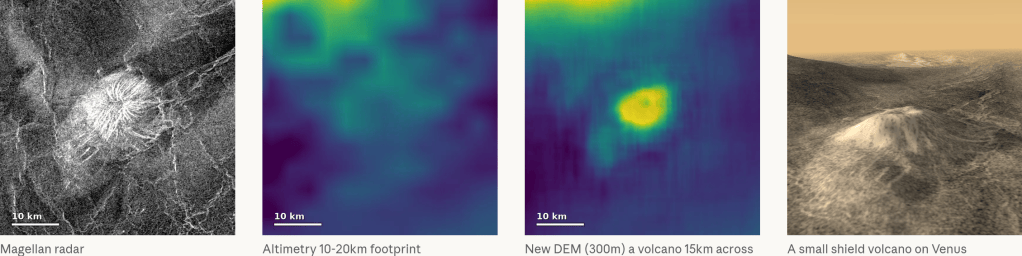
Venus elevation map: Fable 5.1 trained a neural network on 30-year-old NASA Magellan radar data plus an existing map of one-fifth of the planet, producing a map of one-third of Venus at 2–3 km resolution (up from 10–20 km) with heights up to 25% more accurate. Released under a Creative Commons license ahead of NASA VERITAS and ESA EnVision.
GPU kernel optimization: Mythos 5.1 wrote custom kernels and cached intermediates to speed up seven open-source deep learning models by 1.4×–2.5× on an H100 with identical outputs, cutting estimated GPU costs 30–60%. Done in days from public source code alone; optimizations to be open-sourced.
Related efforts: the Model Hardware Standard for safe operation of lab equipment, the AI for Science credit program, and a discounted Claude Team plan for scientists.
Safety, security, and alignment
Chemical and biological: expert red-teaming, automated evaluations, and a tabletop exercise pairing PhD biologists with AI experts. Mythos 5.1 exceeds Mythos 5 in capability but falls short of the next Responsible Scaling Policy risk tier, so it ships with Mythos 5’s safeguards restricting research biology capabilities.
Cyber: with safeguards off, Mythos 5.1 shows the strongest cyber capabilities of any released model but remains in the lower risk category of the Frontier Compliance Framework. Fable 5.1’s safeguards were stress-tested internally, by two commissioned external organizations, and via automated testing by Gray Swan; no critical-severity jailbreak found.
Agentic safety: refuses malicious agentic coding and computer-use requests at rates comparable to Mythos 5, Sonnet 5, and Opus 5; most robust model to date on an external prompt-injection benchmark.
Alignment: assessed via static and interactive behavioral evaluations, natural language autoencoder analysis of internal thinking, misalignment capability evaluations, training data review, internal pilot analysis, and external reports. Full detail is in the System Card.