• About
    • Contact

/root

  • anki-snapshot: Git-Based Version Control for Your Anki Collection

    January 14th, 2026

    I’ve released anki-snapshot, a tool that brings proper version control to your Anki flashcard collection. Every change to your notes is tracked in git, giving you full history, searchable diffs, and the ability to see exactly what changed and when.

    The Problem

    Anki’s built-in backup system saves complete snapshots of your database, but it doesn’t tell you what changed. If you accidentally delete a note, modify a card incorrectly, or want to see how your deck evolved over time, you’re stuck comparing opaque database files.

    The Solution

    anki-snapshot exports your Anki collection to human-readable text files and commits them to a git repository. This means you get:

    • Full history: See every change ever made to your collection
    • Meaningful diffs: View exactly which notes were added, modified, or deleted
    • Search through time: Find when a specific term appeared or disappeared
    • Easy recovery: Restore individual notes from any point in history

    How It Works

    The tool reads your Anki SQLite database and exports notes and cards to pipe-delimited text files. These files are tracked in git, so each time you run anki-snapshot, any changes are committed with a timestamp.

    ~/anki-snapshot/
    ├── .git/
    ├── notes.txt      # All notes: id|model|fields...
    ├── cards.txt      # All cards: id|note_id|deck|type|queue|due|ivl...
    └── decks.txt      # Deck information
    

    Commands

    CommandDescription
    anki-snapshotExport current state and commit to git
    anki-diffShow changes since last snapshot
    anki-logShow commit history with stats
    anki-search "term"Search current notes for a term
    anki-search "term" --historySearch through all git history
    anki-restore <commit> <note_id>Restore a specific note from history

    Example: Tracking Changes

    After editing some cards in Anki, run the snapshot and see what changed:

    $ anki-snapshot
    [main a3f2b1c] Snapshot 2026-01-14 21:30:45
     1 file changed, 3 insertions(+), 1 deletion(-)
    
    $ anki-diff
    ━━━ Changes since last snapshot ━━━
    
    Modified notes: 2
    + [1462223862805] Which antibodies are associated with Hashimoto...
    − [1462223862805] Which antibodies are associated with Hashimoto...
    
    New notes: 1
    + [1767170915030] Germline polymorphisms of the ATPase 6 gene...
    

    Example: Searching History

    Find when “mitochondria” was added or modified across your entire collection history:

    $ anki-search "mitochondria" --history
    
    commit e183cea7b3e36ad8b8faf7ca9d5eb8ca44d5bb5e
    Date:   Tue Jan 13 22:43:47 2026 +0100
    + [1469146863262] If a disease has a mitochondrial inheritance pattern...
    + [1469146878242] Mitochondrial diseases often demonstrate variable expression...
    
    commit 41c25a53471fc72a520d2683bd3defd6c0d92a88
    Date:   Tue Jan 13 22:34:48 2026 +0100
    − [1469146863262] If a disease has a mitochondrial inheritance pattern...
    

    Integration with Anki

    For seamless integration, you can hook the snapshot into your Anki workflow. I use a wrapper script that runs the snapshot automatically when closing Anki:

    $ anki-wrapper  # Opens Anki, snapshots on close
    

    Or add it to your shell aliases to run before building/syncing your deck.

    Installation

    The tool is available on the AUR for Arch Linux users:

    yay -S anki-snapshot
    

    Or install manually:

    git clone https://github.com/chrislongros/anki-snapshot-tool
    cd anki-snapshot-tool
    ./install.sh
    

    Requires: bash, git, sqlite3

    Why Not Just Use Anki’s Backups?

    Anki’s backups are great for disaster recovery, but they’re binary blobs. You can’t:

    • See what changed between two backups without restoring them
    • Search for when specific content was added
    • Selectively restore individual notes
    • Track your collection’s evolution over months or years

    With git-based snapshots, your entire editing history becomes searchable, diffable, and recoverable.

    Source Code

    github.com/chrislongros/anki-snapshot-tool

  • Introducing fsrsr: R Bindings for the FSRS Spaced Repetition Algorithm

    January 14th, 2026

    I’ve just released fsrsr, an R package that provides bindings to fsrs-rs, the Rust implementation of the Free Spaced Repetition Scheduler (FSRS) algorithm. This means you can now use the state-of-the-art spaced repetition algorithm directly in R without the maintenance burden of a native implementation.

    What is FSRS?

    FSRS is a modern spaced repetition algorithm that outperforms traditional algorithms like SM-2 (used in Anki’s default scheduler). It uses a model based on the DSR (Difficulty, Stability, Retrievability) framework to predict memory states and optimize review intervals for long-term retention.

    Why Bindings Instead of Native R?

    Writing and maintaining a native R implementation of FSRS would be challenging:

    • The algorithm involves complex mathematical models that evolve with research
    • Performance matters when scheduling thousands of cards
    • Keeping pace with upstream changes requires ongoing effort

    By using extendr to create Rust bindings, we get:

    • Automatic updates: Just bump the fsrs-rs version to get algorithm improvements
    • Native performance: Rust’s speed with R’s convenience
    • Battle-tested code: The same implementation used by Anki and other major apps

    Installation

    You’ll need Rust installed (rustup.rs), then:

    remotes::install_github("chrislongros/fsrsr")
    

    Basic Usage

    Here’s a simple example showing the core workflow:

    library(fsrsr)
    
    # Initialize a new card with a "Good" rating (3)
    state <- fsrs_initial_state(3)
    # $stability: 3.17
    # $difficulty: 5.28
    
    # After reviewing 3 days later with "Good" rating
    new_state <- fsrs_next_state(
      stability = state$stability,
      difficulty = state$difficulty,
      elapsed_days = 3,
      rating = 3
    )
    
    # Calculate next interval for 90% target retention
    interval <- fsrs_next_interval(new_state$stability, 0.9)
    # Returns: days until next review
    
    # Check recall probability after 5 days
    prob <- fsrs_retrievability(new_state$stability, 5)
    # Returns: 0.946 (94.6% chance of recall)
    

    Available Functions

    FunctionDescription
    fsrs_default_parameters()Get the 21 default FSRS parameters
    fsrs_initial_state(rating)Initialize memory state for a new card
    fsrs_next_state(S, D, days, rating)Calculate next memory state after review
    fsrs_next_interval(S, retention)Get optimal interval for target retention
    fsrs_retrievability(S, days)Calculate probability of recall

    Ratings follow Anki’s convention: 1 = Again, 2 = Hard, 3 = Good, 4 = Easy.

    Use Cases

    • Research: Analyze spaced repetition data using R’s statistical tools
    • Custom SRS apps: Build R Shiny applications with proper scheduling
    • Simulation: Model learning outcomes under different review strategies
    • Data analysis: Process Anki export data with accurate FSRS calculations

    Technical Details

    The package uses extendr to generate R bindings from Rust code. The actual FSRS calculations happen in Rust via the fsrs-rs library (v2.0.4), with results passed back to R as native types.

    Source code: github.com/chrislongros/fsrsr

  • High iowait in TrueNAS server

    January 12th, 2026

    I recently ran into a performance issue on my TrueNAS SCALE 25.10.1 system where the server felt sluggish despite low CPU usage. The system was running Docker-based applications, and at first glance nothing obvious looked wrong. The real problem turned out to be high iowait.

    What iowait actually means

    In Linux, iowait represents the percentage of time the CPU is idle while waiting for I/O operations (usually disk). High iowait doesn’t mean the CPU is busy — it means the CPU is stuck waiting on storage.

    In top, this appears as wa:

    %Cpu(s):  1.8 us,  1.7 sy,  0.0 ni, 95.5 id,  0.2 wa,  0.0 hi,  0.8 si,  0.0 st

    Under normal conditions, iowait should stay very low (usually under 1–2%). When it starts climbing higher, the system can feel slow even if CPU usage looks fine.

    Confirming the issue with iostat

    To get a clearer picture, I used iostat, which shows per-disk activity and latency:

    iostat -x 1

    This immediately showed the problem. One or more disks had:

    • Very high %util (near or at 100%)
    • Elevated await times
    • Consistent read/write pressure

    At that point it was clear the bottleneck was storage I/O, not CPU or memory.

    Tracking it down to Docker services

    This system runs several Docker-based services. Using top alongside iostat, I noticed disk activity drop immediately when certain services were stopped.

    In particular, high I/O was coming from applications that:

    • Continuously read/write large files
    • Perform frequent metadata operations
    • Maintain large active datasets

    Examples included downloaders, media managers, and backup-related containers.

    Stopping services to confirm

    To confirm the cause, I stopped Docker services one at a time and watched disk metrics:

    iostat -x 1

    Each time a heavy I/O service was stopped, iowait dropped immediately. Once the worst offender was stopped, iowait returned to normal levels and the system became responsive again.

    Why the system looked “fine” at first

    This was tricky because:

    • CPU usage was low
    • Memory usage looked reasonable
    • The web UI was responsive but sluggish

    Without checking iostat, it would have been easy to misdiagnose this as a CPU or RAM issue.

    Lessons learned

    • High iowait can cripple performance even when CPU is idle
    • top alone is not enough — use iostat -x
    • Docker workloads can silently saturate disks
    • Stopping services one by one is an effective diagnostic technique

    Final takeaway

    On TrueNAS SCALE 25.10.1 with Docker, high iowait was the real cause of my performance issues. The fix wasn’t a reboot, more CPU, or more RAM — it was identifying and controlling disk-heavy services.

    If your TrueNAS server feels slow but CPU usage looks fine, check iowait and run iostat. The disk may be the real bottleneck.

  • Seaweedfs 4.06

    January 12th, 2026

    What’s Changed

    • Helm Chart
      • chart: Set admin metrics port to http port by @sheyabernstein in #7936
      • fix: Invalid volume mount conditional in filer template by @nichobi in #7992
    • S3 API
      • Fix S3 list objects marker adjustment for delimiters by @chrislusf in #7938
      • fix: directory incorrectly listed as object in S3 ListObjects by @chrislusf in #7939
      • Refine Bucket Size Metrics: Logical and Physical Size by @chrislusf in #7943
      • Fix AWS SDK Signature V4 with STS credentials (issue #7941) by @chrislusf in #7944
      • fix: correcting S3 nil cipher dereference in filer init by @tjasko in #7952
      • Support AWS standard IAM role ARN formats (issue #7946) by @chrislusf in #7948
      • s3api: fix authentication bypass and potential SIGSEGV (Issue #7912) by @chrislusf in #7954
      • store S3 storage class in extended atrributes #7961 by @ravenschade in #7962
      • fix: handle range requests on empty objects (size=0) by @chrislusf in #7963
      • Fix trust policy wildcard principal handling by @chrislusf in #7970
      • Support Policy Attachment for Object Store Users by @chrislusf in #7981
      • Fix STS identity authorization by populating PolicyNames (#7985) by @chrislusf in #7986
      • Fix: ListObjectVersions delimiter support by @chrislusf in #7987
      • Fix STS authorization in streaming/chunked uploads by @chrislusf in #7988
      • fix(s3api): ensure S3 configuration persistence and refactor authorization tests by @chrislusf in #7989
    • Misc
      • Standardize -ip.bind flags to default to empty and fall back to -ip by @chrislusf in #7945
      • Fix unaligned 64-bit atomic operation on ARM32 (#7958) by @aimmac23 in #7959
      • Fix flaky EC integration tests by collecting server logs on failure by @chrislusf in #7969
      • test: fix EC integration test needle blob mismatch by @chrislusf in #7972
      • chore: execute goimports to format the code by @promalert in #7983
    • Filer
      • fix(gcs): resolve credential conflict and improve backup logging by @chrislusf in #7951
      • Fix jwt error in Filer pod (k8s) by @MorezMartin in #7960
      • Fix chown Input/output error on large file sets by @chrislusf in #7996
    • Admin
      • fix: EC UI template error when viewing shard details by @chrislusf in #7955
      • Fix special characters in admin-generated secret keys by @chrislusf in #7994
    • FUSE Mount
      • Fix: prevent panic when swap file creation fails by @LeeXN in #7957
      • Enable writeback_cache and async_dio FUSE options by @chrislusf in #7980
    • Mini
      • feat: add flags to disable WebDAV and Admin UI in weed mini by @chrislusf in #7971
    • Volume Server
      • storage/needle: add bounds check for WriteNeedleBlob buffer by @chrislusf in #7973
      • opt: reduce ShardsInfo memory usage with bitmap and sorted slice by @chrislusf in #7974

    https://github.com/seaweedfs/seaweedfs/releases/tag/4.06

  • Contributing to Open Source: Creating Packages for FreeBSD and Arch Linux

    January 11th, 2026

    A journey through packaging Python libraries for spaced repetition and Anki deck generation across multiple platforms.

    As someone passionate about both medical education tools and open-source software, I recently embarked on a project to make several useful Python libraries available as native packages for FreeBSD and Arch Linux. This post documents the process and shares what I learned along the way.

    The Motivation

    Spaced repetition software like Anki has become indispensable for medical students and lifelong learners. However, the ecosystem of tools around Anki—libraries for generating decks programmatically, analyzing study data, and implementing scheduling algorithms—often requires manual installation via pip. This creates friction for users and doesn’t integrate well with system package managers.

    My goal was to package three key Python libraries:

    • genanki – A library for programmatically generating Anki decks
    • fsrs – The Free Spaced Repetition Scheduler algorithm (used in Anki and other SRS apps)
    • ankipandas – A library for analyzing Anki collections using pandas DataFrames

    Arch Linux User Repository (AUR)

    The AUR is a community-driven repository for Arch Linux users. Creating packages here involves writing a PKGBUILD file that describes how to fetch, build, and install the software.

    python-fsrs 6.3.0

    The FSRS (Free Spaced Repetition Scheduler) algorithm represents the cutting edge of spaced repetition research. Version 6.x brought significant API changes, including renaming the main FSRS class to Scheduler.

    # PKGBUILD for python-fsrs
    pkgname=python-fsrs
    pkgver=6.3.0
    pkgrel=1
    pkgdesc="Free Spaced Repetition Scheduler algorithm"
    arch=('any')
    url="https://github.com/open-spaced-repetition/py-fsrs"
    license=('MIT')
    depends=('python' 'python-typing_extensions')
    makedepends=('python-build' 'python-installer' 'python-wheel' 'python-setuptools')
    source=("https://files.pythonhosted.org/packages/source/f/fsrs/fsrs-${pkgver}.tar.gz")
    sha256sums=('3abbafd66469ebf58d35a5d5bb693a492e1db44232e09aa8e4d731bf047cd0ae')
    
    build() {
        cd "fsrs-$pkgver"
        python -m build --wheel --no-isolation
    }
    
    package() {
        cd "fsrs-$pkgver"
        python -m installer --destdir="$pkgdir" dist/*.whl
        install -Dm644 LICENSE "$pkgdir/usr/share/licenses/$pkgname/LICENSE"
    }
    

    The package is now available at: aur.archlinux.org/packages/python-fsrs

    python-genanki 0.13.1

    genanki allows developers to create Anki decks programmatically—perfect for generating flashcards from databases, APIs, or other structured data sources.

    Package available at: aur.archlinux.org/packages/python-genanki

    python-ankipandas 0.3.15

    ankipandas provides a pandas-based interface for reading and analyzing Anki collection databases, enabling data science workflows on your study data.

    Package available at: aur.archlinux.org/packages/python-ankipandas

    FreeBSD Ports Collection

    FreeBSD’s ports system is more formal than the AUR, with stricter guidelines and a review process. Ports are submitted via Bugzilla and reviewed by committers before inclusion in the official ports tree.

    py-genanki Port

    Creating a FreeBSD port required several steps:

    1. Setting up the port skeleton – Creating the Makefile, pkg-descr, and distinfo files
    2. Handling dependencies – Mapping Python dependencies to existing FreeBSD ports
    3. Patching setup.py – Removing the pytest-runner build dependency which doesn’t exist in FreeBSD ports
    4. Testing the build – Running make and make install in a FreeBSD environment

    The final Makefile:

    PORTNAME=       genanki
    PORTVERSION=    0.13.1
    CATEGORIES=     devel python
    MASTER_SITES=   PYPI
    PKGNAMEPREFIX=  ${PYTHON_PKGNAMEPREFIX}
    
    MAINTAINER=     chris.longros@gmail.com
    COMMENT=        Library for generating Anki decks
    WWW=            https://github.com/kerrickstaley/genanki
    
    LICENSE=        MIT
    LICENSE_FILE=   ${WRKSRC}/LICENSE.txt
    
    RUN_DEPENDS=    ${PYTHON_PKGNAMEPREFIX}cached-property>0:devel/py-cached-property@${PY_FLAVOR} \
                    ${PYTHON_PKGNAMEPREFIX}chevron>0:textproc/py-chevron@${PY_FLAVOR} \
                    ${PYTHON_PKGNAMEPREFIX}frozendict>0:devel/py-frozendict@${PY_FLAVOR} \
                    ${PYTHON_PKGNAMEPREFIX}pystache>0:textproc/py-pystache@${PY_FLAVOR} \
                    ${PYTHON_PKGNAMEPREFIX}pyyaml>0:devel/py-pyyaml@${PY_FLAVOR}
    
    USES=           python
    USE_PYTHON=     autoplist distutils
    
    .include <bsd.port.mk>
    

    One challenge was that genanki’s setup.py required pytest-runner as a build dependency, which doesn’t exist in FreeBSD ports. The solution was to create a patch file that removes this requirement:

    --- setup.py.orig       2026-01-11 15:32:48.887894000 +0100
    +++ setup.py    2026-01-11 15:32:51.336128000 +0100
    @@ -27,9 +27,6 @@
             'chevron',
             'pyyaml',
           ],
    -      setup_requires=[
    -          'pytest-runner',
    -      ],
           tests_require=[
               'pytest>=6.0.2',
           ],
    

    py-fsrs Port

    The FSRS port followed a similar pattern, with its own set of dependencies to map to FreeBSD ports.

    Both ports are available in my GitHub repository and have been submitted to FreeBSD Bugzilla for review:

    • py-genanki branch
    • py-fsrs branch

    Lessons Learned

    Dependency Resolution

    One of the biggest challenges in packaging is mapping upstream dependencies to existing packages in the target ecosystem. For FreeBSD, this meant:

    • Searching /usr/ports for existing Python packages
    • Understanding the @${PY_FLAVOR} suffix for Python version flexibility
    • Discovering hidden dependencies (like chevron) that weren’t immediately obvious from the package metadata

    Build System Quirks

    Python packaging has evolved significantly, with projects using various combinations of:

    • setup.py with setuptools
    • pyproject.toml with various backends (setuptools, flit, hatch, poetry)
    • Legacy setup_requires patterns that don’t translate well to system packaging

    Creating patches to work around these issues is a normal part of the porting process.

    Testing Across Platforms

    Running a FreeBSD VM (via VirtualBox) proved essential for testing ports before submission. The build process can reveal missing dependencies, incorrect paths, and other issues that only appear in the actual target environment.

    Summary

    PackageVersionAURFreeBSD
    python-fsrs / py-fsrs6.3.0✅ Published📝 Submitted
    python-genanki / py-genanki0.13.1✅ Published📝 Submitted
    python-ankipandas0.3.15✅ Published🔜 Planned

    Get Involved

    If you use these tools on Arch Linux or FreeBSD, I’d love to hear your feedback. And if you’re interested in contributing to open-source packaging:

    • AUR: Browse orphaned packages and consider adopting one you use
    • FreeBSD: Run pkg query -e %m=ports@FreeBSD.org %o to find unmaintained ports you have installed

    Every package maintained is one less barrier to entry for users who want to use great software without fighting with dependency management.


    Published: January 2026

    Repository: github.com/chrislongros/freebsd-ports

  • Introducing ankiR: Analyze Your Anki Data in R with FSRS Support

    January 11th, 2026

    If you use Anki for spaced repetition learning, you’ve probably wondered about your study patterns. How many cards have you reviewed? What’s your retention like? Which cards are giving you trouble?

    I built ankiR to make this easy in R.

    The Problem

    Anki stores everything in a SQLite database, but accessing it requires writing raw SQL queries. Python users have ankipandas, but R users had nothing—until now.

    Installation

    # From GitHub
    remotes::install_github("chrislongros/ankiR")
    
    # Arch Linux (AUR)
    yay -S r-ankir


    Basic Usage

    ankiR auto-detects your Anki profile and provides a tidy interface:

    library(ankiR)
    
    # See available profiles
    anki_profiles()
    
    # Load your data as tibbles
    notes &lt;- anki_notes()
    cards &lt;- anki_cards()
    reviews &lt;- anki_revlog()
    
    # Quick stats
    nrow(notes)    # Total notes
    nrow(cards)    # Total cards  
    nrow(reviews)  # Total reviews


    FSRS Support

    The killer feature: ankiR extracts FSRS parameters directly from your collection.

    FSRS (Free Spaced Repetition Scheduler) is the modern scheduling algorithm in Anki that calculates optimal review intervals based on your memory patterns.

    fsrs_cards &lt;- anki_cards_fsrs()


    This gives you:

    • stability – memory stability in days (how long until you forget)
    • difficulty – card difficulty on a 1-10 scale
    • retention – your target retention rate (typically 0.9 = 90%)
    • decay – the decay parameter used in calculations

    Example: Visualize Your Card Difficulty

    library(ankiR)
    library(dplyr)
    library(ggplot2)
    
    anki_cards_fsrs() |&gt;
      filter(!is.na(difficulty)) |&gt;
      ggplot(aes(difficulty)) +
      geom_histogram(bins = 20, fill = "steelblue") +
      labs(
        title = "Card Difficulty Distribution",
        x = "Difficulty (1-10)",
        y = "Count"
      ) +
      theme_minimal()


    Example: Stability vs Difficulty

    anki_cards_fsrs() |&gt;
      filter(!is.na(stability)) |&gt;
      ggplot(aes(difficulty, stability)) +
      geom_point(alpha = 0.3, color = "steelblue") +
      scale_y_log10() +
      labs(
        title = "Memory Stability vs Card Difficulty",
        x = "Difficulty",
        y = "Stability (days, log scale)"
      ) +
      theme_minimal()


    Example: Review History Over Time

    anki_revlog() |&gt;
      count(review_date) |&gt;
      ggplot(aes(review_date, n)) +
      geom_line(color = "steelblue") +
      geom_smooth(method = "loess", se = FALSE, color = "red") +
      labs(
        title = "Daily Review History",
        x = "Date",
        y = "Reviews"
      ) +
      theme_minimal()


    Calculate Retrievability

    You can also calculate the probability of recalling a card after N days:

    # What's my retention after 7 days for a card with 30-day stability?
    fsrs_retrievability(stability = 30, days_since_review = 7)
    # Returns ~0.93 (93% chance of recall)


    Links

    • GitHub: github.com/chrislongros/ankiR
    • AUR: aur.archlinux.org/packages/r-ankir

    I built this because I wanted to analyze my USMLE study data in R. If you find it useful, let me know!

  • My first AUR package python-genanki 0.13.1-1

    January 11th, 2026

    https://aur.archlinux.org/packages/python-genanki

  • Building Anki from Source on Arch Linux with Python 3.14: A PyO3 Compatibility Fix

    January 11th, 2026

    If you’re running Arch Linux and trying to build Anki from source, you may have encountered a frustrating build failure related to Python 3.14. Here’s what went wrong and how I fixed it.

    The Problem

    Arch Linux recently updated to Python 3.14.2 as the system default. When attempting to build Anki from the main branch, the build failed with this error:

    error: the configured Python interpreter version (3.14) is newer than PyO3's maximum supported version (3.13)
    = help: please check if an updated version of PyO3 is available. Current version: 0.23.3
    

    The issue is that Anki depends on orjson, a fast JSON library written in Rust. This library uses PyO3 for Python bindings, and the bundled version (0.23.3) only supports Python up to 3.13.

    Why UV_PYTHON and .python-version Didn’t Work

    My first attempts involved setting the UV_PYTHON environment variable and creating a .python-version file in the repository root. Neither worked because Anki’s build runner wasn’t passing these settings through to uv when creating the virtual environment. The build system kept detecting and using /usr/bin/python3 (3.14.2) regardless.

    The Solution

    The fix is to install Python 3.13 via pyenv and put it first in your PATH so it gets detected before the system Python.

    First, install pyenv and Python 3.13:

    sudo pacman -S pyenv
    pyenv install 3.13.1
    

    Then, for your build session, prepend Python 3.13 to your PATH:

    export PATH="$HOME/.pyenv/versions/3.13.1/bin:$PATH"
    

    Now clean the build directory and rebuild:

    cd ~/ankidev/anki
    rm -rf out
    ./tools/runopt
    

    The build should now complete successfully, with the virtual environment using Python 3.13.1:

    ./out/pyenv/bin/python --version
    Python 3.13.1
    

    Making It Permanent

    If you regularly build Anki, add the PATH modification to your shell configuration:

    echo 'export PATH="$HOME/.pyenv/versions/3.13.1/bin:$PATH"' >> ~/.bashrc
    

    Alternatively, create a simple wrapper script for building Anki that sets the PATH temporarily.

    Conclusion

    This is a temporary issue that will resolve itself once orjson updates its bundled PyO3 to a version that supports Python 3.14. Until then, using pyenv to provide Python 3.13 is a clean workaround that doesn’t require downgrading your system Python or breaking other applications.

    The Arch Linux philosophy of staying on the bleeding edge occasionally runs into these compatibility gaps with projects that have Rust dependencies—something to keep in mind when building from source.

  • AnkiDroid v2.23.3

    January 11th, 2026
  • Prices are getting ABSURD !!

    January 10th, 2026
  • Finding your SSD model in Linux

    January 10th, 2026

    lsblk -o NAME,FSTYPE,LABEL,MOUNTPOINT,SIZE,MODEL

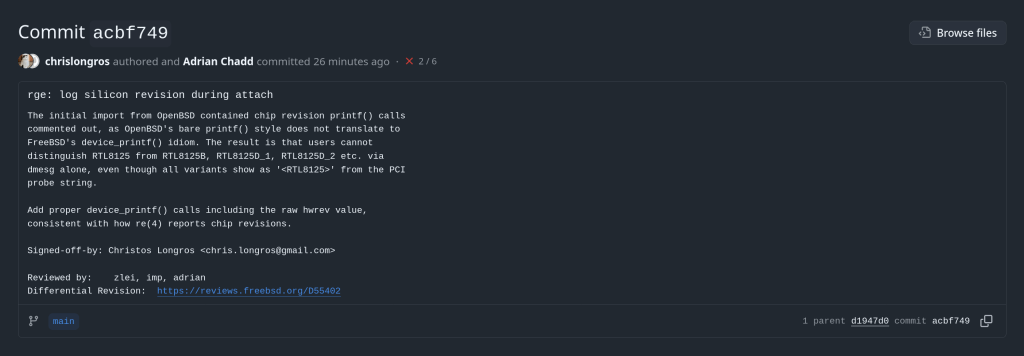
  • RTL8125 has been ported to FreeBSD CURRENT Branch

    January 10th, 2026

    https://cgit.freebsd.org/src/commit/?id=5d73fca1f4b2bac8833e2b9233fa496059dab745

  • January 9th, 2026
  • My neovim lua configuration !

    January 4th, 2026

    https://github.com/chrislongros/neovim-config

  • Tailscale serve at startup script v1.1

    January 4th, 2026

    New version that is “battlefield tested” on my home server !!

    https://github.com/chrislongros/docker-tailscale-serve-preserve/releases/tag/v1.1.0

    https://github.com/chrislongros/docker-tailscale-serve-preserve/tree/main

1 2 3 … 132
Next Page→

Blog at WordPress.com.

Privacy & Cookies: This site uses cookies. By continuing to use this website, you agree to their use.
To find out more, including how to control cookies, see here: Cookie Policy
 

Loading Comments...
 

    • Subscribe Subscribed
      • /root
      • Already have a WordPress.com account? Log in now.
      • /root
      • Subscribe Subscribed
      • Sign up
      • Log in
      • Report this content
      • View site in Reader
      • Manage subscriptions
      • Collapse this bar