Two models built on the same underlying system, differing only in safeguards.
Fable 5.1: generally available.
Mythos 5.1: restricted to trusted access programs; its safeguards are designed to support cybersecurity and life-sciences work.
Positioned as the leading models for coding and knowledge work, with research capabilities framed as an early sign of AI contributing to scientific progress.
Customer-facing changes
Price: roughly 25% cheaper than Fable 5 for typical token-billed workloads, driven by lower cache-read pricing; up to ~45% cheaper for highly agentic work.
Data retention: new Enterprise Frontier Safeguards (EFS) store data in customer-controlled cloud infrastructure, giving privacy equivalent to zero data retention while still preventing adversarial use. Rolling out to enterprise customers in phases starting later this fall; eligible customers get zero data retention with Fable 5.1 in the interim.
Safeguards: fewer false positives — 60% fewer in cybersecurity. Fable 5.1 may now be used to discover software vulnerabilities, but not to develop exploits. A biology access program developed with the US government will open enrollment for scientists soon.
Performance
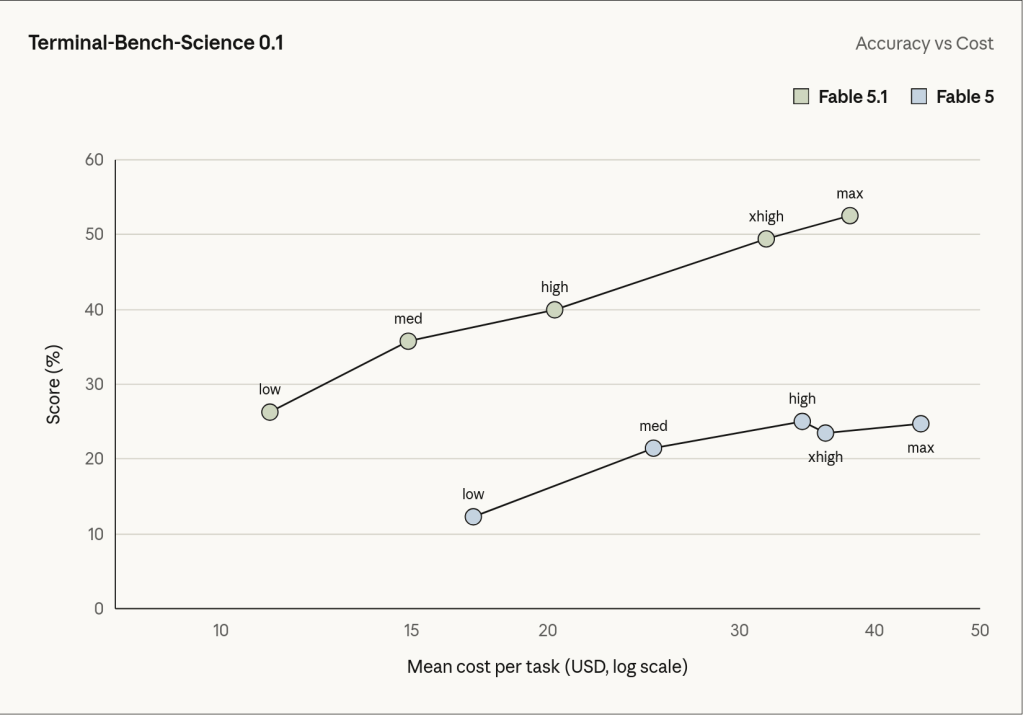
Effort levels are configurable; Low or Medium effort matches or beats Fable 5 at much lower cost. Defaults: High in Claude Code, Medium in Claude Cowork and on Claude.ai.
Humanity’s Last Exam (no tools): 60.9% / 57.8% / 56.6% / —
AutomationBench: 31.4% / 17.1% / 26.9% / 19.6%
CursorBench 3.2.0: 73.4% / 70.5% / 70.0% / 67.2%
Benchmarks were run with production safeguards on; safeguard interventions scored zero on some tasks, likely understating Fable 5.1 and Fable 5 results.
Millennium reported Fable 5.1 diagnosed a rare crash in its internal systems that its engineers and other models had failed to explain over several years.
Jane Street’s Craig Falls reported more coding problems solved than Fable 5 or Opus 5, state-of-the-art trading intuition, and better readability over long multi-step tasks.
Scientific research results
Molecular design: given open-source protein design and folding tools, Mythos 5.1 produced binders with affinities 10× higher than the best entries in Adaptyv Bio’s competitions on three targets, and a ~50% hit rate across 12 targets (10–15% is typical).
Venus elevation map: Fable 5.1 trained a neural network on 30-year-old NASA Magellan radar data plus an existing map of one-fifth of the planet, producing a map of one-third of Venus at 2–3 km resolution (up from 10–20 km) with heights up to 25% more accurate. Released under a Creative Commons license ahead of NASA VERITAS and ESA EnVision.
GPU kernel optimization: Mythos 5.1 wrote custom kernels and cached intermediates to speed up seven open-source deep learning models by 1.4×–2.5× on an H100 with identical outputs, cutting estimated GPU costs 30–60%. Done in days from public source code alone; optimizations to be open-sourced.
Related efforts: the Model Hardware Standard for safe operation of lab equipment, the AI for Science credit program, and a discounted Claude Team plan for scientists.
Safety, security, and alignment
Chemical and biological: expert red-teaming, automated evaluations, and a tabletop exercise pairing PhD biologists with AI experts. Mythos 5.1 exceeds Mythos 5 in capability but falls short of the next Responsible Scaling Policy risk tier, so it ships with Mythos 5’s safeguards restricting research biology capabilities.
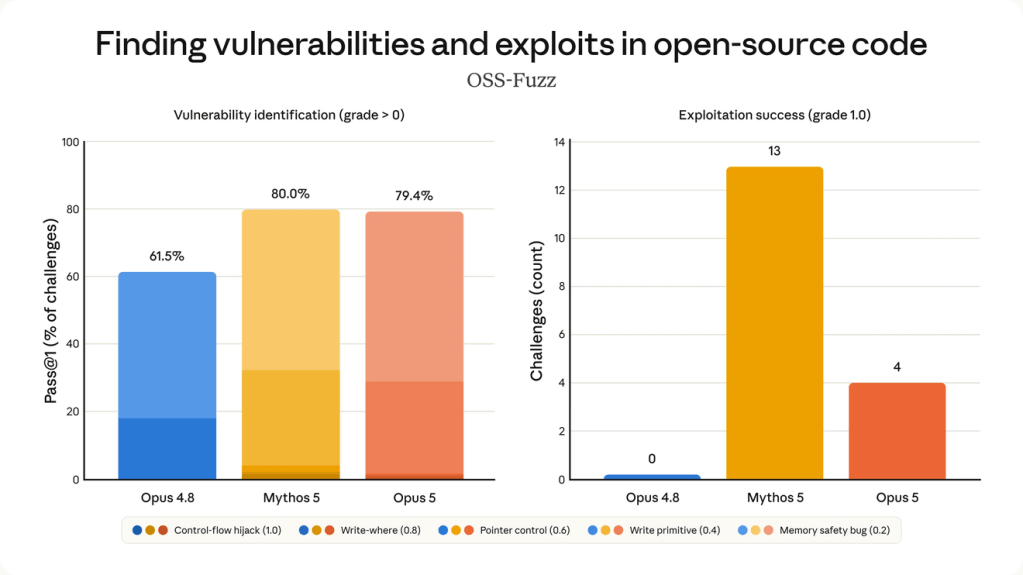
Cyber: with safeguards off, Mythos 5.1 shows the strongest cyber capabilities of any released model but remains in the lower risk category of the Frontier Compliance Framework. Fable 5.1’s safeguards were stress-tested internally, by two commissioned external organizations, and via automated testing by Gray Swan; no critical-severity jailbreak found.
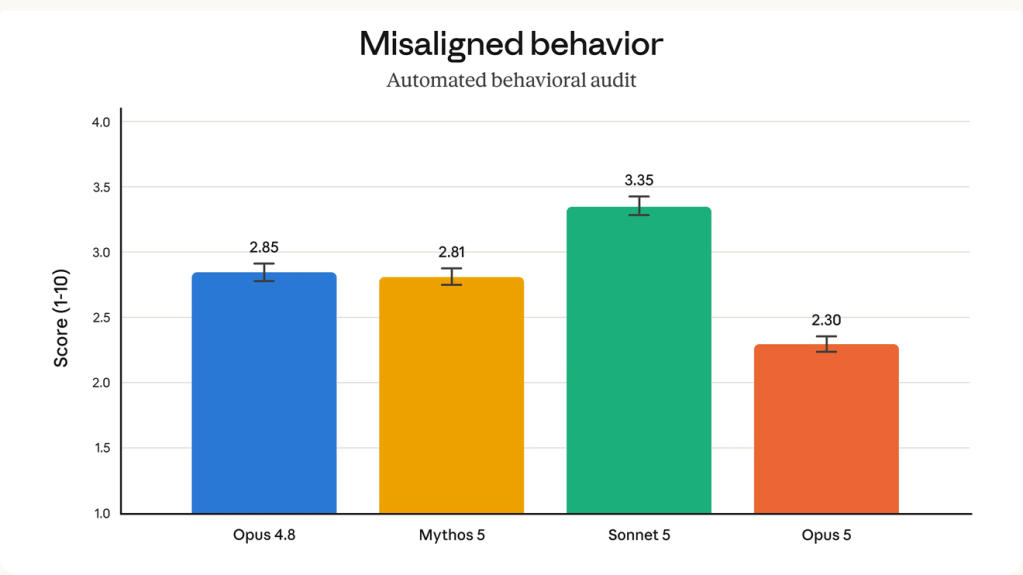
Agentic safety: refuses malicious agentic coding and computer-use requests at rates comparable to Mythos 5, Sonnet 5, and Opus 5; most robust model to date on an external prompt-injection benchmark.
Alignment: assessed via static and interactive behavioral evaluations, natural language autoencoder analysis of internal thinking, misalignment capability evaluations, training data review, internal pilot analysis, and external reports. Full detail is in the System Card.
“Future Claude models will generate text that contains a watermark. This is a way of determining the likelihood that Claude was involved in writing the text, and we, along with several other major AI providers, are implementing this change to comply with the EU AI Act.”
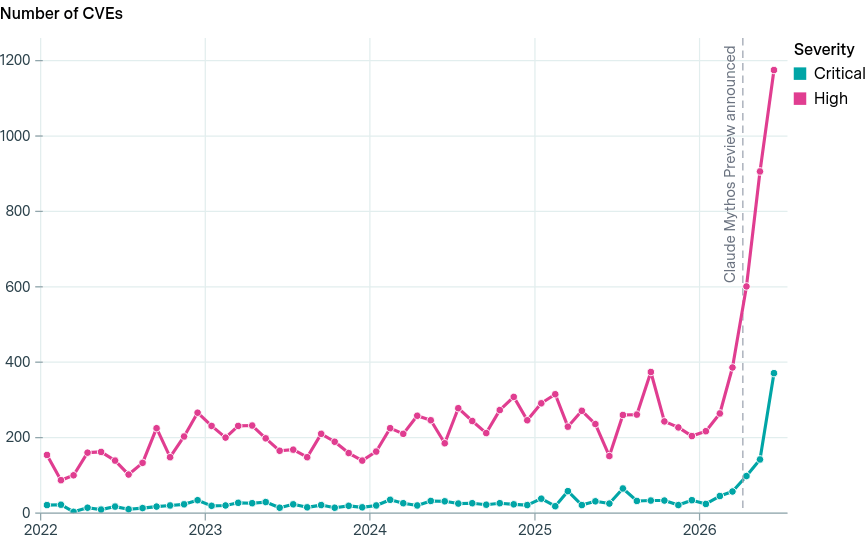
“Severe cybersecurity vulnerability disclosures (CVEs) spiked in 2026. In June, notable organizations published around 1,500 high- and critical-severity CVEs — more than 3.5× the monthly record prior to Mythos’ release.”
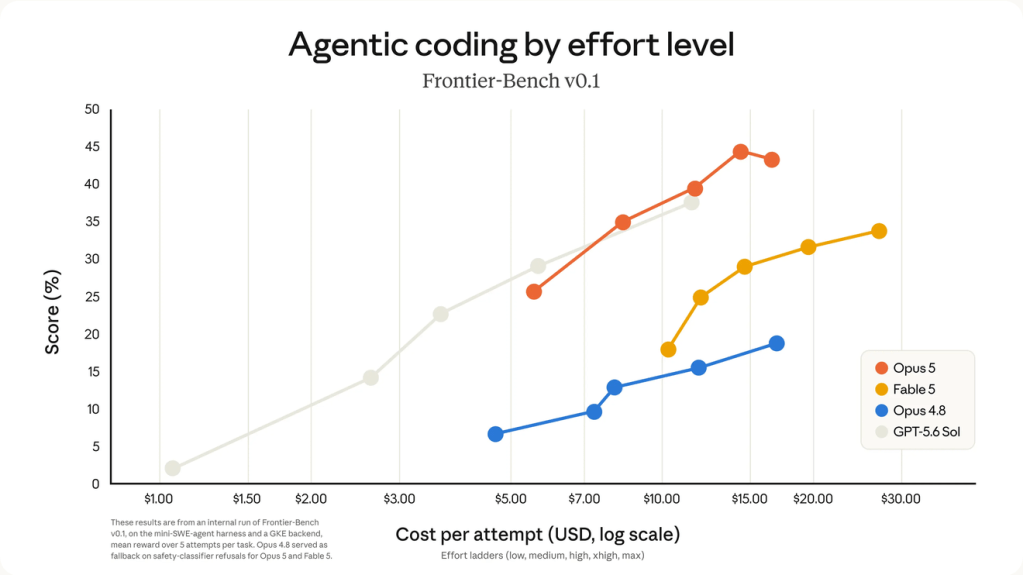
Long-running work: It can work for hours on a task, recovering from errors and routing around blockers instead of stopping. It also checks its own work as it goes and catches issues that earlier models missed. It reaches 43.3% on Frontier-Bench v0.1 and 68.8% on DeepSWE v1.1 (up from 18.7% / 59.0% on Opus 4.8).
It more regularly asks clarifying questions before guessing, pushes back on flawed instructions, and considers the implications of its work before jumping ahead to implementation. The result is cleaner, higher-quality code.
“Opus 5 does not advance the frontier in risky, dual-use capabilities. In rigorous evaluations conducted alongside private-sector and government partners, we found it remains behind Mythos 5 in both biology research and offensive cybersecurity.
As with its predecessor, Opus 4.8, we’ve intentionally avoided training Opus 5 on cyber tasks. Opus 5’s cyber classifiers are proportionally less restrictive than those on Fable 5. They allow Opus 5 to find vulnerabilities in source code, but block “binary-based” vulnerability scanning, penetration testing, and exploit generation.”
“Starting July 20, Claude Fable 5 is included in all Max and Team Premium plans at 50% of usage limits, and Claude Code’s 50% higher weekly rate limits run through August 19. /code-review gained effort levels plus an ultra tier, artifacts went multiplayer with MCP connectors, and the MCP 2026-07-28 spec RC drops session pinning entirely.”
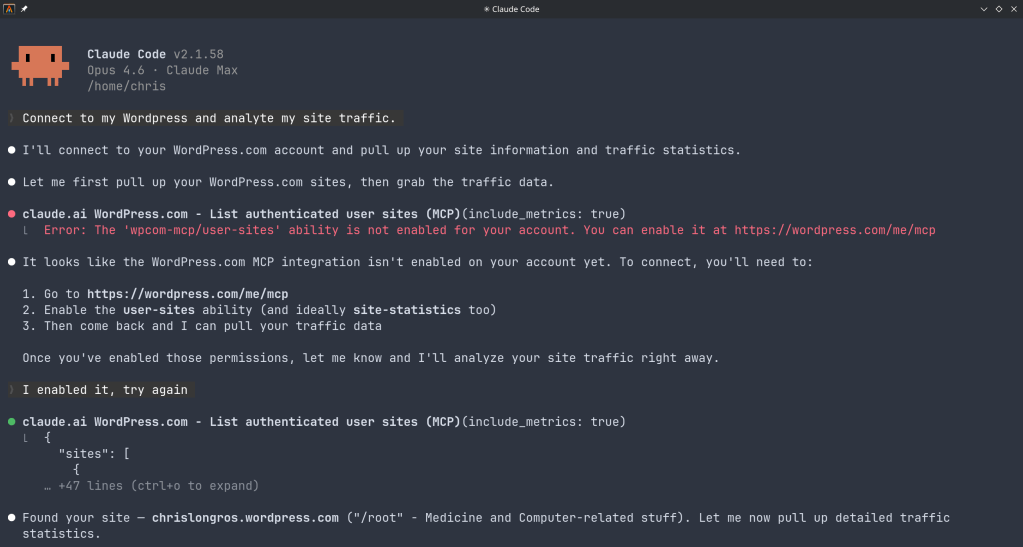
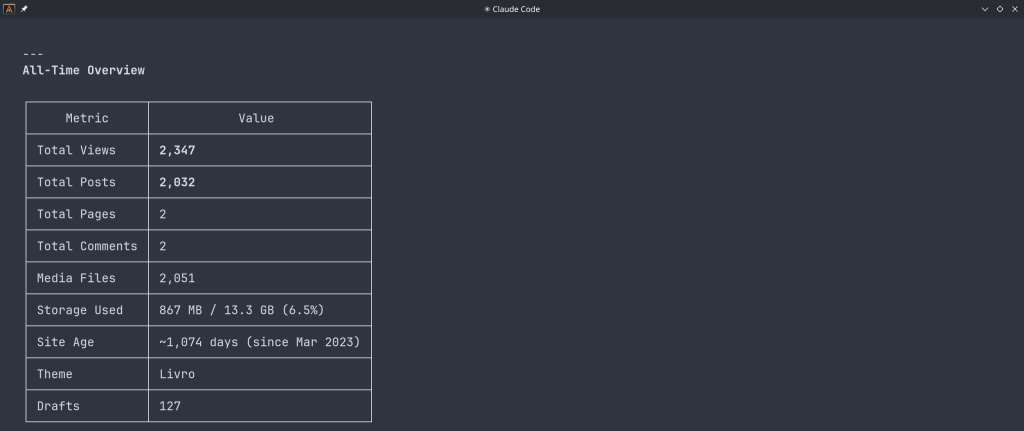
“The WordPress.com MCP server allows AI assistants to securely interact with your WordPress.com sites. It exposes tools for listing, searching, and viewing posts, pages, and comments, managing users and site settings, and retrieving statistics. By leveraging OAuth 2.1, it ensures that agents only access resources you’ve approved, making it easy to integrate AI-driven workflows into your publishing experience.”
You can use WordPress.com to:
Manage Content: “Show me my latest blog posts” or “Search for posts about technology”
View Analytics: “What are my site statistics for this month?”
Manage Users: “List all users on my WordPress site”
Site Administration: “Check my site settings and installed plugins”
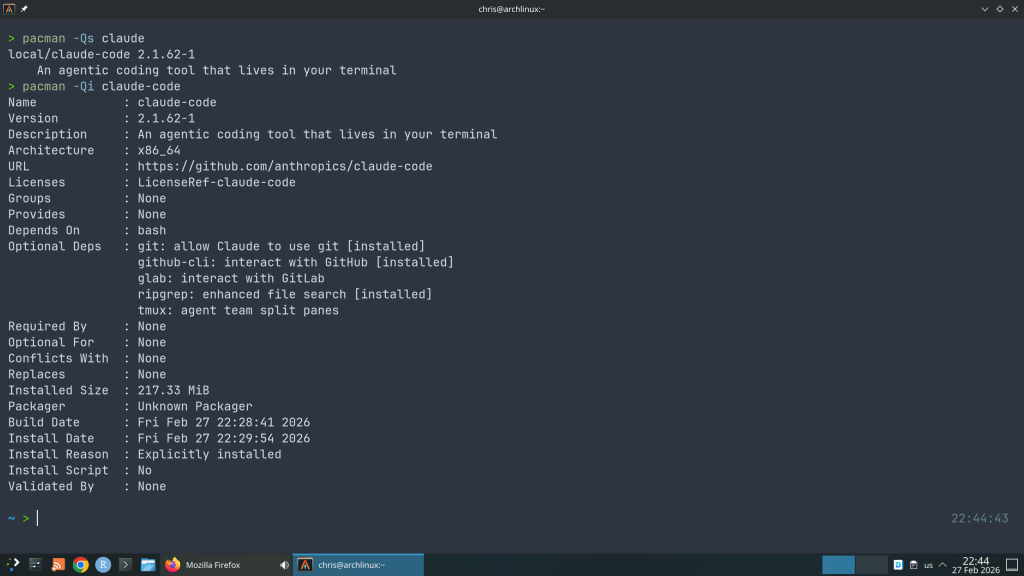
And I wondered why so many AUR package updates for the claude-code …
“Cybersecurity researchers have disclosed multiple security vulnerabilities in Anthropic’s Claude Code, an artificial intelligence (AI)-powered coding assistant, that could result in remote code execution and theft of API credentials.”
“The vulnerabilities exploit various configuration mechanisms, including Hooks, Model Context Protocol (MCP) servers, and environment variables – executing arbitrary shell commands and exfiltrating Anthropic API keys when users clone and open untrusted repositories”
How the Model Context Protocol turns your NAS into a conversational system
What is MCP?
The Model Context Protocol (MCP) is an open standard developed by Anthropic that allows AI assistants like Claude to connect to external tools, services, and data sources. Think of it as a universal plugin system for AI — instead of copy-pasting terminal output into a chat window, you give the AI a live, structured connection to your systems so it can query and act on them directly.
MCP servers are small programs that speak a standardized JSON-RPC protocol. The AI client (Claude Desktop, Claude Code, etc.) spawns the server process and communicates with it over stdio. The server translates AI requests into real API calls — in this case, against the TrueNAS middleware WebSocket API.
The TrueNAS MCP Connector
TrueNAS Research Labs recently released an official MCP server for TrueNAS systems. It is a single native Go binary that runs on your desktop or workstation, connects to your TrueNAS over an encrypted WebSocket (wss://), authenticates with an API key, and exposes the full TrueNAS middleware API to any MCP-compatible AI client.
Crucially, nothing is installed on the NAS itself. The binary runs entirely on your local machine.
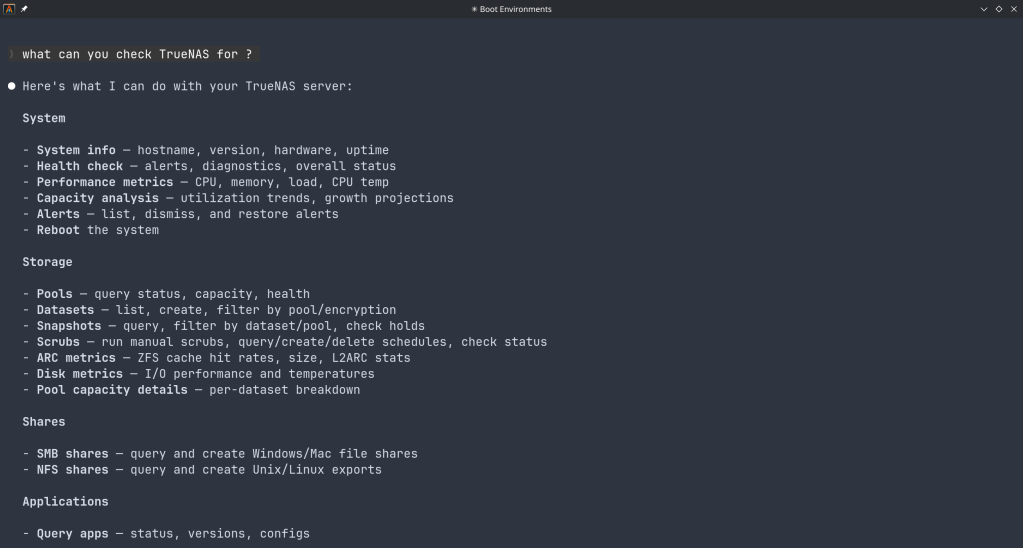
What it can do
The connector covers essentially the full surface area of TrueNAS management:
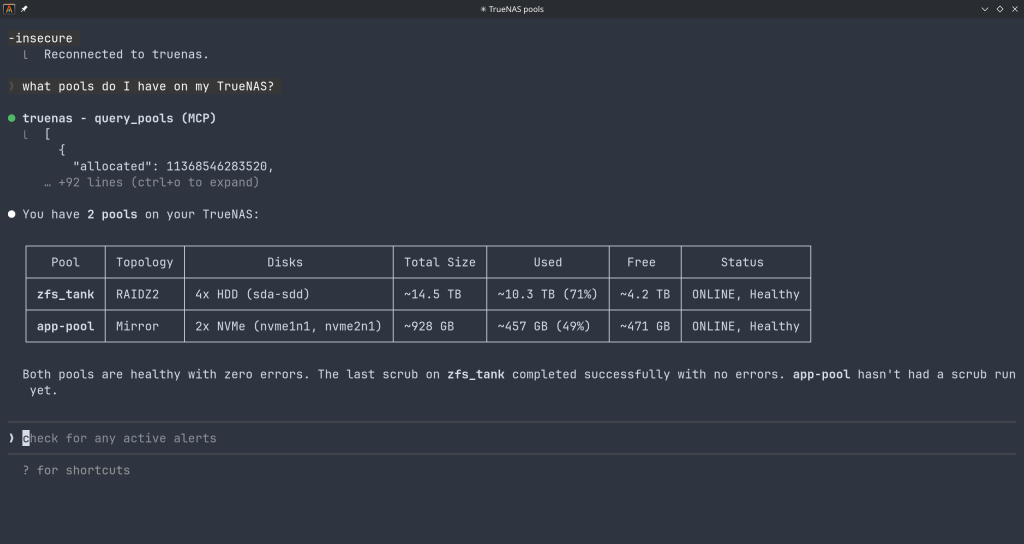
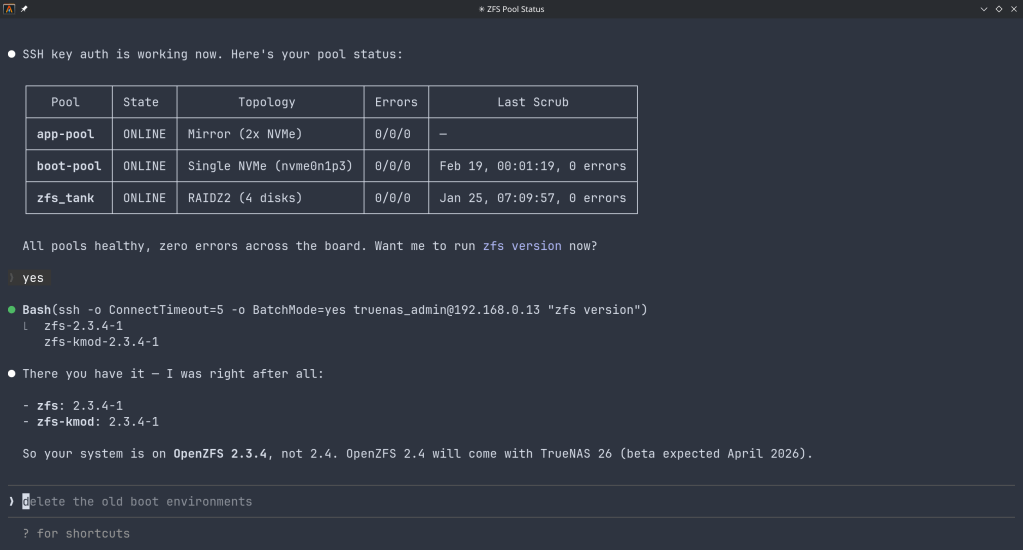
Storage — query pool health, list datasets with utilization, manage snapshots, configure SMB/NFS/iSCSI shares. Ask “which datasets are above 80% quota?” and get a direct answer.
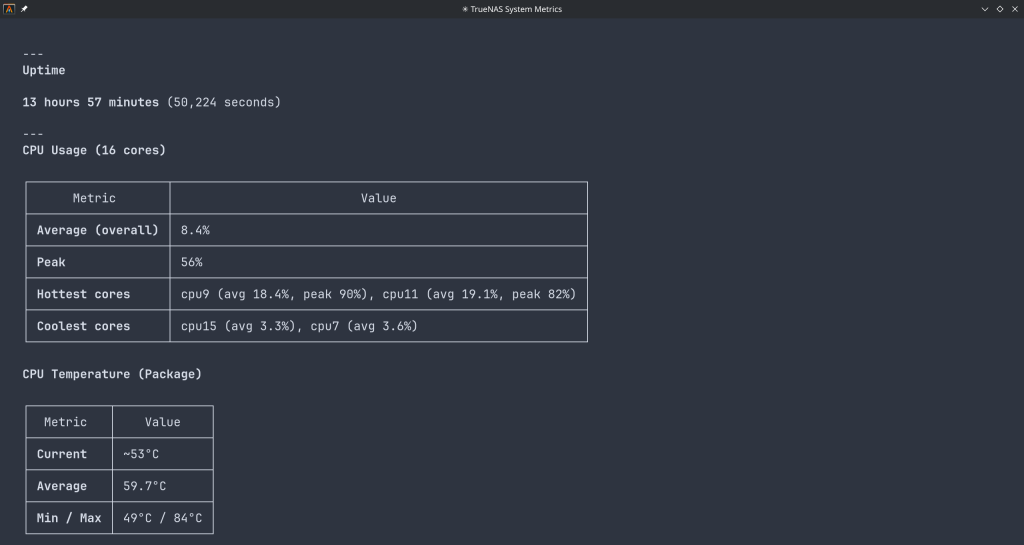
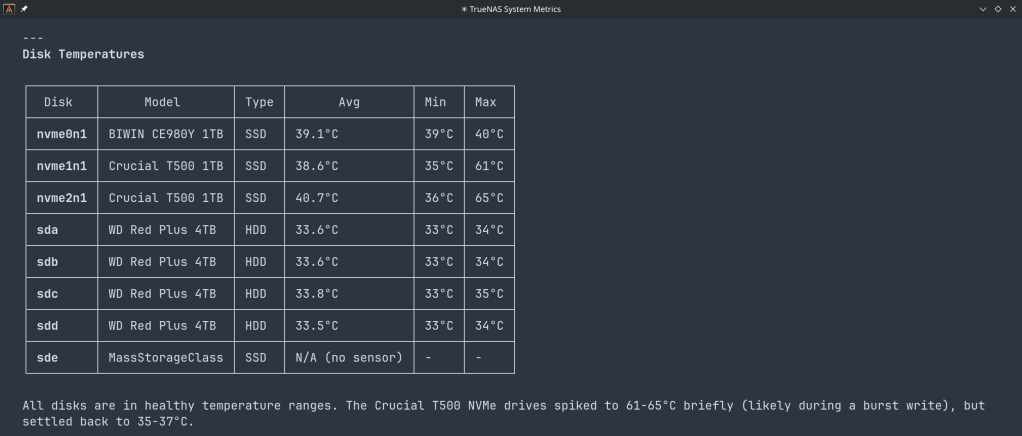
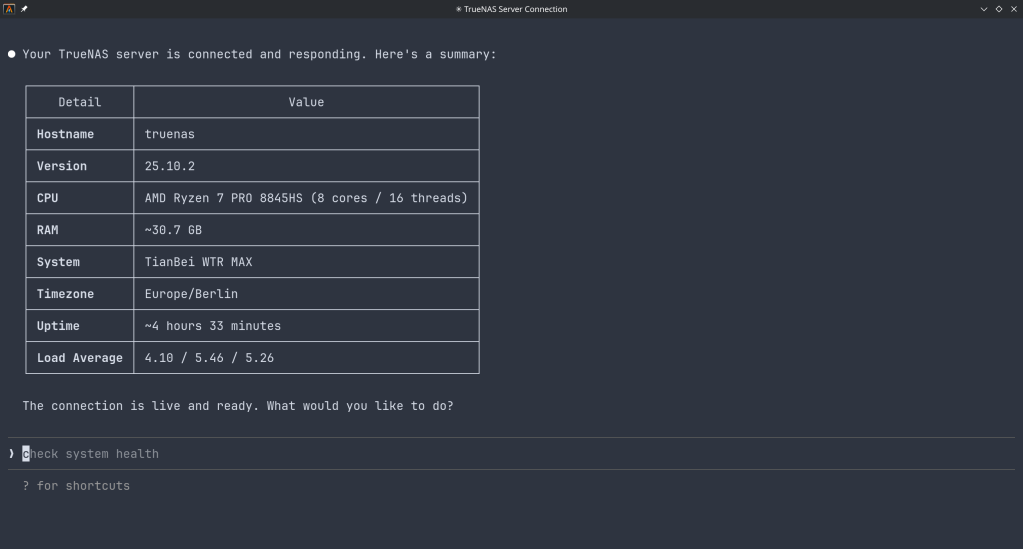
System monitoring — real-time CPU, memory, disk I/O, and network metrics. Active alerts, system version, hardware info. The kind of overview that normally requires clicking through several pages of the web UI.
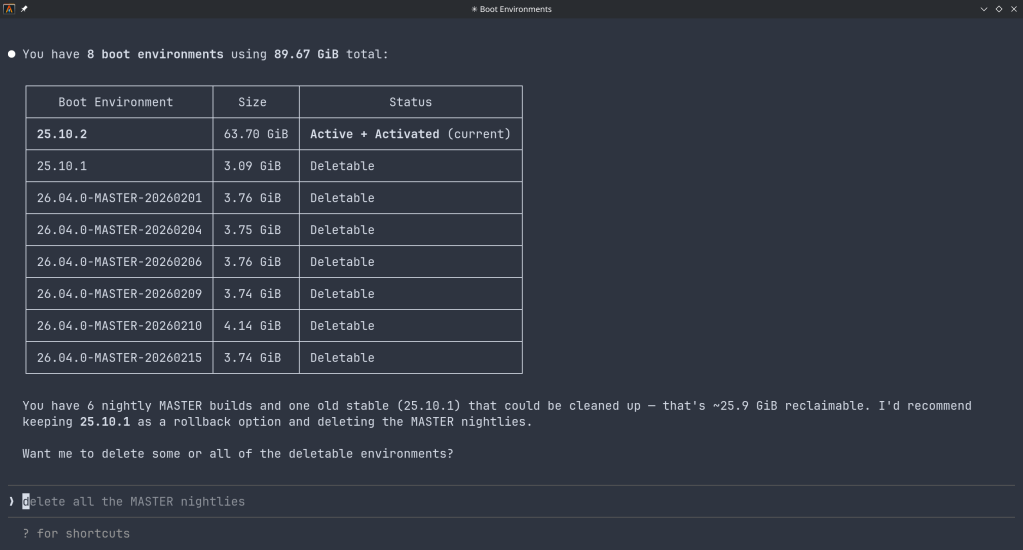
Maintenance — check for available updates, scrub status, boot environment management, last backup timestamps.
Application management — list, install, upgrade, and monitor the status of TrueNAS applications (Docker containers on SCALE).
Virtual machines — full VM lifecycle: create, start, stop, monitor resource usage.
Capacity planning — utilization trends, forecasting, and recommendations. Ask “how long until my main pool is full at current growth rate?” and get a reasoned answer.
Directory services — Active Directory, LDAP, and FreeIPA integration status and management.
Safety features
The connector includes a dry-run mode that previews any destructive operation before executing it, showing estimated execution time and a diff of what would change. Built-in validation blocks dangerous operations automatically. Long-running tasks (scrubs, migrations, upgrades) are tracked in the background with progress updates.
Why This Matters
Traditional NAS management is a context-switching problem. You have a question — “why is this pool degraded?” — and answering it means opening the web UI, navigating to storage, cross-referencing the alert log, checking disk SMART data, and reading documentation. Each step is manual.
With MCP, the AI holds all of that context simultaneously. A single question like “my pool has an error, what should I do?” triggers the AI to query pool status, check SMART data, look at recent alerts, and synthesize a diagnosis — in one response, with no tab-switching.
This is especially powerful for complex homelab setups with many datasets, containers, and services. Instead of maintaining mental models of your storage layout, you can just ask.
Generate an API key in TrueNAS under System Settings → API Keys.
Configure your MCP client — Claude Desktop (~/.config/claude/claude_desktop_config.json) or Claude Code (claude mcp add ...).
Restart the client and start asking questions.
The binary supports self-signed certificates (pass -insecure for typical TrueNAS setups) and works over Tailscale or any network path to your NAS.
Example queries you can use right away
“What is the health status of all my pools?”
“Show me all datasets and their current usage”
“Are there any active alerts I should know about?”
“Which of my containers are not running?”
“Preview creating a new dataset for backups with lz4 compression”
“When was the last scrub on my main pool, and did it find errors?”
“What TrueNAS version am I running and are updates available?”
Current Status
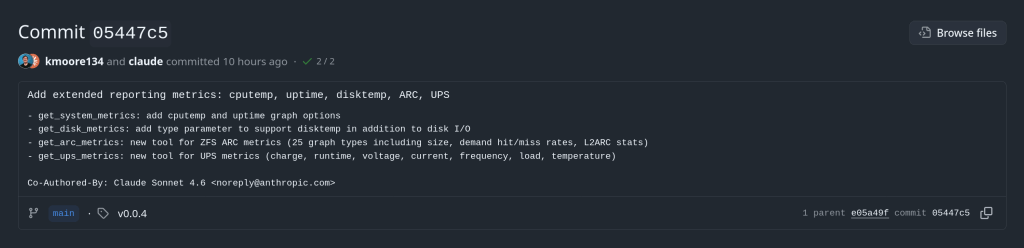
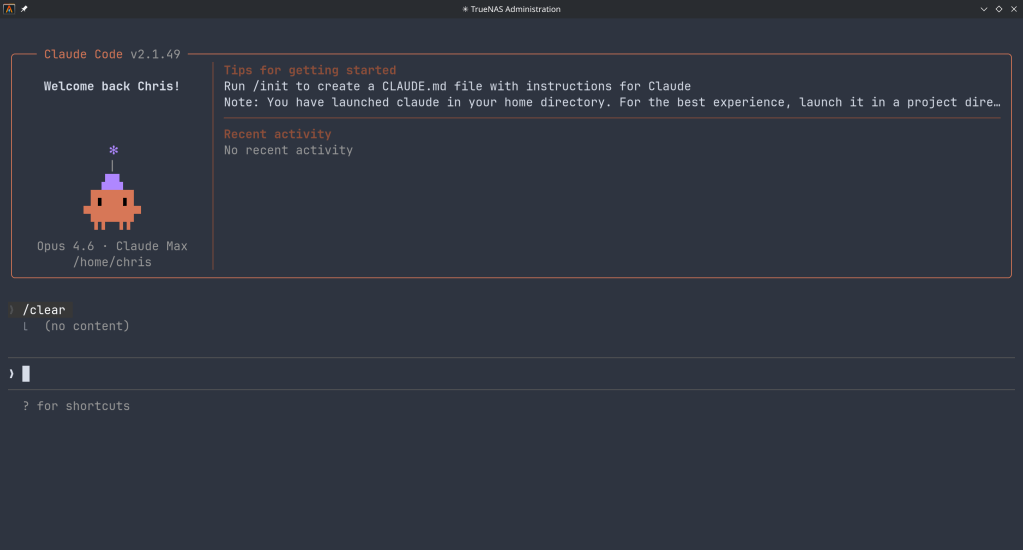
The TrueNAS MCP connector is a research preview (currently v0.0.4). It is functional and comprehensive, but not yet recommended for production-critical automation. It is well-suited for monitoring, querying, and exploratory management. Treat destructive operations (dataset deletion, VM reconfiguration) with the same care you would in the web UI — use dry-run mode first.
The project is open source and actively developed. Given that this is an official TrueNAS Labs project, it is likely to become a supported feature in future TrueNAS releases.
Broader Implications
The TrueNAS MCP connector is an early example of a pattern that will become common: infrastructure that exposes a semantic API layer for AI consumption, not just a REST API for human-written scripts. The difference is significant. A REST API tells you what the data looks like. An MCP server tells the AI what operations are possible, what they mean, and how to chain them safely.
As more homelab and enterprise tools adopt MCP, the practical vision of a conversational infrastructure layer — where you describe intent and the AI handles execution — becomes genuinely achievable, not just a demo.