





-
Summary: Rust 1.88.0 Release (June 26, 2025)
🚀 Installation
- Update via
rustup update stable. - Switch to beta/nightly using
rustup default beta|nightly.
🔧 Key Features in 1.88.0
Let Chains (Rust 2024 Edition Only)
- Allows chaining of
letstatements with&&inifandwhile. - Supports both refutable and irrefutable patterns.
- Improves readability by reducing nesting.
if let A(x) = some_func() && let B(y) = x && y > 0 { ... }Naked Functions
- Define low-level functions without compiler-generated prologue/epilogue.
- Use
#[unsafe(naked)]andnaked_asm!block for full control.
#[unsafe(naked)]
pub unsafe extern "sysv64" fn f(a: u64, b: u64) -> u64 {
    core::arch::naked_asm!("lea rax, [rdi + rsi]", "ret");
}
Boolean Configuration in
cfg- Now supports
cfg(true)andcfg(false)for clearer conditional compilation. - Replaces prior use of
cfg(all())orcfg(any())for unconditional flags.
Cargo Cache Auto-Cleanup
- Cargo now garbage-collects unused cached crates:
- Downloaded files: deleted after 3 months of inactivity.
- Local files: deleted after 1 month.
- Behavior adjustable via
cache.auto-clean-frequency.
✅ Stabilized APIs
New Stable APIs
Cell::update,HashMap::extract_if,hint::select_unpredictable, and more.
Now Const-Stable
NonNull<T>::replace,std::ptr::swap_nonoverlapping,Cellmethods, etc.
📉 Other Changes
i686-pc-windows-gnudemoted to Tier 2 (still supported, less tested).
🙌 Contributors
- Rust 1.88.0 was made possible by numerous community contributions. Thank you!
For full details, check the Rust 1.88.0 release notes.
- Update via
-
How to enable the new study screen:
Settings → About → tap the Anki logo a few times → go back → Developer options → enable “New study screen” → go back → New study screen.


-
This way, you can distinguish between a live iso and the first boot from the disk 😇

-
Automatic updates are also supported!
Another good feature is the portable installation with Anki running on a USB.

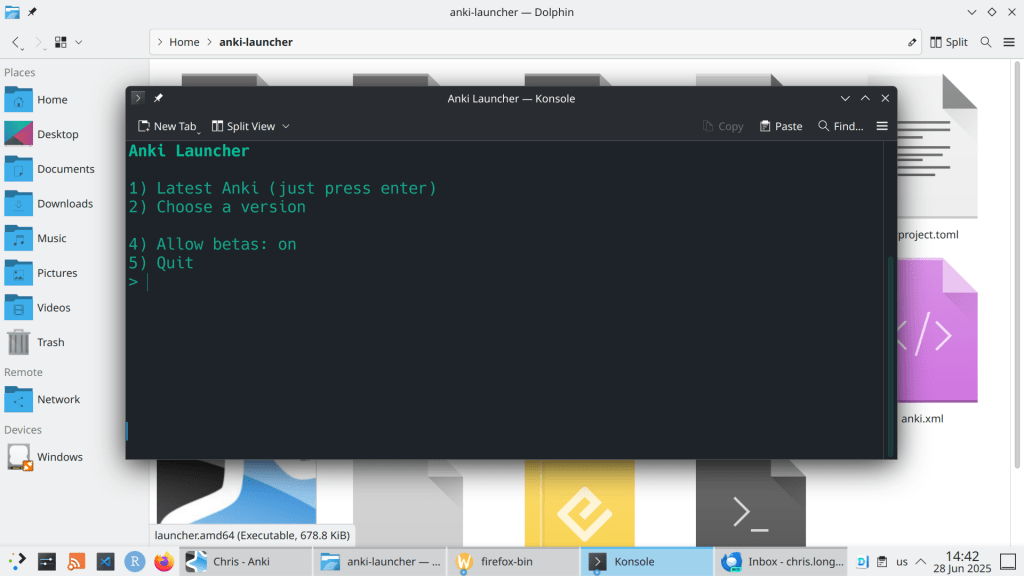

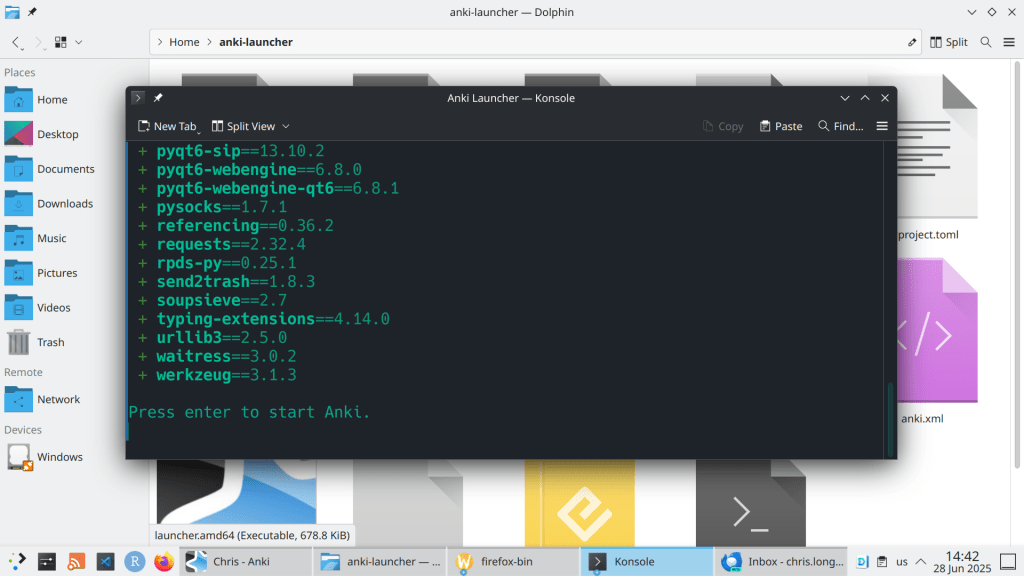
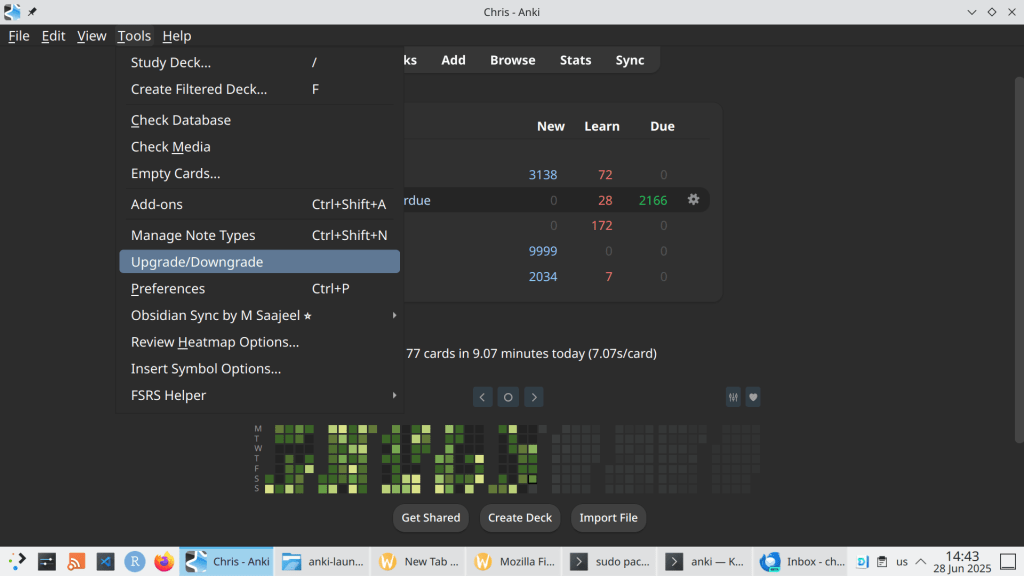
Copying the /.local/share/AnkiProgramFiles folder makes the installation portable !!

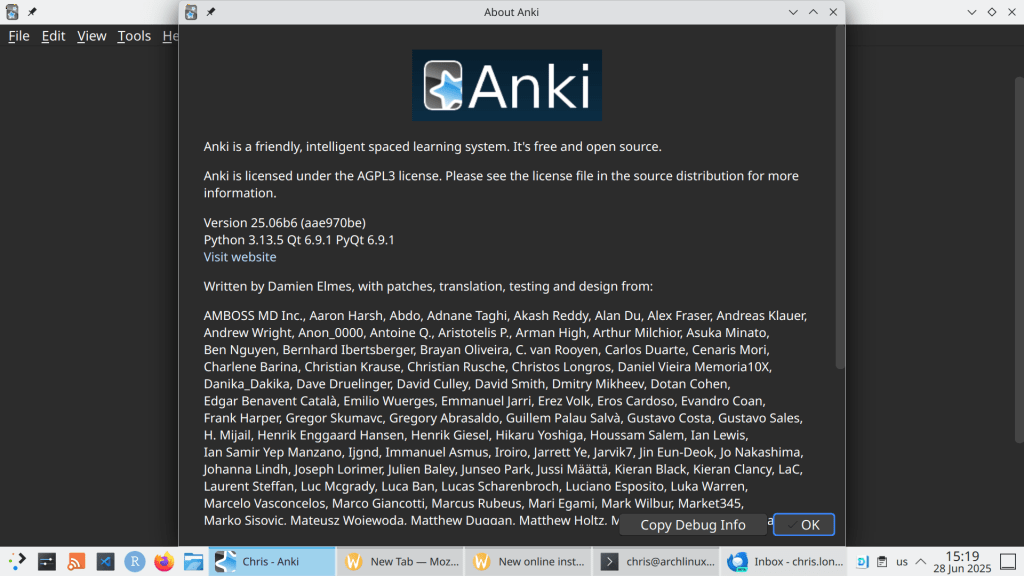
you can even select your preferred Qt version by modifying the pyproject.toml file:
[project]
name = “anki-launcher”
version = “0.1.0”
description = “UV-based launcher for Anki.”
requires-python = “>=3.9”
dependencies = [
“aqt[qt69,audio]==25.06b6”,
]
https://forums.ankiweb.net/t/new-online-installer-launcher/62745/25?page=2
-
Background
Anki’s method for determining the last review time has two main issues:
- Performance: Querying the revlog is slow for batch operations.
- Accuracy: Estimations based on
dueandintervalfields can be incorrect, especially when modified manually or by add-ons.
Key Changes
- Schema Update:
- Added
last_review_time_secs(optionalint64) to the protobuf definition.
- Added
- Data Structures:
- Introduced
last_review_time: Option<TimestampSecs>to the RustCardstruct.
- Introduced
- Serialization:
- Integrated
last_review_timeinto read/write logic.
- Integrated
- Review Logic:
- Updated to store exact timestamp during card reviews.
- Calculation Logic:
- Functions now prioritize
last_review_timeover legacy methods.
- Functions now prioritize
Affected Components
- Card protobuf and Rust data structures
- Serialization/deserialization
- Browser table and scheduling logic
- Statistics
- Sync functionality
Benefits
- Improved Performance: Avoids costly revlog queries.
- Better Accuracy: Captures actual review timestamp.
- Backward Compatibility: Falls back to older methods if the new field is absent.



 /root
/root 