



Skip to content
    • About
    • Contact

/root

OpenZFS
  • AnkiDroid 2.25.2 available!

    October 13th, 2026

    The complete change log: https://github.com/ankidroid/Anki-Android/compare/v2.25.2…main

    https://github.com/ankidroid/Anki-Android/releases/tag/v2.25.2

  • Immich v3.3.1

    October 13th, 2026

    This patch addresses various bugs around people sharing, as well as a scroll issue on mobile. Further, there is now an indicator showing which people are shared.

    What’s Changed

    🌟 Enhancements

    • feat: shared person indicator by @danieldietzler in #32223

    🐛 Bug fixes

    • fix(mobile): keep memories full screen while swiping by @santoshakil in #32171
    • fix(server): read ISO values above 65535 by @bo0tzz in #32182
    • fix: include partner shared assets for people even without showInTimeline by @danieldietzler in #32219
    • fix: clarify people sharing does not share assets by @jrasm91 in #32231
    • fix(mobile): prevent rapid toggling and rerendering of cells by @agg23 in #32200
    • fix: include unamed people in otherPeople by @jrasm91 in #32237
    • fix: run workflow steps in their configured order by @infocus13 in #32240
    • fix: show date on memories page by @alextran1502 in #32206

    https://github.com/immich-app/immich/releases/tag/v3.3.1

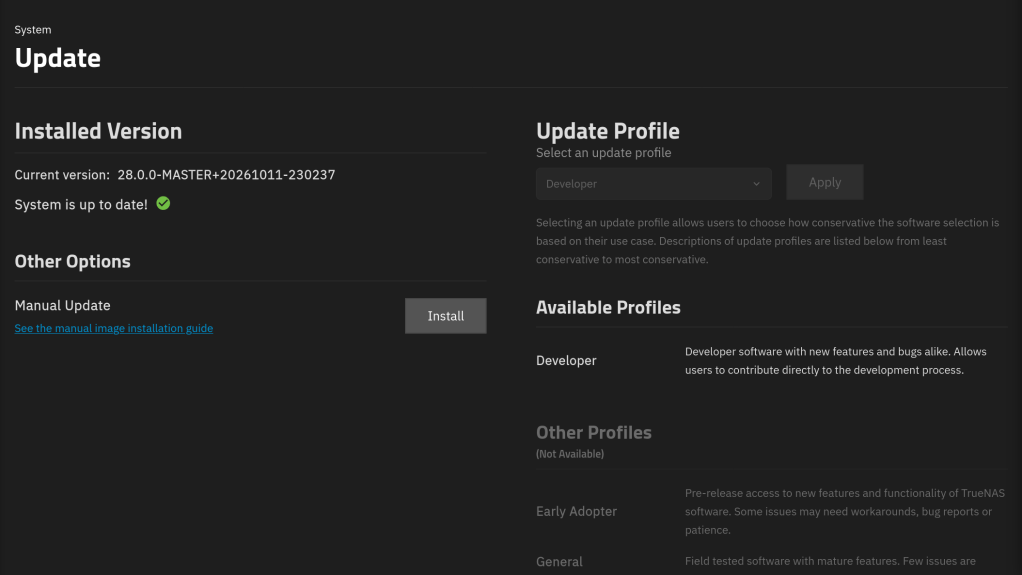
  • Another uncomplicated TrueNAS update

    October 13th, 2026

    This time to 28.0.0-MASTER+20261011-230237.
  • TrueNAS 27 RC1

    October 10th, 2026
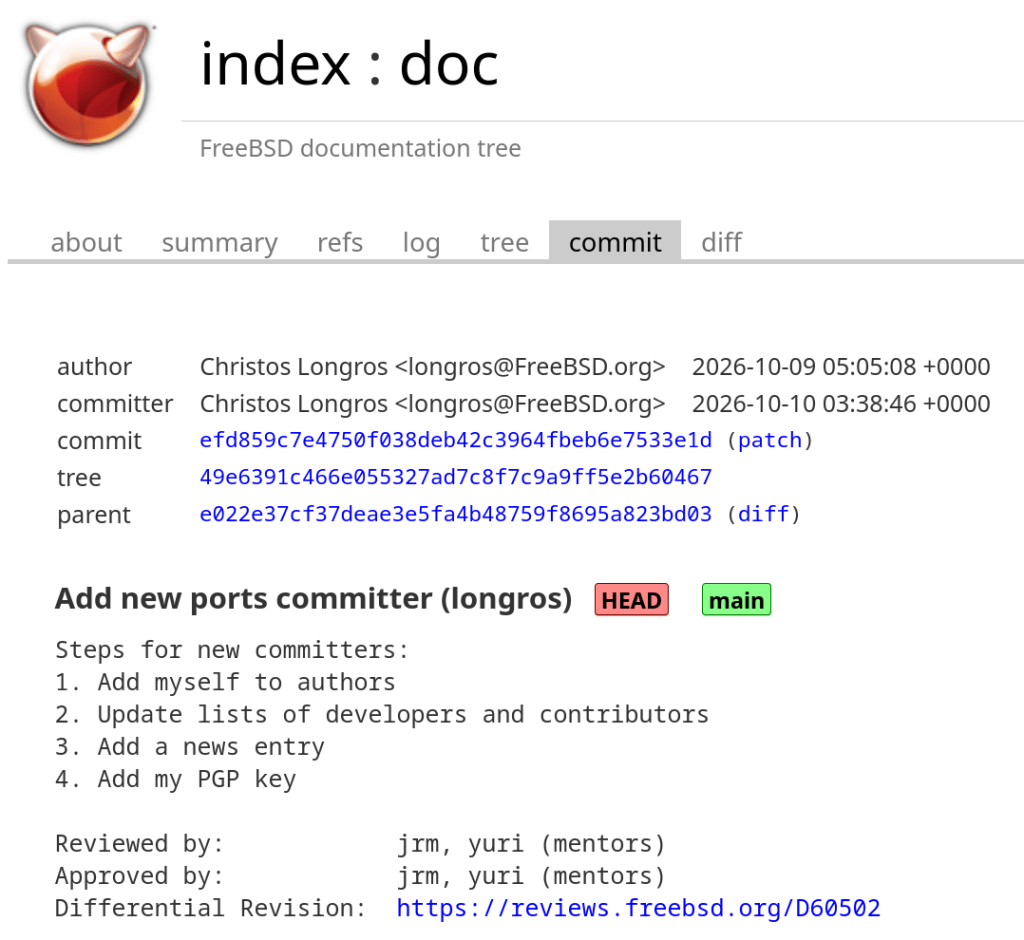
  • Christos Longros – FreeBSD ports committer

    October 10th, 2026

    I am glad to announce that I am officially a FreeBSD ports committer. Thanks Joe Mingrone, Yuri Victorovich as well as the FreeBSD Foundation, for their trust.
    https://www.freebsd.org/news/newsflash/#2026-10-06:1

    https://cgit.freebsd.org/doc/commit/?id=efd859c7e4750f038deb42c3964fbeb6e7533e1d

  • TrueNAS 27 – The Renaming from TrueNAS 26

    October 7th, 2026

    Naming Change

    • The release previously called TrueNAS 26 is now TrueNAS 27, beginning with RC.1 on October 6, 2026.
    • The change reflects the year most users are expected to deploy and operate the release, similar to automobile model years.
    • The release schedule is unchanged: TrueNAS 27.0 remains planned for early December 2026.

    Simplified Versioning

    • TrueNAS is dropping the previous year.month format such as 25.10 and 25.04.
    • Because TrueNAS now targets one major release per year, future major releases will simply follow the deployment year:
      • TrueNAS 27
      • TrueNAS 28
      • etc.
    • Minor releases will use sequential numbering such as 27.0, 27.1, 27.2, without representing specific months.

    Why the Version Number Matters

    • Version numbers are often checked during security reviews and audits.
    • TrueNAS 27 is based on:
      • Linux kernel 6.18
      • OpenZFS 2.4
    • The 27.x series will continue receiving regular security and maintenance updates.

    Why Rename It at RC.1?

    • RC.1 is when substantially more users and customers begin adopting the release.
    • Renaming it now ensures that documentation, upgrades, and support references consistently use TrueNAS 27 before the final release.

    What Has Not Changed

    • Release date: early December 2026.
    • Core code and overall feature set: largely unchanged from the TrueNAS 26 development releases.
    • RC.1 does include additional improvements introduced since Beta.3, detailed separately in the RC.1 feature announcement.

    https://www.truenas.com/blog/truenas-27-is-here

  • TrueNAS 27 RC.1 – Feature Set

    October 7th, 2026

    Release Overview

    • TrueNAS 27 RC.1 is the first release candidate of the next major TrueNAS version.
    • Previously developed as TrueNAS 26.
    • Final TrueNAS 27.0 release is planned for early December 2026.
    • Core platform:
      • OpenZFS 2.4
      • Linux kernel 6.18

    TrueSearch & WebShare

    • TrueSearch
      • Server-side indexing of filenames, metadata, and file contents.
      • Provides fast searches across large NAS datasets.
      • Integrates with macOS Spotlight over SMB.
      • Avoids clients having to crawl network shares themselves.
    • WebShare
      • Browser-based access to SMB/NFS-compatible files.
      • Works from desktops, tablets, and phones.
      • Preserves existing ACLs and permissions.
      • Supports file previews, snapshots, sharing, and file collection.
      • Integrates with Active Directory.
    • Both features require TrueNAS Connect.

    Fusion Pools 2.0

    • Expands ZFS hybrid flash/HDD storage capabilities.
    • Special vdevs can now use RAIDZ, rather than being limited to mirrors.
    • Flash special vdevs can accelerate:
      • Metadata
      • Small files
      • Selected datasets
    • A special vdev can also participate in the ZFS intent log (ZIL) for synchronous writes.
    • A dedicated SLOG still takes priority when available.

    Live Dataset Tiering

    • Available in TrueNAS Enterprise.
    • Transparently moves data blocks between:
      • High-performance flash storage
      • Larger HDD capacity tiers
    • Migration occurs without disrupting connected clients.

    Stateful SMB Failover

    • Available on TrueNAS Enterprise HA systems.
    • SMB session state survives controller failover.
    • Clients no longer need to reconnect or re-authenticate after failover.
    • Interrupted large file transfers can continue instead of restarting.

    OpenZFS 2.4 Improvements

    • Up to 25% faster deduplication writes.
    • Faster encryption on CPUs with AVX2.
    • Improved write allocation to reduce fragmentation.
    • Better responsiveness as pools become full.
    • Adds:
      • Default user quotas
      • Group quotas
      • Project quotas
      • Time-window scheduling for scrubs

    Linux 6.18 & Containers

    • Updated hardware support, including:
      • Broadcom tri-mode HBAs
      • PCIe Gen5 switching
      • New NVIDIA GPUs
    • LXC containers are now fully supported, after being experimental in earlier TrueNAS releases.

    TrueNAS Object Interface

    • New Early Access feature.
    • Provides native S3-compatible access directly to ZFS datasets.
    • Available across TrueNAS editions.
    • Can coexist with SMB, NFS, Active Directory, and WebShare access.

    https://www.truenas.com/blog/truenas-27-rc1-feature-set

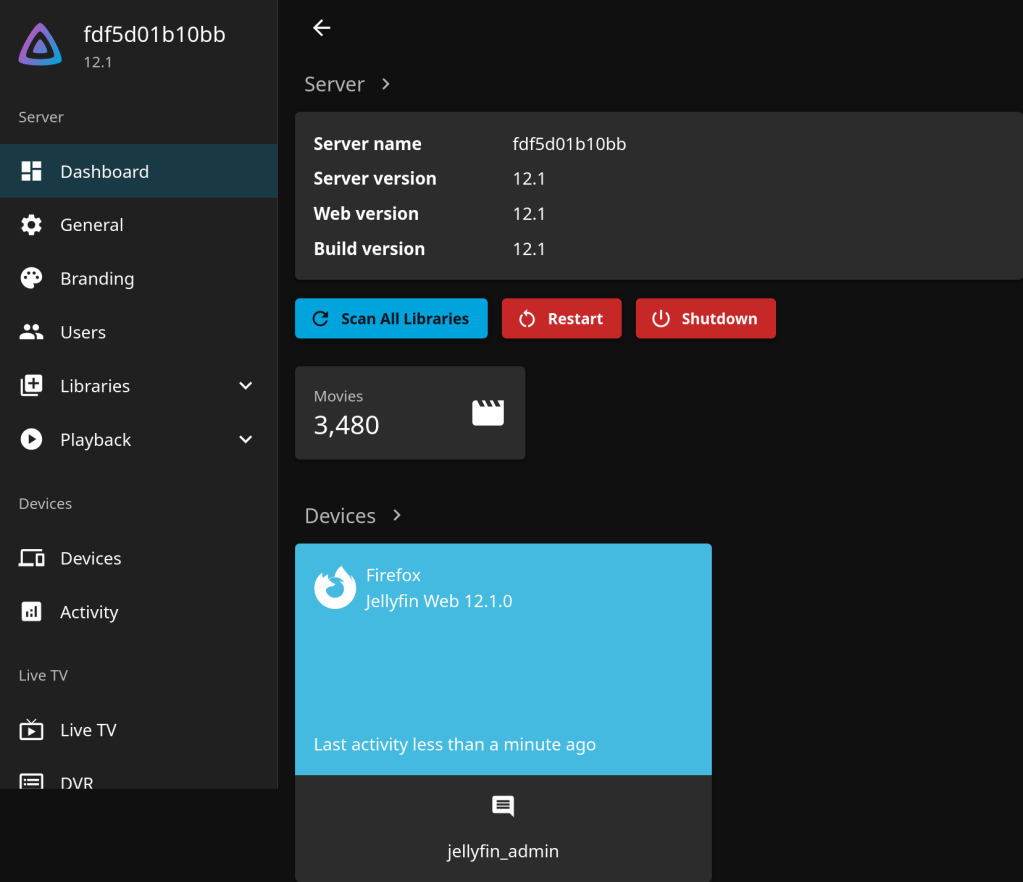
  • Jellyfin 12.1 & 12.0 – Release Summary

    October 3rd, 2026

    Jellyfin 12.1 (15 September 2026)

    Stable maintenance release containing 47 changes, primarily addressing performance, memory consumption, database reliability, library management, and playback issues.

    Key Improvements

    – Performance & Memory

    • Fixed excessive memory consumption in /UserViews.
    • Reduced unnecessary database queries and metadata processing.
    • Improved memory management during library scans.
    • Reduced memory usage during database optimization.

    – Database & Library Management

    • Fixed database optimization and pre-migration backup integrity issues.
    • Improved data cleanup before database migrations.
    • Prevented accidental library item removal when directory enumeration fails.
    • Fixed incorrectly grouped video versions while preserving manual merges.
    • Corrected nested season-folder recognition.
    • Improved background refresh and library scan reliability.

    – Playback & Transcoding

    • Fixed incorrect color range after Vulkan tone mapping.
    • Fixed transcoding throttling not activating due to a race condition.
    • Corrected trickplay selecting the wrong video stream.
    • Improved subtitle selection, including forced-only subtitles.
    • Fixed SyncPlay authentication and playback-position synchronization.

    – Additional Fixes

    • Corrected Norwegian and Italian parental ratings.
    • Fixed EPG and playlist encoding issues.
    • Improved TMDb image previews and metadata handling.
    • Fixed device-access revocation not terminating existing sessions.
    • Improved WebSocket error handling.

    Upgrade recommendation: Create a complete backup before installing 12.1.

    Jellyfin 12.0 (8 September 2026)

    A major release introducing database changes, expanded library functionality, and numerous server improvements.

    Important Upgrade Instructions

    • Direct upgrades from 10.10.7 and 10.11.x to 12.0 are supported.
    • Versions older than 10.10.7 should first upgrade to 10.10.7.
    • A complete backup of the Jellyfin data directory is essential because database changes prevent a simple rollback.
    • Remove installed third-party repository plugins before migration and reinstall compatible versions afterward.
    • Use the official stable plugin repository:

    https://repo.jellyfin.org/files/plugin/manifest.json

    Major Server Changes

    • Support for multiple versions of individual TV episodes.
    • New similarity, recommendation, and extensible search providers.
    • Improvements to parental ratings and EPG refreshes.
    • Better cleanup when media files are replaced or deleted.
    • Support for episode numbers containing three or more digits.
    • Library-specific BoxSet and Playlist filtering.
    • Improved metadata parsing, including provider IDs in filenames.
    • Additional Android TV video-rotation compatibility.

    Post-Upgrade Requirements

    • Run a full library scan after migration. This is required to reconstruct automatically detected alternative media versions.
    • Expect the initial scan to take considerably longer than usual.
    • Some previously indexed films might temporarily appear as newly added.
    • Check plugin compatibility before reinstalling extensions.

    Packaging Changes

    – Debian Bullseye and Ubuntu Focal packages are no longer built.

    Key Takeaway

    Jellyfin 12.1 primarily stabilizes the major architectural changes introduced in 12.0. Its database, memory-management, library-scanning, and playback fixes are particularly relevant for self-hosted installations with large media collections.

    When upgrading from Jellyfin 10.x, follow the 12.0 migration precautions even if your target version is 12.1.
    https://jellyfin.org/posts/jellyfin-release-12.0

    https://github.com/jellyfin/jellyfin/releases#release-v12.1

    https://github.com/jellyfin/jellyfin/releases#release-v12.0

  • Mullvad Is Shutting Down Its Public Encrypted DNS Servers

    October 3rd, 2026

    Mullvad will discontinue its free public DNS-over-HTTPS (DoH) service on November 2, 2026, redirecting its resources toward financially supporting Quad9.

    Why Mullvad Is Discontinuing the Service

    • Mullvad has operated public encrypted DNS servers since 2022.
    • Mullvad VPN users do not need these servers because the VPN already encrypts traffic and provides internal DNS resolution.
    • Outside the VPN, public DoH protects DNS queries from ISP visibility.
    • Mullvad considers Quad9 better equipped to operate a specialized, privacy-focused public DNS service and will support it financially instead.

    Required Migration Actions

    User / ConfigurationRequired Action
    Mullvad VPN usersNo changes necessary.
    Manually configured Mullvad DoHSwitch to Quad9 before November 2, 2026.
    Mullvad Browser (default DoH or included ad-blocking setting)Automatic migration to Quad9.
    Mullvad Browser (custom DoH)Settings remain unchanged; manually configured Mullvad DoH variants must be switched back to the default.
    iOS / macOS Mullvad DoH profilesReplace existing profiles with Quad9 profiles.

    https://mullvad.net/en/blog/shutting-down-our-public-encrypted-dns-servers-and-sponsoring-quad9-instead

  • TCP vs UDP

    October 3rd, 2026
  • Immich v3.3.0 (planed for October 5, 2026)

    October 2nd, 2026

    Highlights

    • Shared people management: People can be shared between users, including people you don’t own, so they appear in shared assets. With permission, you can edit another user’s person. Sharing is limited to users in the same cluster group.
    • Birthday memories: A special memory featuring previous birthdays appears on the birthday of a person in your library.
    • Auto-stack edits (mobile): Edits made in other apps are stacked on the original on upload, keeping the timeline uncluttered.
    • OAuth claim sync on every login: Storage quota, user role, and preferred username were previously synced only at registration; they can now be synced on each login, enabling user management through the IDP.
    • GeoNames reverse geocoding: Place names now come from GeoNames, giving more politically neutral country names.
    • Image and ML: Linear-light resampling gives more accurate lighting on re-scaled images; ML model loading and inference are improved, and TRT-RTX support is added.

    Other enhancements

    • Albums: Editors can update title and description; a “leave album” action is added on web.
    • Web: Better non-Latin text rendering on the map; the activity log defaults to latest.
    • Server: .jfif file support; manufacturer and device extraction for Samsung videos.
    • Onboarding: Improved storage template onboarding.

    https://pr-846.dev.immich.app/blog/v3.3.0-release

  • FreeBSD Security Advisories – 29 September 2026

    September 30th, 2026

    On 29 September 2026 the FreeBSD Security Team published six security advisories covering nine CVEs. Five fix bugs in the kernel and one fixes OpenSSL in the base system. The most serious are three local privilege-escalation bugs (sysvsem, kqueue) and a set of jail filesystem escapes. There is also a remote kernel panic that affects hosts using receive-side kernel TLS.

    Fixed releases are 15.1-RELEASE-p4, 15.0-RELEASE-p14, 14.5-RELEASE-p1 and 14.4-RELEASE-p10. Every kernel fix needs a reboot.

    AdvisoryComponentIssueImpactAffectsCVE
    SA-26:64.sysvsemKernel: System V semaphoresHeap out-of-bounds access in semop(2)Local privilege escalationAll supportedCVE-2026-58098
    SA-26:65.kqueueKernel: kqueue copy-on-forkUse-after-free and out-of-bounds readLocal privilege escalation15.1 onlyCVE-2026-58099, CVE-2026-58100
    SA-26:66.jailKernel: jailsThree FD_RESOLVE_BENEATH bypassesJail filesystem root escapeAll supportedCVE-2026-101304, -101305, -101306
    SA-26:67.ktlsKernel: receive-side KTLSOff-by-one in TLS 1.3 record parsingRemote kernel panic (DoS)All supportedCVE-2026-101302
    SA-26:68.opensslBase OpenSSLOut-of-bounds read in DTLS retransmissionHeap memory disclosure, DoSAll supportedCVE-2026-84782
    SA-26:69.udpKernel: IPv6 UDPJail loopback rewrite missing on sendto(2)Jail network isolation bypassAll supportedCVE-2026-101303

    Kernel advisories

    SA-26:64.sysvsem: heap out-of-bounds in semop(2)

    When semop(2) blocks, it drops the set lock and sleeps. On waking, it checks a sequence number in the IPC identifier to detect whether the set was removed in the meantime. That number is only 15 bits wide. If enough sets are created and destroyed in the same slot while a caller sleeps, it wraps around and semop(2) can touch a semaphore out of bounds. An unprivileged local user can use this to corrupt kernel heap memory and potentially escalate privileges. There is no workaround. Credit: Reo Shiseki and Andrew Griffiths.

    SA-26:65.kqueue: races in copy-on-fork

    This advisory affects only FreeBSD 15.1, which introduced the KQUEUE_CPONFORK mode that copies knotes into a child on fork(2). It covers two bugs. The copy code did not skip internal marker knotes before dropping the kqueue lock, so a concurrent free led to a use-after-free (CVE-2026-58099). It also indexed the child’s descriptor table without a bounds check, so a parent thread growing its table mid-fork caused an out-of-bounds read (CVE-2026-58100). Both can give local privilege escalation, and there is no workaround. Credit: Reo Shiseki and Mark Johnston.

    SA-26:66.jail: three jail root escapes

    If a directory descriptor is passed into a jail over SCM_RIGHTS, it carries FD_RESOLVE_BENEATH so lookups stay inside that directory. Three flaws let a jailed process drop that restriction:

    • fdescfs(4) mounted with nodup returned /dev/fd/N descriptors without the flag or their Capsicum rights (CVE-2026-101304).
    • renameat(2) ignored the flag, so a directory could be renamed and then escaped via fchdir(2) (CVE-2026-101305).
    • SCM_RIGHTS passing did not preserve the flag, so a process could clear it by sending the descriptor to itself (CVE-2026-101306).

    The result is an escape from the jail’s filesystem root. Systems that never pass directory descriptors into jails are not affected. Credit: Jan Bramkamp and firk.

    SA-26:67.ktls: remote panic via receive-side KTLS

    TLS 1.3 hides the real record type in the last non-zero byte of the decrypted payload. The kernel’s search for that byte had an off-by-one error. A crafted record causes an underflow and then a NULL pointer dereference, which panics the kernel. Any remote TLS 1.3 peer can trigger it against an application that enables receive-side KTLS. If kern.ipc.tls.enable is 0, you are not affected. Credit: Mark Johnston.

    SA-26:69.udp: IPv6 UDP escapes jail loopback rewrite

    Classic (non-VNET) jails rewrite traffic sent to loopback so that it goes to the jail’s own IP instead. The IPv6 UDP send path for unconnected sockets skipped that rewrite. A jailed process could therefore send datagrams to services listening on the host’s ::1. VNET-only setups and classic jails without an IPv6 address are not affected. Credit: Yuxiang Yang, Yizhou Zhao, Ao Wang, Xuewei Feng, Qi Li and Ke Xu (Tsinghua University). They used GLM-5.1 from Z.ai to find the bug.

    Userland advisory

    SA-26:68.openssl: DTLS retransmission out-of-bounds read

    A DTLS handshake write can be suspended part-way through while the transport is busy. If the retransmission timer fired during that pause, OpenSSL resent the message from the stale buffer offset and could read past the end of the allocation. The peer may receive heap memory as plaintext handshake data. If the read reaches unmapped memory, the application crashes. Only applications that use DTLS are affected. Credit: Laurent Gaffie (secorizon.com).

    The upstream OpenSSL advisory lists more issues than this. Its Moderate issue, CVE-2026-84783, affects only OpenSSL 4.0 and not FreeBSD. The Low-severity issues are not being fixed in base. One reason is that OpenSSL 3.0, which FreeBSD 14.x ships, reached end of upstream support in September 2026. After updating, restart any daemons that use libssl, or reboot.

    How to update

    Upgrade to a patched branch and reboot. Only the kqueue fix is limited to 15.1. Every other fix is available on all supported branches.

    BranchFixed in
    releng/15.115.1-RELEASE-p4
    releng/15.015.0-RELEASE-p14
    releng/14.514.5-RELEASE-p1
    releng/14.414.4-RELEASE-p10
    stable/15, stable/14Commits dated 28–29 Sep 2026

    For 15.0 or later on amd64/arm64, installed with base system packages (pkgbase):

    # pkg upgrade -r FreeBSD-base
    # shutdown -r +10min "Rebooting for a security update"

    For RELEASE systems installed from distribution sets:

    # freebsd-update fetch
    # freebsd-update install
    # shutdown -r +10min "Rebooting for a security update"

    If you build from source, fetch each signed patch from https://security.FreeBSD.org/patches/SA-26:NN/, verify it with gpg and apply it with patch -E -p0 in /usr/src. Then rebuild the kernel. The OpenSSL fix needs buildworld/installworld instead. The jail and OpenSSL patches are per-version, so pick the file that matches your branch.

    Also released: errata notices

    Three non-security errata notices came out at the same time and ship in the same patch levels:

    • EN-26:22.usb (14.5 only): an xhci(4) change stopped drivers from resetting the USB data toggle. As a result, some umass(4) drives fail to attach with CAM status 0x444.
    • EN-26:23.syslogd (15.1 only): with pipe (|) destinations, syslogd(8) leaked child processes on each SIGHUP reload. That left zombies behind and could crash syslogd. Restart syslogd after updating.
    • EN-26:24.tzdata (all branches): the base system is updated to tzdata 2026d. Run tzsetup(8) if your local zone changed. Language runtimes with their own zoneinfo need updating separately.

    Sources

    • FreeBSD Security Advisories — SA-26:64 to SA-26:69 and EN-26:22 to EN-26:24, announced 29 September 2026
    • OpenSSL security advisory, 29 September 2026
  • Firefox 157 Release

    September 29th, 2026

    Firefox 157 binaries are now available as part of Mozilla’s regular release cycle.
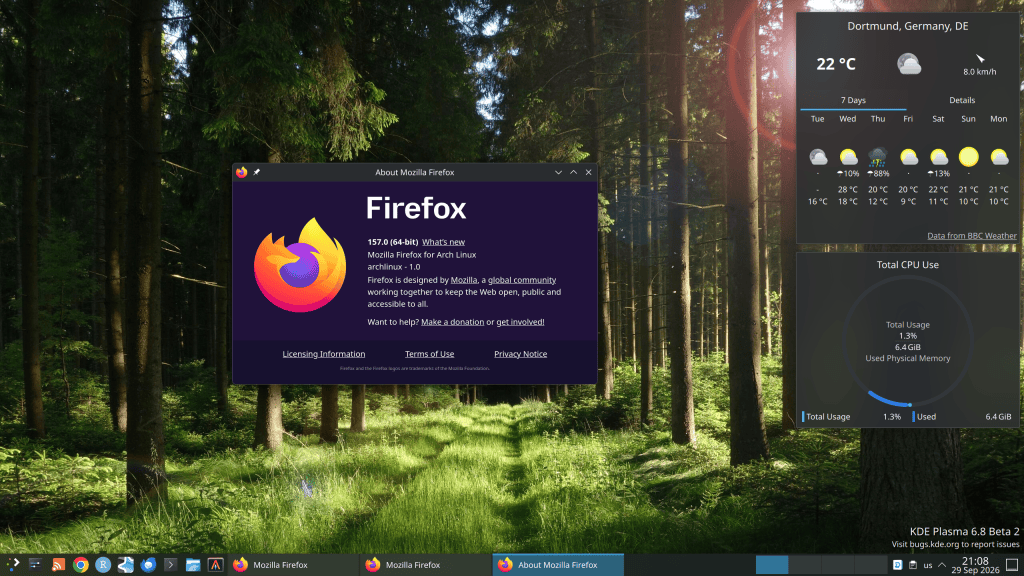
    Nova UI

    • Described as “the biggest visual refresh in years”
    • Modernizes the look of the browser chrome, sidebar, and menus

    Media and WebRTC

    • Hardware AV1 decoding for WebRTC video calls on supported devices (previously software-only)
    • HDR video fixes
    • Better audio/video sync when changing playback speed

    Other Changes

    • Amazon removed as a built-in search engine

    Availability

    • Binaries downloadable from ftp.mozilla.org
  • kldinfo: utility to display module objects deps and version info

    September 28th, 2026

    A very useful utility appeared in the FreeBSD mailing lists.

    Was surprised that FreeBSD had no such tool until today …

    https://lists.freebsd.org/archives/freebsd-current/2026-September/010855.html

    https://github.com/pointcheck/kldinfo

  • KDE Plasma 6.8 Beta 2 Released

    September 25th, 2026

    KDE Plasma 6.8 Beta 2

    • Final beta: Plasma 6.8 Beta 2 is the second and last beta before the stable release.
    • Union theming: The new Union theme engine enters the latter half of its public tech preview and now supports QtWidgets applications, including Dolphin and Kate.
    • KWin memory leak fix: KWin now depends on Plasma-Wayland-Protocols 1.23, addressing a Wayland resource leak that could cause RAM usage to grow dramatically over long uptimes.
    • Wayland improvements: Adds dwell-click support, commit-timing protocol support, improved remote desktop functionality, and server-side drop shadows.
    • Performance: Includes VRAM usage optimizations and additional KWin/desktop efficiency improvements.
    • Multi-GPU & displays: Improves multi-GPU handling and multi-monitor behavior.
    • New tool: Introduces kscreenctl for managing display configurations.

    • General polish: Numerous additional fixes and refinements are included across Plasma.
    • Release date: Plasma 6.8.0 is scheduled for 14 October 2026, coinciding with KDE’s 30th anniversary.

    https://kde.org/announcements/plasma/6/6.7.91

1 2 3 … 152
Next Page→

Blog at WordPress.com.

Privacy & Cookies: This site uses cookies. By continuing to use this website, you agree to their use.
To find out more, including how to control cookies, see here: Cookie Policy
Loading Comments...
  • Subscribe Subscribed
    /root

    Have a WordPress.com account? Log in now.

  • /root
    View site in Reader
    Manage subscriptionsSign upLog in
    Report this content
    Collapse this bar