



• About
    • Contact

/root

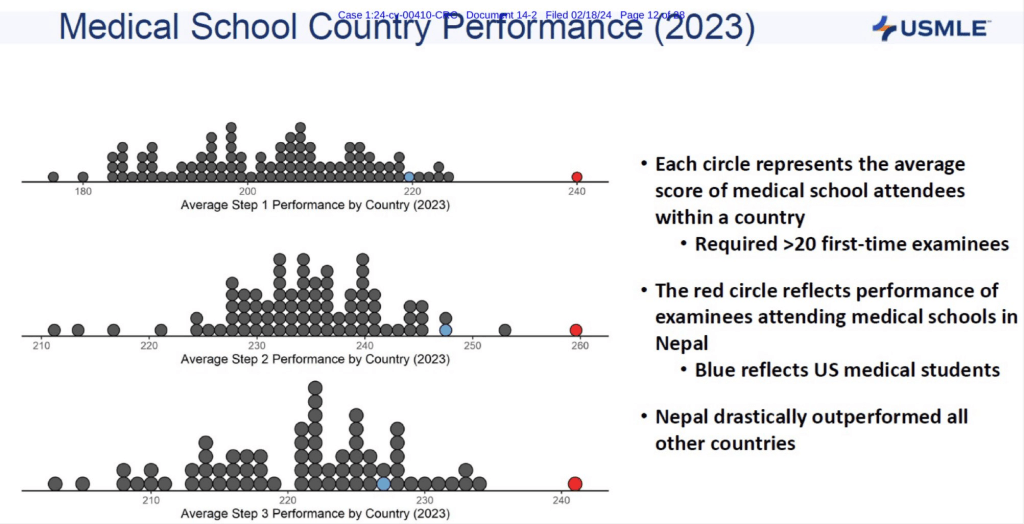
  • USA vs Nepal statistical analysis and performance in USMLE Steps

    February 21st, 2024
  • USMLE cheaters responded to questions in under 20 seconds …

    February 21st, 2024

    They also identified cheaters by their very unusual response times and accuracy.

    For instance, although USMLE questions typically require ~90 seconds to answer, the plaintiff answered many USMLE Step 1 questions in <20 seconds – and did so with 100% accuracy. pic.twitter.com/A7IbUogEW5

    — Bryan Carmody (@jbcarmody) February 19, 2024
  • 832 candidates had their USMLE scores invalidated

    February 21st, 2024

    First, the NBME confirmed the number of examinees involved.

    According to their filing, 832 examinees have had at least one of their USMLE scores invalidated… so far. pic.twitter.com/LQbh80EJ0x

    — Bryan Carmody (@jbcarmody) February 19, 2024
  • NBME court ruling

    February 21st, 2024

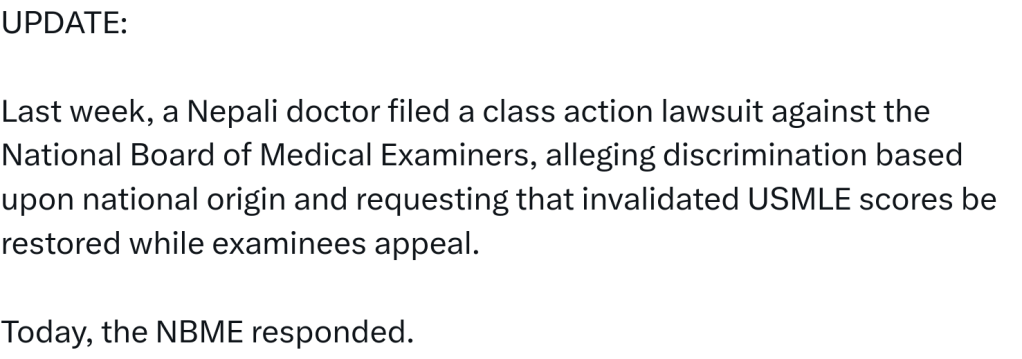
    UPDATE:

    Last week, a Nepali doctor filed a class action lawsuit against the National Board of Medical Examiners, alleging discrimination based upon national origin and requesting that invalidated USMLE scores be restored while examinees appeal.

    Today, the NBME responded.

    (🧵) https://t.co/Cm8PS6c0wA

    — Bryan Carmody (@jbcarmody) February 19, 2024
  • USMLE cheaters from Nepal

    February 21st, 2024

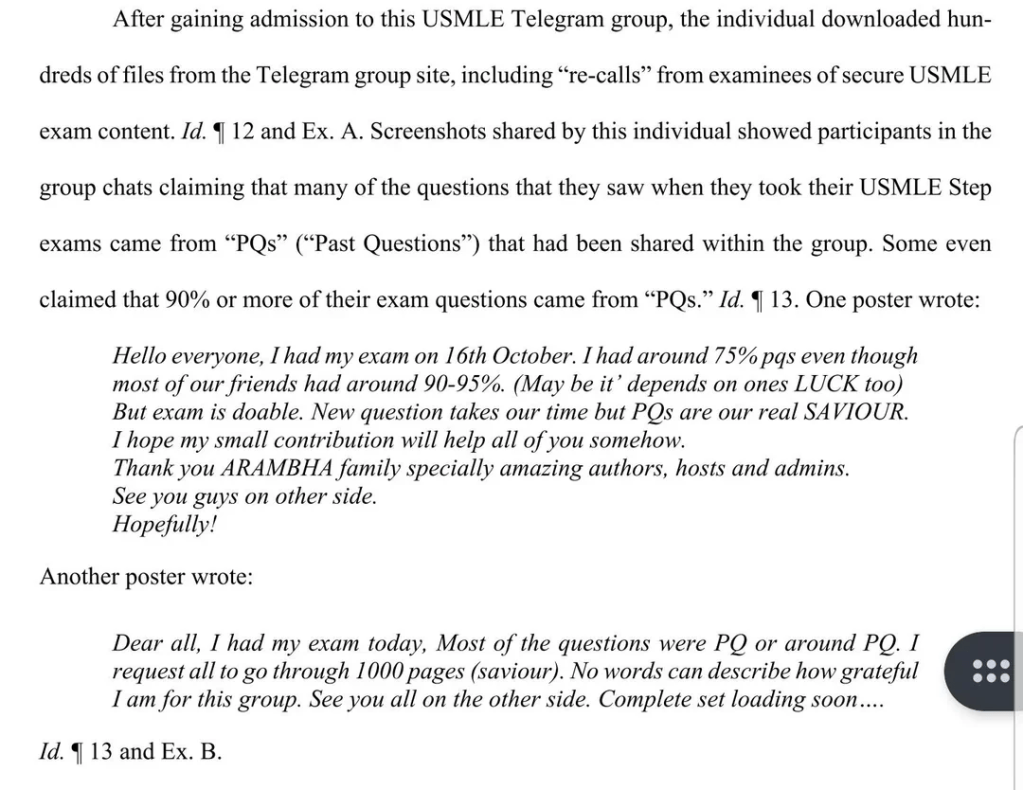
    A screenshot from a Telegram group by another anonymous reddit user
  • February 21st, 2024
  • February 20th, 2024
  • Starting using Weblate for FreeBSD localization

    February 18th, 2024

    https://github.com/freebsd/freebsd-doc-translate/commit/a40088fd18c9c02c1395795084fe8efabce79bc8

  • Uber – Database model

    February 18th, 2024

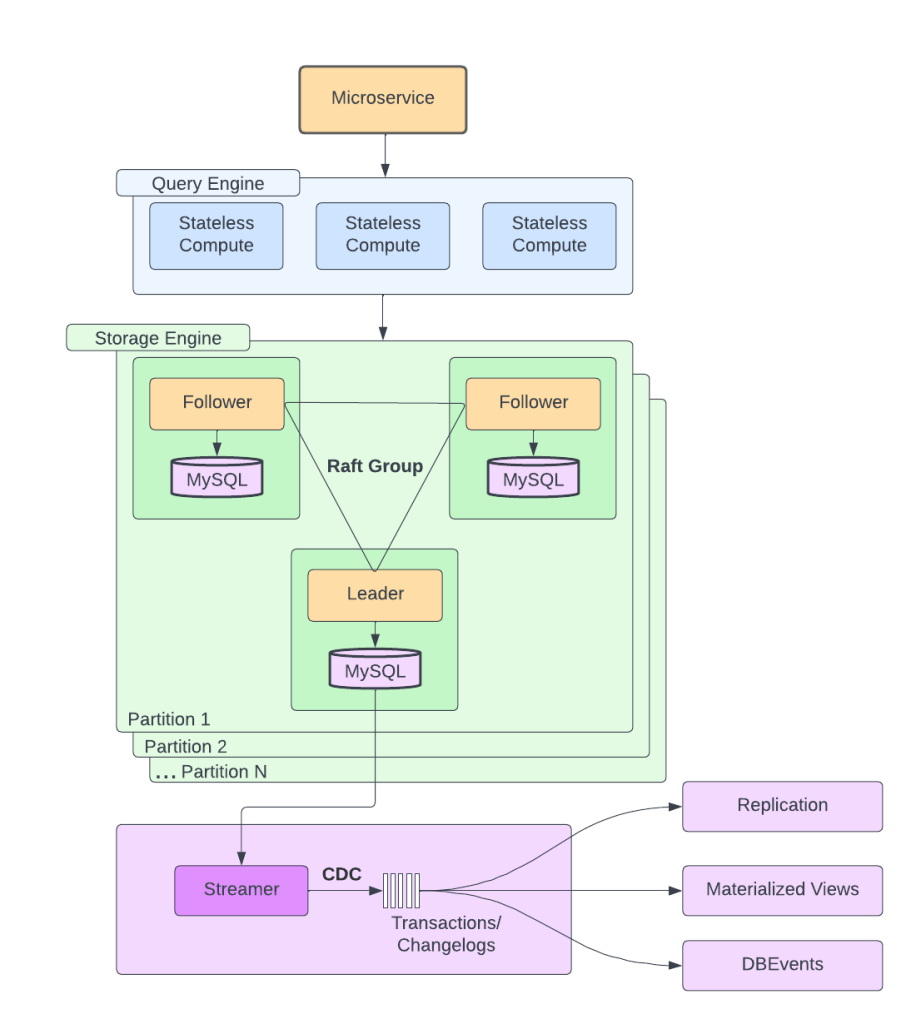
    Uber uses Docstore an in-house, distributed database built on top of MySQL, serving 40 Million Reads Per Second in a dataset of tens of Petabytes.
    https://www.uber.com/en-IN/blog/how-uber-serves-over-40-million-reads-per-second-using-an-integrated-cache

  • GNOME 46 beta

    February 18th, 2024

    With Variable Refresh Rate (VRR) support by Mutter

    https://discourse.gnome.org/t/gnome-46-beta-released/19505

  • OpenZFS – Fast Dedup

    February 18th, 2024

    Fast Deduplication was developed by Klara Inc and iXsystems and offers up to x20 greater performance.

    “With the introduction of Fast Dedup, there have been several major innovations including:

    • The size of metadata is now dynamically sized to fit in either RAM or dedicated flash devices to avoid hitting the performance penalty wall.
    • The metadata structure has been completely re-engineered to enable efficient updates using a log append process, greatly improving performance for large updates such as deletions.
    • The dedup table will favor dedup-able data and prune blocks that show no dedup potential.
    • Combining metadata improvements with properly configured storage, including dedicated metadata flash devices, will improve the sustained dedup performance by over an order of magnitude for larger systems.”
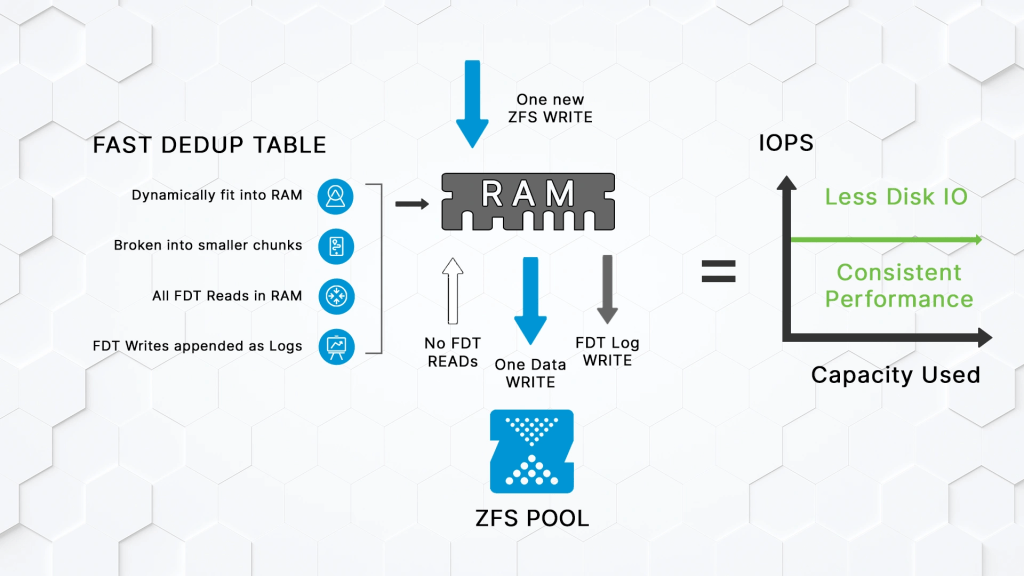
    Some users are sceptical about potential data loss issues, as with any filesystem technologies..

    https://www.ixsystems.com/blog/fast-dedup-is-a-valentines-gift-to-the-openzfs-and-truenas-communities

  • FreeBSD – progress made on SIMD

    February 18th, 2024

    String processing is essential in many UNIX commands. C strings are terminated with nul characters.

    Routines processing such strings, such as those provided by the C standard library libc are often reduced to walking through strings character by character in search for the nul terminator. This is why these operations have the reputation of poor performance.

    The FreeBSD Team has been working in a reimplementation of libc string functions using SIMD techniques and getting advantage of instruction set extensions by new CPUs.

    https://freebsdfoundation.org/blog/a-sneak-peek-simd-enhanced-string-functions-for-amd64
    https://man.freebsd.org/cgi/man.cgi?query=simd&manpath=FreeBSD+15.0-CURRENT
  • Anki – Qt update to 6.6.2

    February 18th, 2024
  • antimicrox – could not open uinput device file

    February 17th, 2024

    This problem came up today. Adding a udev rule solved the issue:

    cd /usr/lib/udev/rules.d/
    sudo wget https://raw.githubusercontent.com/AntiMicroX/antimicrox/master/other/60-antimicrox-uinput.rules

    https://github.com/AntiMicroX/antimicrox/wiki/Open-uinput-error
  • An interesting publication for patient data hashing

    February 17th, 2024

    Use of a hash algorithm in patient’s sensitive information (Name, Date of Birth or Social Security Number) using salt has the advantage of de-identifying personal data and also yields a unique identifier. This unique identifier can be later used to compare the disease course or follow ups in a different clinic. On the contrary an alphanumeric code can not re-identify these individuals.

    https://www.ncbi.nlm.nih.gov/pmc/articles/PMC10030136

←Previous Page
1 … 98 99 100 101 102 … 132
Next Page→

Blog at WordPress.com.

Privacy & Cookies: This site uses cookies. By continuing to use this website, you agree to their use.
To find out more, including how to control cookies, see here: Cookie Policy
 

Loading Comments...
 

    • Subscribe Subscribed
      • /root
      • Already have a WordPress.com account? Log in now.
      • /root
      • Subscribe Subscribed
      • Sign up
      • Log in
      • Report this content
      • View site in Reader
      • Manage subscriptions
      • Collapse this bar