





-
What’s Changed
🚀 Features
- feat: workflow logging by @benbeckford in feat: workflow logging #29878
- feat(web): new search ui by @benbeckford in feat(web): new search ui #30279
- feat: new config endpoints by @jrasm91 in feat: new config endpoints #30881
- feat: cluster groups by @jrasm91 in feat: cluster groups #30739
- feat: asset file apis by @jrasm91 in feat: asset file apis #25900
- feat: memories view by @benbeckford in feat: memories view #28675
- feat(mobile): show asset owner in asset details by @Lauritz-Tieste in feat(mobile): show asset owner in asset details #29302
- feat(server): new search API by @timonrieger in feat(server): new search API #30179
🌟 Notable Improvements
- Maps: Web interface can show assets within the currently visible map viewport; mobile displays asset counts.
- Facial recognition: Users can manually re-run facial recognition for their group.
- Tags: Improved tag-renaming implementation.
- Albums: Album descriptions can be searched when adding assets to albums; selection count is displayed.
- API keys: API keys can now be rotated.
- OAuth: Support for an OAuth account-management URL.
- Actions: Improved undo handling.
- Uploads: Faster browser-side SHA-1 hashing using
hash-wasm, with a pure-JS fallback. - iOS: Dynamic background IDs.
- Widgets: Option to match the system/icon theme.
- Better search animations, error handling, downgrade messaging, and CLI Node.js version enforcement.
-
KDE’s new Union theming system gained initial support for styling QtWidgets-based apps (Akseli Lahtinen). It’s a first draft with known visual glitches, but a notable milestone. Plasma 6.8 is taking shape.
New features
- Plasma 6.8: Union theming for QtWidgets apps; built-in RDP server adapts quality to available bandwidth for steadier frame rates; Strongswan VPN now supports EAP-TTLS authentication.
UI improvements
- Plasma 6.7.5: Discover only offers
.debinstall on systems that natively support the format. - Plasma 6.8:
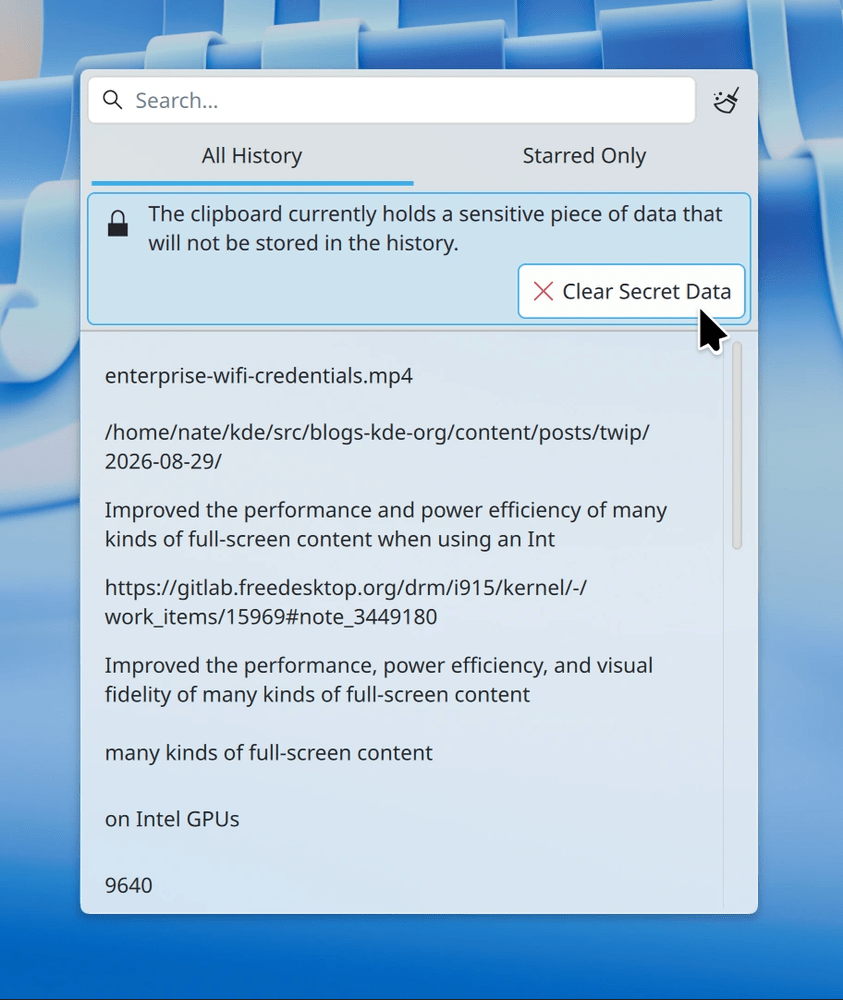
- Clipboard history now indicates when copied text was marked secret, instead of silently hiding it.
- Screen-recording indicator appears only during actual recording.
- Overview effect easier to trigger via four-finger touchpad swipe.
- Digital Clock calendar event text fully selectable.
- Less awkward dialog design for drawing-tablet pen button config.
- Bluetooth widget’s “Configure” button moved to the standard location.
- Enterprise Wi-Fi connection jumps straight to credential entry.
- System Tray icons stay visible until their popup closes.
- “Keep selection and clipboard the same” no longer disables unrelated settings.
- Mass crashes now produce a single System Tray icon listing all crashes, not dozens.
- Frameworks 6.30: Better contrast for in-window Kirigami dialogs in dark themes; System Monitor graph legends request tabular numerals for alignment.
Bug fixes
- Plasma 6.6.7: Security fix — screen locker failed to lock under a specific screen-off + grace-period configuration.
- Plasma 6.7.5: Discover no longer hangs on update checks with the Snap backend and no upgradeable Snaps; non-KDE app crashes on dialog close fixed; pointer-movement regression in VMs with non-accelerated drivers fixed; RTL languages no longer block force-quit in System Monitor; malformed panel edit-mode tooltip fixed; DrKonqi no longer crash-loops until memory exhaustion.
- Plasma 6.8: Fixed Plasma’s second-most-common crash (during logout); Plasma Search “Defaults” button and non-default highlighting work correctly; all Kickoff widgets can return results for uninstalled apps; logout sound no longer needlessly delays logout.
Performance & technical
- Plasma 6.7.5: Improved HDR appearance with ICC profiles.
- Plasma 6.8: Better performance/power efficiency for full-screen content on Intel and NVIDIA GPUs with HDR, ICC profiles, or Night Light; HLG transfer function support in KWin; screen-casting latency cut by one frame; lower resource use for notification/Activities thumbnails and the Trash widget; Spectacle omits the alpha channel when unused; disabling a System Tray widget frees memory immediately;
showConfigurationInterface()works in Plasma scripting; Plasma launches with a plain background if all wallpaper plugins are broken or missing. - Frameworks 6.30: KWallet log spam removed along with the non-functional feature causing it.
- KDE Gear 26.12.0: System Settings’ Proxy page rewritten in QML, enabling Plasma Mobile support with a near-identical design.
Contributing
KDE asks for help with the weekly report (via its Matrix room), general project involvement — noting donated time matters more than money and non-programmers are welcome — and financial donations covering operations, salaries, and contributor travel. Work is featured here by pushing commits to merge requests on invent.kde.org.
https://blogs.kde.org/2026/08/28/this-week-in-plasma-qtwidgets-apps-join-the-union
-
LLVM 23.1 is a substantial compiler update focused on next-generation CPU/GPU hardware, newer C/C++ standards, and improved security/offloading. (Phoronix)
Key highlights:
- New hardware support: AMD Zen 6 (
znver6) with AVX-512 BMM, AMD GFX1310/RDNA 5 GPUs, NVIDIA Rigel, Arm C1-Ultra, and SpacemiT X100 RISC-V. - x86-64 LFI: Adds Lightweight Fault Isolation targeting, intended to sandbox native C/C++/assembly code within the same process with relatively low overhead. (LLVM)
- C/C++ improvements: Partial C++26 support via
-std=c++2cplus additional upcoming C2Y features. - AMD GPU computing: Introduces the newer HIP offload driver, improving LLVM/Clang’s GPU-offloading infrastructure.
- RISC-V: Adds experimental assembler support for several newer ISA extensions.
- Toolchain improvements: Better LLD linker, diagnostics, and general compiler behavior.
In short: LLVM 23.1 prepares Clang/LLVM for upcoming Zen 6, RDNA 5, NVIDIA Rosa/Rigel, newer Arm and RISC-V hardware, while advancing C++26/C2Y, GPU compute, and native-code sandboxing. (Phoronix)
https://github.com/llvm/llvm-project/releases/tag/llvmorg-23.1.0
- New hardware support: AMD Zen 6 (
-
(2026-07-23)
Important Note
- After installing this update, you will not be able to downgrade to a previous DSM version.
- This update will restart your Synology NAS.
- If auto update does not run, perform a manual update in Control Panel. Before updating, follow the instructions and complete the required actions to ensure success.
- To uphold our commitment to quality, every DSM release undergoes rigorous validation. To ensure optimal stability, the models listed below will not receive this update on your device and will remain on their most suitable version. You can only download the upgrade patch from Synology Download Center because you won’t receive notifications for this update on your DSM.
- Enhanced KMIP certificate handling to comply with updated certificate issuance policies for public certificate authorities (CAs). KMIP client authentication now requires certificates issued by a private CA. Synology default certificates, the QuickConnect certificate, and certificates issued by public CAs (e.g., Let’s Encrypt, SSL.com, and Sectigo) are not supported for KMIP client authentication. For detailed configuration instructions, refer to this article. To generate self-signed certificate files for KMIP client authentication, refer to this article.
Compatibility & Installation
- To ensure compatibility, the following packages will be automatically updated or will require a manual update to a compatible version: SnapshotReplication
Fixed Issues
- Fixed an issue where a USB UPS could not be recognized after updating to DSM 7.4.
- Fixed an issue where USB devices could not be used on certain models after updating to DSM 7.4.
- Improved cache handling to enhance system stability.
https://www.synology.com/en-global/releaseNote/DSM?model=DS425%2B#ver_90080
-
Proud to be in that 0.0000000001% lol

-
What’s Changed
Add-on Compatibility Note
The following legacy modules have been removed:
anki.importingandanki.exporting. See the docs for alternatives.This affects the AnkiConnect add-on.
Notable Changes
- Fix audio playback in macOS 27 by @abdnh in #5363
- Remove Python-based legacy importing/exporting handling by @chrislongros in #5153
- Improve performance of reviewer initialization by lazy-loading MathJax by @BrayanDSO in #5171
- Fix HTML dropdowns/datepickers growing indefinitely with scaled UI on Windows by @abdnh in #5396
- Fix audio not being played automatically when attached in the editor by @JaksonSouza in #5320
- Recompute FSRS data after changing deck by @user1823 in #5339
-
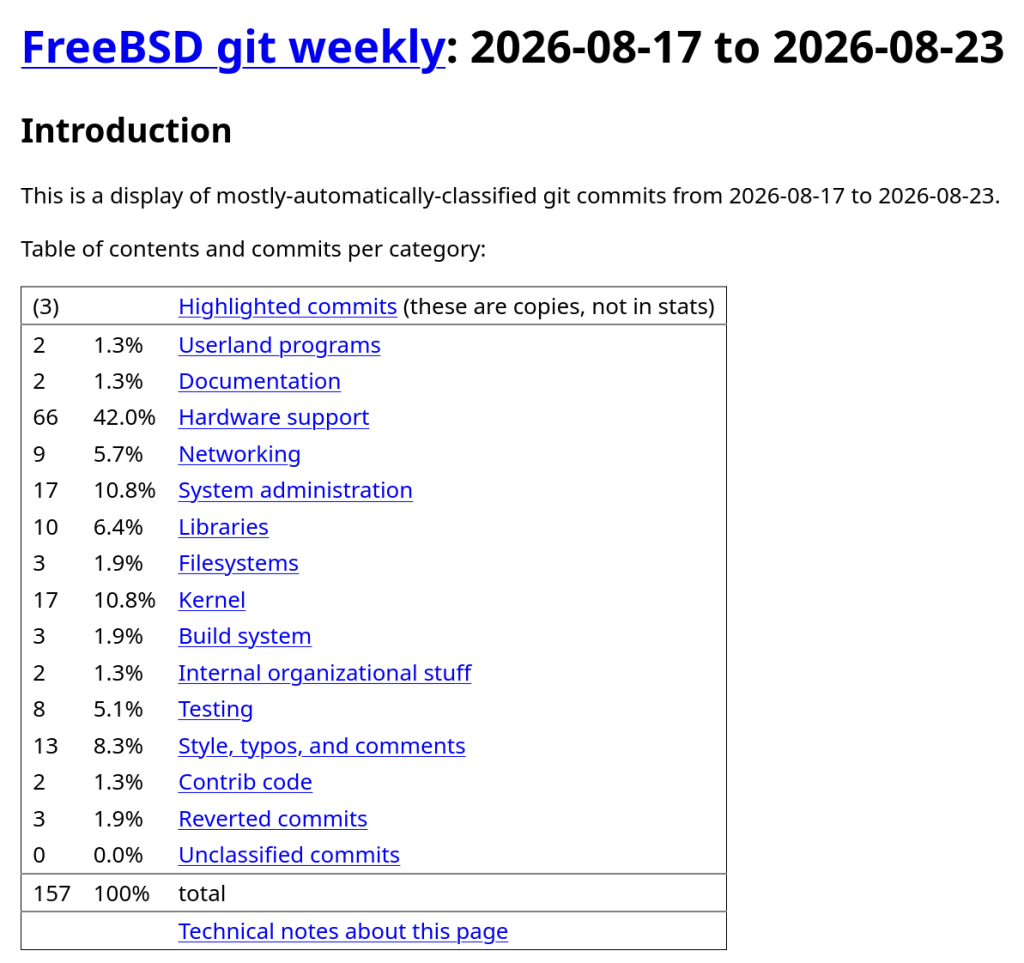
Highlighted commits:
- fts: add fts_openat() API
- shmfd: consistently return size in 512 byte blocks for fstat(2) st_blocks
- chflags: use Capsicum capability mode
-
Maintainer load threshold
A committer or maintainer becomes overloaded, and ineligible to add new ports or adopt orphaned ones, once all of the following are true:
- They maintain 100 or more ports,
- Their outdated ratio (per portscout/repology, calculated as in section 2b) is 10% or higher,
- That ratio has remained at or above 10% continuously for 30 days or more.
https://wiki.freebsd.org/Ports/MaintainerLoadAndPortLifecyclePolicy
-
According to the HexOS blog post AnyRAID should be implemented into upstream OpenZFS approximately at the end of 2026 and then ported to TrueNAS sometime in 2027 in the TrueNAS 27 version.
AnyRAID implementation timeline:
- OpenZFS 2.5 — targeted for later this year, likely toward the end of 2026. This is where the full AnyRAID feature set lands upstream, including AnyRAID support for RAID-Z1, Z2, and Z3 (the initial 2.4 release only covered AnyRAID mirrors), along with pool contraction and rebalancing.
- TrueNAS SCALE — once AnyRAID is accepted upstream, the next step is getting it into TrueNAS SCALE, which will likely be the SCALE 27 release, expected sometime next year.
- HexOS — the final step is bringing support into HexOS itself. Since we build on top of TrueNAS, this should be the simplest part of the journey. Our goal is to have this done by the end of 2027.
-
The html is under /usr/local/share/poudriere/html directory.
If you point a browser at this directory it does not load because privacy.file_unique_origin treats every file:// document as its own origin, so the page’s fetch of /data/…/.data.json is blocked.
The privacy.file_unique_origin feature: it was added in Firefox 68 to improve local file security and prevent data theft but consequently dropped in Firefox 95 because it posed a major security risk.
Save the following script as poudriere-web.py and run it with python3 poudriere-web.py
#!/usr/bin/env python3"""Poudriere local web UI"""import functoolsimport http.serverimport osimport reimport sysCONF = "/usr/local/etc/poudriere.conf"HTML = "/usr/local/share/poudriere/html"ROOT = os.path.expanduser("~/.cache/poudriere-web")PORT = int(sys.argv[1]) if len(sys.argv) > 1 else 8088def basefs(path=CONF, default="/usr/local/poudriere"):"""BASEFS is configurable, so read it rather than hardcoding it."""try:with open(path) as conf:for line in conf:match = re.match(r'\s*BASEFS=["\']?([^"\'#\s]+)', line)if match:return match.group(1)except OSError:passreturn defaultclass Handler(http.server.SimpleHTTPRequestHandler):# .log is in no standard MIME table, so it would be served as# application/octet-stream and the browser would download build logs# instead of displaying them.extensions_map = {**http.server.SimpleHTTPRequestHandler.extensions_map,".log": "text/plain",}def link(target, name):path = os.path.join(ROOT, name)if not os.path.lexists(path):os.symlink(target, path)logs = os.path.join(basefs(), "data", "logs", "bulk")for required in (HTML, logs):if not os.path.isdir(required):sys.exit(f"{required} does not exist -- is poudriere installed and has a build run?")os.makedirs(ROOT, exist_ok=True)for entry in os.listdir(HTML):link(os.path.join(HTML, entry), entry)link(logs, "data")print(f"serving {HTML}\n and {logs}\n at http://127.0.0.1:{PORT}/")http.server.test(HandlerClass=functools.partial(Handler, directory=ROOT),bind="127.0.0.1",port=PORT,)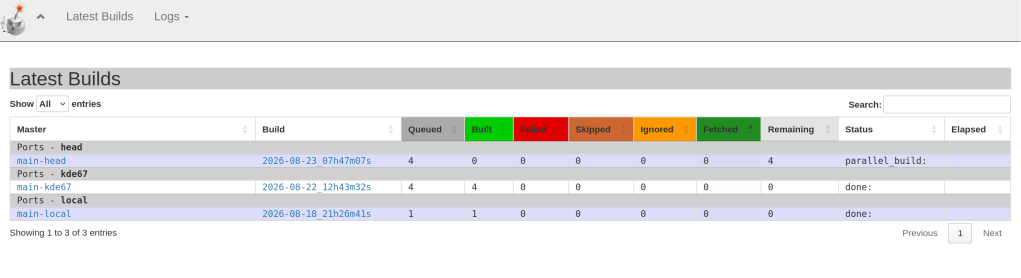

 /root
/root 