The push for a modern graphical installer in FreeBSD has been ongoing for a while. With FreeBSD 15.0 released in December 2025, many expected it to ship with a graphical installation option — but it didn’t make the cut. The good news: it’s coming in FreeBSD 15.1.
What Happened with 15.0
FreeBSD 15.0 shipped with the traditional bsdinstall text-based installer. While functional, it’s showing its age — the text-based dialogs work fine for experienced admins, but they’re a barrier for adoption compared to what Linux distros offer.
KDE Plasma desktop as an installable option during installation
Testing with Intel, AMD, and NVIDIA GPUs (including a NVIDIA GPU selection menu)
Generic VESA driver support as a fallback
Refactored installer code to support the graphical workflow
The Bigger Picture
This is part of the FreeBSD Foundation’s broader laptop usability initiative, which has received over $750,000 in funding throughout 2025 and continues into 2026. The project covers Wi-Fi, graphics drivers, audio, power management, and installation experience.
FreeBSD has always been technically excellent but lagged behind Linux in user-friendliness. A graphical installer with KDE won’t change the OS itself, but it removes one of the biggest friction points for new users. Combined with improvements like PkgBase, s2idle sleep support, and the new SPMC power management driver, FreeBSD is becoming more approachable without sacrificing what makes it great.
For those of us who’ve been installing FreeBSD since the sysinstall days, it’s exciting to see the project evolve while keeping its identity. The FreeBSD 15.1 release schedule is worth keeping an eye on.
This is a cautionary tale about how I nearly lost everything on my external SSD because of a moment of carelessness.
What Happened
I wanted to create a bootable USB with Ventoy to run a Linux or FreeBSD ISO. Simple enough — I’ve done it a hundred times. The problem was that I also had my external SSD connected at the same time.
I somehow selected the wrong disk. Instead of formatting the USB stick, I formatted my external SSD. Just like that — all my data was gone.
That sinking feeling when you realize what you’ve done is something I wouldn’t wish on anyone.
Recovery with PhotoRec
Thankfully, I was able to recover most of my data using PhotoRec, a free and open-source data recovery tool (currently at version 7.2, with 7.3 in beta as of January 2026). PhotoRec ignores the filesystem and goes after the underlying data, so it works even after formatting. It can recover over 480 file formats.
PhotoRec will scan the disk and recover files into a directory of your choice. It recovered most of my files, though filenames and directory structure were lost — everything gets sorted by file type.
Lessons Learned
Always double-check the target disk. Run lsblk before any destructive operation. Verify the disk size and partitions match what you expect. Ventoy (currently at v1.1.10) shows disk names and sizes — take the extra second to verify.
Disconnect drives you don’t need. If you’re formatting a USB, unplug your external drives first. It takes 5 seconds and can save you hours of recovery.
Follow the 3-2-1 backup rule: 3 copies, 2 different media, 1 offsite. If I had a proper backup, the accidental format would have been a minor inconvenience instead of a disaster.
ZFS snapshots are your friend. On my TrueNAS server, I now run automatic snapshots. Even if something goes wrong, I can roll back instantly.
Keep PhotoRec/TestDisk installed. You never know when you’ll need it. Better to have it ready than to scramble in a panic.
Don’t be like me. Disconnect your drives, check twice, and back up your data. Your future self will thank you.
PostgreSQL 18 was released in September 2025, and it’s packed with major improvements across the board. As of February 2026, the latest point release is PostgreSQL 18.3 — an out-of-cycle release on February 26th that fixes several regressions from the last update. Here are the highlights of the 18.x series.
Performance
New asynchronous I/O subsystem (AIO) delivers up to 3x faster data reads
Better index usage and parallel GIN index builds
Skip scans on multicolumn indexes
Improved OR condition optimization
Faster hash/merge joins
Upgrades
Planner statistics preserved across major upgrades — faster recovery of query performance
EXPLAIN now shows buffer, index, CPU, and WAL stats
Expanded monitoring views
Other Notable Changes
Page checksums enabled by default in new clusters
New wire protocol version 3.2 — the first update since 2003!
Point Releases
18.1 (Nov 2025) — first maintenance release
18.2 (Feb 2026) — regular update cycle
18.3 (Feb 26, 2026) — out-of-cycle fix for regressions in 18.2
The AIO subsystem alone makes the upgrade worthwhile for anyone running read-heavy workloads. If you’re still on 17.x, now is a great time to plan the migration — 18.3 is stable and battle-tested. More details at postgresql.org.
Immich, the popular open-source, self-hosted photo and video management solution, has launched a community-driven initiative to improve its metadata handling capabilities. Through the new EXIF Dataset project, users can contribute their photos to help train and improve Immich’s EXIF parsing and metadata extraction features.
I recently contributed some of my own photos to the project, and I want to share how easy and straightforward the process is. If you’re an Immich user (or simply an open-source enthusiast), this is a fantastic way to give back to the community.
What is the EXIF Dataset Project?
EXIF (Exchangeable Image File Format) data is the metadata embedded in your photos by your camera or smartphone. This includes information like the camera make and model, date and time, GPS coordinates, lens information, and much more. Immich uses this data extensively to organize your photo library, enable timeline views, power location-based features, and facilitate powerful search capabilities.
The EXIF Dataset project at datasets.immich.app/projects/exif allows community members to contribute photos along with their intact EXIF metadata. This crowdsourced dataset helps the Immich team understand how different cameras and devices encode their metadata, ultimately improving compatibility and parsing accuracy for everyone.
The contribution process is remarkably simple and well-designed. Here’s how it works:
Step 1: Upload Your Photos
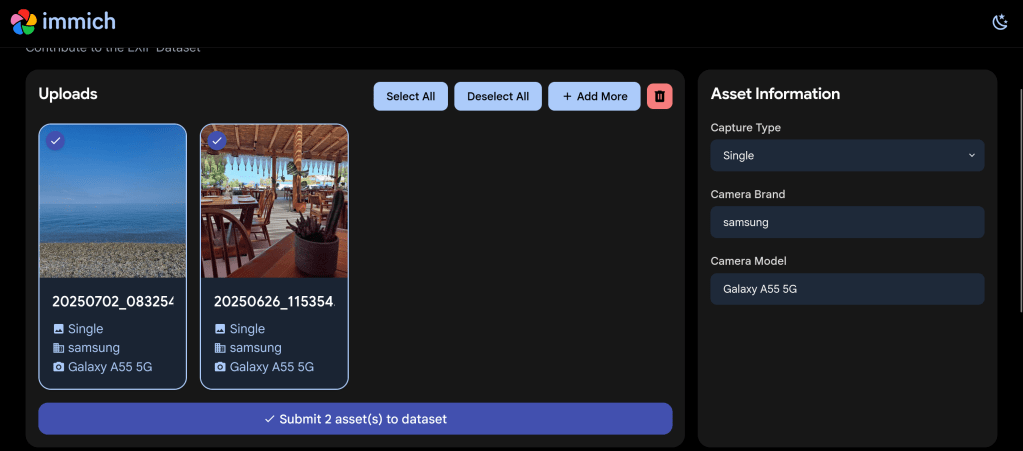
After navigating to the EXIF Dataset project page, you’re greeted with a clean upload interface. I uploaded a couple of photos taken with my Samsung Galaxy A55 5G – a beach landscape shot and a photo from a beachside restaurant.
The clean upload interface showing my first selected photo with its EXIF metadata displayed
The interface immediately displays the extracted EXIF information on the right side, including the capture type (Single), camera brand (Samsung), and camera model (Galaxy A55 5G). This lets you verify that your photos contain the metadata you want to contribute.
Step 2: Select Photos for Submission
You can upload multiple photos at once using the “+ Add More” button. I selected both of my photos for contribution – each showing clearly with a checkmark indicating selection.
Two photos selected and ready to submit to the EXIF Dataset
The interface provides convenient “Select All” and “Deselect All” buttons, as well as a delete option if you change your mind about any uploads.
Step 3: Agree to the CC0 License
When you click “Submit asset(s) to dataset”, a Dataset Agreement dialog appears. This is where the legal side of your contribution is handled transparently.
The Dataset Agreement confirms your photos will be released under the CC0 public domain license
ℹ️ About CC0: The CC0 (Creative Commons Zero) license means you’re releasing your contributed photos into the public domain. This allows the Immich project (and anyone else) to use the images freely for any purpose. Make sure you only upload photos you own the rights to and are comfortable sharing publicly.
The agreement requires you to confirm two things:
You agree to release the uploaded assets under the CC0 license into the public domain
The files have not been modified in any way that would alter their original content or metadata
You also provide a contact email in case the Immich team has any questions about your upload.
Why Should You Contribute?
Contributing to the EXIF Dataset helps improve Immich in several ways:
Better Device Support: By collecting EXIF samples from many different cameras and phones, Immich can improve its parsing for devices that may have quirks or non-standard metadata encoding
Improved Metadata Extraction: The dataset helps identify edge cases and unusual metadata formats that might otherwise go unnoticed
Community-Driven Development: Your contribution directly influences the quality of an open-source project used by thousands of self-hosters worldwide
Supporting Privacy-Focused Software: Immich is a privacy-respecting alternative to cloud-based photo services like Google Photos – your contribution helps make it even better
Tips for Contributing
To make your contribution as valuable as possible:
Contribute from different devices: If you have photos from older cameras, different smartphone brands, or professional equipment, these are especially valuable
Keep metadata intact: Don’t strip or modify the EXIF data before uploading – the original metadata is exactly what’s needed
Consider variety: Photos taken in different conditions (indoor, outdoor, various lighting) may contain different metadata values
Check your ownership: Only contribute photos you’ve taken yourself or have explicit rights to share
About Immich
For those unfamiliar with Immich, it’s a high-performance, self-hosted photo and video management solution that offers features comparable to Google Photos – but with full control over your data. Key features include automatic backup from mobile devices, facial recognition, smart search, timeline views, shared albums, and much more.
Immich is developed under the AGPL-3.0 license and is backed by FUTO, an organization dedicated to developing privacy-preserving technology. The project has grown tremendously, with over 77,000 stars on GitHub, making it one of the most popular self-hosted applications available.
🏠 Self-Host Immich: Get started with Immich at immich.app – available for Docker, TrueNAS, Unraid, and other platforms.
Conclusion
Contributing to the Immich EXIF Dataset is a simple yet meaningful way to support open-source software development. The process takes just a few minutes, and your contribution will help improve photo management for the entire Immich community.
The first maintenance release of the 24.12 series is out packed with important fixes and enhancements. This update focuses on polishing the newly introduced built-in effects, resolving issues with bin effects and the effect stack, and addressing some recently introduced crashes. Other highlights include fixing an issue where hiding a track in a sequence could alter the length of the parent sequence, ensuring tags and markers are maintained when reloading proxy clips, fixing Whisper model downloads and installation of Python virtual environment (venv) issues on some Linux distributions.
Full changelog:
Ensure sequence clips in timeline are not resized to smaller when hiding a track. Commit. Fixes bug #498178.
Fix crash moving build-in effect with feature disabled. Commit.
Rejecting commits and removing developers based on nationality !!! What does even has nationality to do with open-source contributions !!? If the code is good, non-malicious and runs it should be accepted …










 /root
/root 