




Tag: FreeBSD
-
“KIOXIA CD8 SSDs routinely take ~25 seconds to delete non-empty
namespace. In some cases like hot-plug it takes longer, triggering
timeout and controller resets after just 30 seconds. Linux for many
years has separate 60 seconds timeout for admin queue. This patch
does the same. And it is good to be consistent.”https://github.com/freebsd/freebsd-src/commit/8d6c0743e36e3cff9279c40468711a82db98df23
-
“Unique opportunity to meet face-to-face with developers and contributors to get features requested and problems solved”
The program includes talks from Klara Inc. , Netflix and developers: John Baldwin, Ed Maste.
-
A summary of changes since 14.0-BETA4 includes:
- An issue preventing binary upgrades using freebsd-update on earlier
supported releases had been fixed. - Several networking-related bug fixes had been addressed.
- Experimental support for Amazon EC2 cloud-init AMIs had been added.
- Several additional miscellaneous bug fixes and enhancements.

https://download.freebsd.org/releases/ISO-IMAGES/14.0/FreeBSD-14.0-BETA5-amd64-bootonly.iso
- An issue preventing binary upgrades using freebsd-update on earlier
-
So the official RELEASE announcement is shifted on 7 November 2023
-
“A nasty vulnerability has been made public today concerning Glibc’s dynamic loader that can lead to full root privileges being obtained by local users. This affects Linux distributions of the past two years”
FreeBSD does not use glibc and has it’s own libc system that is not affected by this vulnerability.
Even the Linux Binary Compatibility package emulators/linux_base-c7 should be safe according to https://access.redhat.com/security/cve/cve-2023-4911
-

Due to the following issues according to Glen Barber, the Release Engineering Lead of the FreeBSD Project:
1) freebsd-update(8) has previously failed to upgrade from 13.x and
earlier due to a file name that had been replaced with a directory of
the same name. A patch for this is under testing.
2) FreeBSD arm64/aarch64 EC2 AMIs have been failing to build properly,
presumably due to lang/rust build failures leading to the ec2-scripts
package from being prevented to be available. The last 15.0-CURRENT
snapshots seem to have this resolved, so hopefully it is also
resolved for what will eventually be the ‘release_0’ package set for
14.0-RELEASE, but that is still over a week away.
3) There are no “official” FreeBSD base packages available. I have been
occupied with external factors preventing me from having cycles
available to look into this without interruption, but I think I am
going to err on the side of caution and have a manual package set run
available via https://download.freebsd.org/ somewhere within the
version, architecture, and machine type namespace.
4) Vagrant images fail to upload due to an incorrect target following
the addition of ZFS images. This is another issue where I have
personally been blocked/blocking progress.
5) The ‘ftp-stage’ target does not currently account for ZFS virtual
machine images. I again have this in my queue. I do not know if
I necessarily care too much about this for 14.0-RELEASE, since all
virtual machine images are within the ‘Latest/’ directory namespace
for all builds, but I am intent on fixing it.
6) The ZFS-root EC2 AMIs panic a few seconds after booting, apparently
due to memory corruption in ZFS.
Note regarding (3) above: this is not yet done, but the datasets in
which the builds were done are preserved. I hope to have at least a few
hours this weekend to try to get binary packages for the FreeBSD base
system in place, wherever that ends up being. -
Add the following parameters in the /etc/rc.conf configuration file:
ntpd_enable=”YES”
ntpd_sync_on_start=”YES”
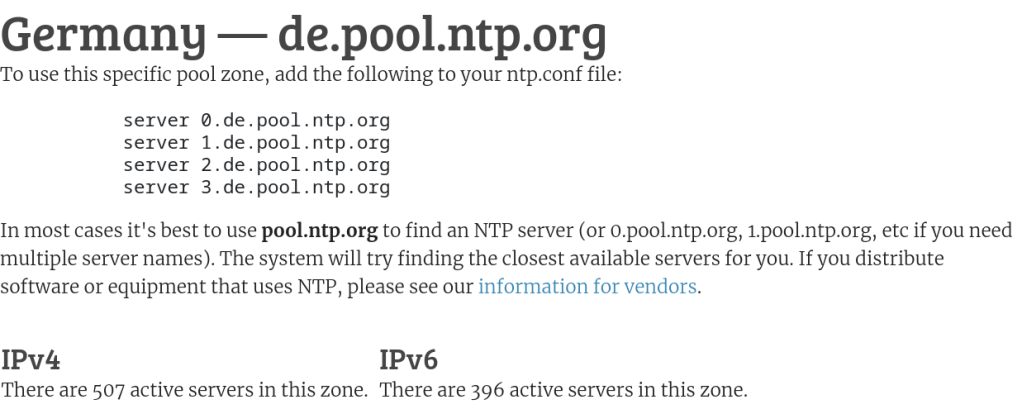
add the line: pool de.pool.ntp.org iburst in /etc/ntp.conf file
iburst denotes that ntpd will perform a burst of 8 quick packet
exchanges with a server when contact is first established, to help quickly synchronize system time.The de prefix differs depending on the servers of the country you choose. In my case Germany. A complete list of active servers is on https://www.ntppool.org/en/
In addition, FreeBSD provides a project-sponsored pool, 0.freebsd.pool.ntp.org.
-
The supported hashing algorithms are DES, MD5, SHA256, SHA512, and Blowfish but the default is SHA512
Hashes that start with $6$ are indicative of SHA512
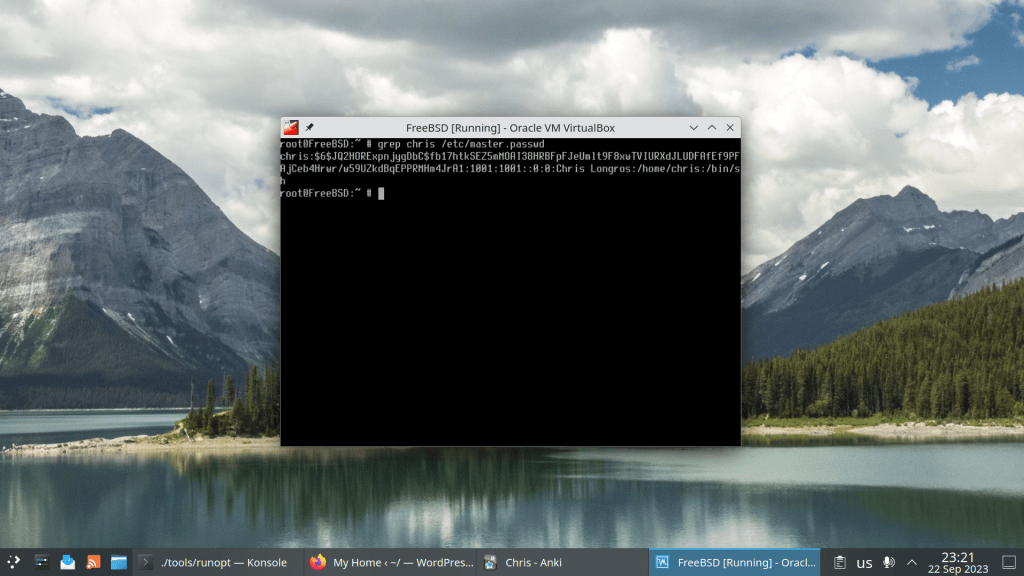
The settings are found in /etc/login.conf where :passwd_format=sha512:\ declares the preferred hashing algorithm
In order to change the hashing method execute cap_mkdb /etc/login.conf. It will only affect the new passwords. The old ones need to be re-hashed by asking users to run passwd in order to change their password


 /root
/root 