Using AI to generate Anki flashcards has evolved rapidly over the past couple of years. Here’s a look at how it started and where we are in 2026.
The Beginning: ChatGPT Prompts (2023)
The first to provide an Anki flashcard-generating ChatGPT prompt was Jarret Lee in this Anki forums post: Casting a Spell on ChatGPT: Let it Write Anki Cards for You. The idea was simple — give ChatGPT a structured prompt and it returns properly formatted flashcards you can import.
AnkiBrain Add-on
Shortly after, the AnkiBrain add-on was developed, integrating AI directly into Anki’s interface. This made it possible to generate cards without leaving the application.
Current Landscape (2026)
The ecosystem has exploded. Here are the main tools available today:
AnkiDecks AI — upload PDFs, PowerPoints, Word docs, or even YouTube links and get flashcards generated instantly
Ankify — turns notes, PDFs, and slides into export-ready Anki decks with card preview and editing before export
NovaCards — uses LLMs to generate cards from class notes, with a companion Anki plugin for in-app generation
AnkiAIUtils — AI-powered tools to enhance existing cards with explanations, mnemonics, and illustrations
Agentic AI approaches — tools like Claude Code can now generate batches of contextualised cards by describing the pattern you want
MCP interfaces — AI models can now interact directly with your Anki collection through MCP connectors
My Approach
I still prefer writing my own cards for deep learning, but AI-generated cards are great for:
Quickly converting lecture notes or documentation into reviewable material
Generating vocabulary cards in bulk
Creating first-pass cards that you then refine manually
The key is to always review AI-generated cards before adding them to your collection. Bad cards lead to bad learning.
WordPress.com strips <style> tags from posts. Here’s how to work around that and create beautifully styled technical articles with custom typography, code blocks, and layout components — without a self-hosted installation.
If you’ve ever tried to write a technical blog post on WordPress.com and found the default styling lacking — ugly code blocks, no control over fonts, tables that look like spreadsheets from 2005 — you’ve hit the platform’s biggest limitation. WordPress.com sanitizes post HTML aggressively, stripping out <style> and <link> tags for security reasons.
This post documents the approach I use to get full control over article styling on a WordPress.com Premium plan, without needing a self-hosted WordPress installation.
The Problem
WordPress.com’s block editor (Gutenberg) gives you paragraphs, headings, images, and code blocks. But the built-in styling is generic — it inherits your theme’s defaults, which are designed for broad appeal, not for technical writing. Specifically:
Code blocks use your theme’s monospace font with minimal contrast. No syntax highlighting, no language labels, no dark background that signals “this is code” to a scanning reader.
Tables get basic browser defaults — no header styling, inconsistent padding, no visual hierarchy between header and data rows.
Callout boxes don’t exist natively. You can use a Quote block, but it looks like a quote, not like a tip or warning. There’s no way to add a colored left border with a label.
Typography is locked to your theme. If your theme uses a system font stack, every post looks like a Google Doc.
The obvious fix — adding a <style> block to your post HTML — doesn’t work. WordPress.com strips it on save.
The Solution: Additional CSS + Custom HTML Blocks
The approach splits styling from content across two places:
Additional CSS site-wide styles
+
Custom HTML Block post content with classes
=
Styled Post fonts, colors, layout
Additional CSS lives in the WordPress Customizer (Appearance → Customize → Additional CSS, or via the Site Editor on block themes). It’s injected into every page’s <head> as a legitimate <style> block. WordPress.com allows this on paid plans (Personal and above) because it’s a controlled environment — you’re editing a dedicated CSS field, not injecting arbitrary HTML into post content.
Custom HTML blocks in the post editor accept raw HTML with class attributes. WordPress.com doesn’t strip class from elements, so your post HTML can reference any class defined in Additional CSS.
The result: your CSS lives in one place and applies to all posts. Your post content is clean, semantic HTML with descriptive class names. No inline styles, no duplication, no fighting the sanitizer.
Setting Up the CSS
I scope everything under a single wrapper class — .rss-post — to avoid polluting the rest of the site. Every selector starts with .rss-post, so the styles only apply inside posts that use the wrapper div.
Fonts
The CSS imports three fonts from Google Fonts via @import:
Newsreader is an optical-size serif that works beautifully for body text — it adjusts its weight and contrast based on font size, so headings and body text both look sharp without manual tweaking. JetBrains Mono is a purpose-built coding font with ligatures and distinct characters for 0/O and 1/l/I. DM Sans handles UI elements like labels, table headers, and info box titles — places where a clean sans-serif reads better than a serif.
The accent system
A single accent color (#e07a2f, a warm amber) ties the design together. It appears in four places: the left border on headings, the left border on info boxes, the info box label text, and link hover states. This creates visual consistency without overwhelming the page.
The ::before pseudo-element creates the accent bar. This is one of the things you can’t do with inline styles — pseudo-elements only work in stylesheets, which is exactly why Additional CSS is necessary.
Code blocks
The default WordPress code block is functional but visually flat. The custom CSS gives code blocks a dark background (#1e1e2e, matching the Catppuccin Mocha palette), a subtle border, and generous padding. A floating language label in the top-right corner uses a <span class="label"> inside the <pre> block:
Inline code gets a light warm background (#edebe6) that’s visible without being distracting.
Info boxes
Tips, warnings, and gotchas use the .infobox class — a light background with an amber left border and an uppercase label:
Example
This is what an info box looks like. The label is a <strong> element styled with uppercase text and the accent color. The background is a warm off-white that distinguishes it from the main content without creating harsh contrast.
The HTML for this is minimal:
html<div class="infobox">
  <strong>Tip</strong>
  Your message here.
</div>
Flow diagrams
For simple architecture or process diagrams, the .flow class creates a horizontal flex layout with dark boxes and arrow separators:
Step 1
→
Step 2
→
Step 3
The .accent modifier highlights one box in amber. On mobile, the flex container wraps naturally.
Writing a Post
The workflow for creating a styled post is:
1. Create a new post in the WordPress editor.
2. Add a Custom HTML block (not a Paragraph, not a Code block). Click the + button, search for “Custom HTML”.
3. Paste your HTML wrapped in <div class="rss-post">. Use standard HTML tags — <h2>, <p>, <pre><code>, <table> — with the custom classes where needed (.infobox, .flow, .label, .lead).
4. Preview and publish. The Additional CSS applies automatically.
Important
Use a single Custom HTML block for the entire post, not multiple blocks. If you mix Custom HTML blocks with regular Paragraph or Heading blocks, the regular blocks won’t be inside the .rss-post wrapper and won’t get the custom styling.
Why Not Use the Block Editor Natively?
A reasonable question. Gutenberg’s blocks do offer some styling — you can set colors, font sizes, and spacing per block. But there are real limitations:
No custom fonts. You’re limited to what your theme provides plus WordPress.com’s font library. Want JetBrains Mono for code? Not an option through the block editor.
No pseudo-elements. The accent bar on headings uses ::before. There’s no block editor control for that.
No reusable component patterns. An info box with a colored border, background, and styled label would need manual per-block styling every time. With CSS classes, it’s one <div class="infobox">.
No code block theming. The built-in Code block doesn’t support dark themes, language labels, or custom fonts.
Consistency. When all styling comes from a single CSS file, every post looks consistent. Per-block styling drifts over time.
Available Components
Here’s a quick reference for the CSS classes available in the current stylesheet:
Class
Element
Purpose
.rss-post
<div>
Wrapper — all styles are scoped under this
.lead
<p>
Subtitle / intro paragraph in muted gray
.infobox
<div>
Tip / warning / note callout box
.flow
<div>
Horizontal flow diagram container
.flow-box
<div>
Individual box in a flow diagram
.flow-box.accent
<div>
Highlighted (amber) flow box
.flow-arrow
<span>
Arrow between flow boxes
.label
<span>
Language label inside <pre> blocks
.tag-list
<ul>
Horizontal tag/category pills
The Tradeoff
This approach is not without downsides. You’re writing raw HTML instead of using the visual editor, which is slower and more error-prone. The post editor’s preview won’t show the custom styles (you need to use the site preview or publish as draft). And if you ever change themes, the Additional CSS carries over but may need adjustments to avoid conflicts with the new theme’s styles.
For me, the tradeoff is worth it. I write technical content with code blocks, tables, and diagrams. The default WordPress.com styling doesn’t serve that content well, and this approach gives me full control without needing to self-host WordPress or pay for a Business plan with plugin access.
One CSS file. Clean HTML with classes. Posts that actually look the way you want them to.
How to bring back RSS feeds for sites that removed them, scrape full article content, and unify everything in a single self-hosted reader.
RSS isn’t dead — it’s just been abandoned by publishers chasing engagement metrics and walled gardens. Websites that once offered clean XML feeds now force you into newsletters, push notifications, or algorithmic timelines. But with a bit of self-hosting, you can take that control back.
This post walks through my setup: FreshRSS as the reader, RSS-Bridge as the scraper for sites that killed their feeds, all running on TrueNAS Scale with Docker and exposed through Tailscale for secure remote access.
The Architecture
The data flow is straightforward:
Website (no RSS)
→
RSS-Bridge scrapes & generates feed
→
FreshRSS polls & displays
→
You browser / app
For sites that still offer RSS, FreshRSS subscribes directly. For sites that removed their feeds, RSS-Bridge sits in between — it loads the page, parses the HTML with CSS selectors, and generates a standard Atom feed that FreshRSS can consume like any other subscription.
Why RSS-Bridge Over Alternatives
There are several tools that can generate feeds from websites. I chose RSS-Bridge for a few reasons:
Lightweight. RSS-Bridge is PHP-based and runs in about 50 MB of RAM. Compare that with RSSHub (Node.js, 300 MB+) or Huginn (Ruby, even heavier). On a NAS where every container counts, this matters.
FreshRSS integration. There’s a native FreshRSS extension (xExtension-RssBridge) if you want tight integration, though the simpler approach — just subscribing to the generated feed URL — works perfectly and survives app updates.
CssSelectorBridge. This built-in bridge is incredibly flexible. Give it a URL, tell it which CSS selectors match your articles, and it produces a feed. No coding required, no custom JavaScript routes to maintain.
Deploying RSS-Bridge on TrueNAS
I run RSS-Bridge as a Docker container through Portainer. First, create the config directory and enable all bridges:
bash# Create config directory on ZFS
sudo mkdir -p /mnt/zfs_tank/docker/rss-bridge

# Enable all bridges
sudo tee /mnt/zfs_tank/docker/rss-bridge/config.ini.php << 'EOF'
[system]
enabled_bridges[] = *
EOF
This makes RSS-Bridge available at https://your-machine.tailnet-name.ts.net:3001/ from any device on your tailnet. Use a non-443 port to avoid overwriting your TrueNAS GUI’s Tailscale Serve config.
Tip
When adding feed URLs to FreshRSS, use the local IP (e.g. http://192.168.0.13:3001/...) rather than the Tailscale hostname. Both services run on the same box, so going through the LAN is faster and more reliable — and the FreshRSS container may not have Tailscale DNS available.
Scraping a Site: A Real Example
The Greek tech blog techblog.gr removed its RSS feed during a 2025 site redesign. Here’s how I brought it back.
Step 1 — Identify the selectors
Open the site, right-click an article title, and choose Inspect. On techblog.gr, each article title is an <a> inside an <h3>. On article pages, the content lives inside div.article-content.
Step 2 — Configure CssSelectorBridge
In the RSS-Bridge web UI, find CSS Selector and fill in:
Field
Value
Site URL
https://techblog.gr/
Selector for article links
h3 a
URL pattern
(empty)
Expand article content
.article-content
Content cleanup
(empty)
Title cleanup
| Techblog.gr
Limit
20
Step 3 — Generate and subscribe
Click Generate feed, right-click the Atom button and copy the link. In FreshRSS, go to Subscription management → Add a feed and paste the URL. Done — full article content in your reader, from a site with no RSS feed.
Finding the Right CSS Selectors
For the article link selector: On the homepage, right-click an article title → Inspect. Look at the tag structure. Common patterns are h2 a, h3 a, or .post-title a. If the site uses generic <a> tags everywhere, combine with a URL pattern to filter (e.g. /blog/202 to match only blog post URLs).
For the content selector: Open any individual article, right-click the body text → Inspect. Look at the parent <div> wrapping all the paragraphs. WordPress sites typically use .entry-content or .article-content. Drupal sites often use .field-name-body or .node-content.
Gotcha: Iframes
Some sites (especially job boards) load content inside iframes. RSS-Bridge can only parse the main page HTML — if the content is in an iframe, you’re limited to titles and links. Check your browser’s inspector for <iframe> elements if the content selector doesn’t seem to work.
Setting Sensible Limits
The Limit field controls how many items RSS-Bridge returns per request. Since FreshRSS remembers articles it has already seen, you only need enough to cover new posts between polling intervals:
Feed type
Limit
Reasoning
News sites
20
High frequency, many posts per day
Blogs
10
Weekly or monthly posts
Job boards
10
Few listings, slow turnover
What About Paywalled Sites?
RSS-Bridge has limits. If a site blocks automated requests (returning 403 errors) or loads content via JavaScript that requires authentication, RSS-Bridge can’t help. This applies to most academic journals and some major news outlets.
For journals like NEJM, the publisher’s RSS feed is your only option — and it often contains just titles and volume/page references, no abstracts. A useful workaround for medical journals: use PubMed’s RSS feeds instead. PubMed indexes the same articles and includes full abstracts. Search for a journal, save the search, and create an RSS feed from the results.
Unifying Multiple Feed Readers
If you’re migrating from a desktop reader like Akregator to a self-hosted FreshRSS instance, both support OPML import/export. Export from both, then compare the feed URLs to identify:
Feeds in both — already synced, nothing to do.
Feeds only in the old reader — evaluate whether to add them to FreshRSS or drop them.
Feeds only in FreshRSS — typically your newer RSS-Bridge feeds replacing broken native feeds.
Watch for feeds that exist in both but with different URLs — same source, different CDN, or an old Politepol/feed proxy URL that you’ve since replaced with RSS-Bridge.
Closing Thoughts
This setup takes about 30 minutes to deploy and configure. What you get in return is a single, self-hosted interface for consuming content from any website — with or without their cooperation. No algorithms deciding what you see, no newsletters cluttering your inbox, no tracking pixels following you around.
RSS never died. It just needs a little infrastructure.
iXsystems lays out its roadmap for the year — an annual release cadence, cloud-style fleet management, and hardware pushing 1 PB per rack unit.
~500K
Systems Deployed
60%+
Fortune 500 Usage
1 PB
NVMe per 1U
📍
Where TrueNAS Stands Today
25.10 “Goldeye” is the recommended version for new deployments, now at GA. 25.04 “Fangtooth” remains best for mission-critical stability. 24.x & 13.0 are end-of-life — no further updates.
🚀
TrueNAS 26 — Annual Releases, No More Fish
A shift to annual releases with simple version numbers (26.1, 26.2…) instead of fish code names. Beta arrives in April 2026 with an extended development cycle for more thorough testing and predictable upgrades.
Unified management for multiple TrueNAS systems, data stays on-prem. Three tiers rolling out through the year:
Foundation (free) — headless setup & config. Plus (Q1, subscription) — replication, Webshare, ransomware protection. Business (Q2) — HA systems, large fleets, MSPs. Early adopters get 50% off the first year.
⚡
Hardware — Terabit Networking & Petabyte Density
The R60 brings 5th-gen hardware with 400GbE and RDMA for AI, video editing, and data science. H-Series hybrid systems mix NVMe and HDDs at 80% lower cost per TB than all-flash.
OpenZFS 2.4 adds intelligent tiering — hot data pinned to flash, cold data on spinning disk. With 122TB SSDs now available, a single 1U can house over 1 PB of NVMe storage.
🎯
The Bottom Line
The theme is clear: own your data. Predictable costs, no vendor lock-in, open-source foundations you can verify. TrueNAS 26 simplifies the release model, Connect simplifies fleet management, and the hardware lineup covers everything from edge deployments to petabyte-scale AI workloads.
Claude Opus 4.6: Anthropic’s Most Capable Model Yet
Published February 6, 2026 — 8 min read
On February 5, 2026, Anthropic released Claude Opus 4.6 — its most powerful AI model to date. Arriving just three months after Opus 4.5, this update delivers a massive expansion to the context window, a new “agent teams” paradigm for parallel task execution, and benchmark scores that surpass both OpenAI’s GPT-5.2 and Google’s Gemini 3 Pro across a range of evaluations.
Whether you’re a developer building agentic workflows, a knowledge worker producing professional documents, or a researcher wrestling with enormous datasets, Opus 4.6 marks a tangible leap in what an AI model can handle in a single session.
1MToken context window (beta)
128KMax output tokens
68.8%ARC AGI 2 score
$5 / $25Input / output per 1M tokens
What’s New in Opus 4.6
While the version bump from 4.5 to 4.6 may seem incremental, the changes under the hood are substantial. Anthropic has focused on three pillars: reasoning depth, context capacity, and agentic execution.
⚡
1 Million Token Context Window A 5× increase over the previous 200K limit. Opus 4.6 scores 76% on the MRCR v2 needle-in-a-haystack benchmark at 1M tokens, compared to just 18.5% for Sonnet 4.5 — a qualitative shift in usable context.
🤖
Agent Teams in Claude Code Multiple specialised agents can now split a task and work in parallel — one on the frontend, one on the API, one on a migration — coordinating autonomously. Anthropic reports a roughly 30% reduction in end-to-end task runtime.
🧠
Adaptive Thinking Replaces the binary on/off extended thinking toggle. Opus 4.6 dynamically decides how much reasoning effort a prompt requires. Four effort levels (low, medium, high, max) give developers fine-grained cost–speed–quality control.
♾️
Context Compaction API A new beta feature that automatically summarises older context as conversations grow, enabling effectively infinite sessions without manual truncation or sliding-window hacks.
📊
Claude in PowerPoint & Excel Updates Claude now operates as a side panel inside PowerPoint, respecting your slide masters and layouts. Excel gets unstructured data support and longer workflows for paid subscribers.
Benchmark Breakdown
Opus 4.6 sets new state-of-the-art scores on several major evaluations. The most striking result is on ARC AGI 2, a benchmark designed to measure novel problem-solving that is easy for humans but notoriously hard for AI. Opus 4.6 scored 68.8% — nearly double Opus 4.5’s 37.6% and well ahead of GPT-5.2 (54.2%) and Gemini 3 Pro (45.1%).
Benchmark
Opus 4.6
Opus 4.5
GPT-5.2
Gemini 3 Pro
Terminal Bench 2.0
65.4%
59.8%
—
—
OSWorld (Agentic)
72.7%
66.3%
< 72.7%
< 72.7%
ARC AGI 2
68.8%
37.6%
54.2%
45.1%
MRCR v2 (1M ctx)
76%
—
—
—
Humanity’s Last Exam
#1
—
—
—
Beyond the headline numbers, Opus 4.6 also tops the GDPval-AA benchmark for economically valuable knowledge work, outperforming GPT-5.2 by approximately 144 ELO points. In life sciences, it delivers nearly twice the performance of its predecessor on computational biology, structural biology, organic chemistry, and phylogenetics tests.
Coding and Developer Impact
Coding has always been a strength of the Opus line, and 4.6 takes it further. The model plans more carefully before generating code, catches its own mistakes through improved self-review, and sustains agentic tasks for longer without losing coherence. For large codebases, Anthropic claims it can now handle autonomous code review, debugging, and refactoring across repositories that would have previously required human intervention.
“Opus 4.6 is a model that makes the shift from chatbot to genuine work partner really concrete for our users.”
— Scott White, Head of Product, Anthropic
The new agent teams feature in Claude Code is particularly noteworthy. Rather than a single agent working sequentially, developers can now spin up parallel agents that own distinct parts of a task. Anthropic’s example: one agent handles the frontend, another the API layer, and a third manages database migrations — all coordinating autonomously. This is available as a research preview and represents a meaningful step towards multi-agent orchestration out of the box.
Enterprise and Knowledge Work
Anthropic has been explicit about targeting enterprise workflows with this release. Roughly 80% of the company’s business comes from enterprise customers, and Opus 4.6 is tuned for the kind of work they care about: financial analysis, legal research, document production, and multi-step research tasks.
The model now leads on the Finance Agent benchmark and TaxEval by Vals AI. Combined with the expanded context window, analysts can feed entire filings, market reports, and internal data into a single session and get coherent, cross-referenced outputs. Anthropic says Opus 4.6 produces documents, spreadsheets, and presentations that approach expert-created quality on the first pass, reducing the rework cycle significantly.
💡 Pricing NoteStandard API pricing remains at $5 input / $25 output per million tokens — identical to Opus 4.5. Requests exceeding 200K input tokens are charged at a premium rate of $10 / $37.50 per MTok. The model is available via the Anthropic API, AWS Bedrock, Google Vertex AI, Microsoft Foundry, and directly on claude.ai.
Availability and API Changes
Opus 4.6 is live now across all major platforms. The API model identifier is simply claude-opus-4-6 — note the simplified naming without a date suffix. It’s available on the Anthropic API, AWS Bedrock, Google Vertex AI, Microsoft Foundry, and through GitHub Copilot for Pro, Pro+, Business, and Enterprise users.
Developers should be aware of a few breaking changes: assistant message prefilling now returns a 400 error (migrate to structured outputs or system prompt instructions), the output_format parameter has moved to output_config.format, and the effort parameter is now generally available without a beta header.
Safety and Alignment
Anthropic reports that the intelligence gains in Opus 4.6 have not come at the cost of safety. On their automated behavioural audit, the model showed low rates of misaligned behaviours including deception, sycophancy, and encouragement of user delusions — matching Opus 4.5’s results. Six new cybersecurity probes have been added to evaluate potential misuse vectors, and the model achieves a lower rate of unnecessary refusals compared to previous releases.
The Bigger Picture
Opus 4.6 arrives at a moment of intensifying competition. OpenAI announced its new OpenAI Frontier enterprise platform just hours before Anthropic’s launch, signalling a strategic pivot towards infrastructure and agent management rather than competing purely on benchmark scores. Google’s Gemini 3 Pro and Microsoft’s deep integration of Opus 4.6 into Foundry add further complexity to the landscape.
What sets this release apart is the combination of raw capability and practical utility. The 1M context window, agent teams, adaptive thinking, and context compaction aren’t just benchmark optimisations — they address real friction points that developers and knowledge workers hit daily. If Opus 4.5 moved Claude from “chatbot” to “useful tool,” Opus 4.6 positions it as a genuine work partner that can own entire workflows end-to-end.
For those already running Opus 4.5 in production, the upgrade path is a single API version change at the same price point. For everyone else, this is a strong argument to take a serious look at what Claude can do in 2026.
Immich, the popular open-source, self-hosted photo and video management solution, has launched a community-driven initiative to improve its metadata handling capabilities. Through the new EXIF Dataset project, users can contribute their photos to help train and improve Immich’s EXIF parsing and metadata extraction features.
I recently contributed some of my own photos to the project, and I want to share how easy and straightforward the process is. If you’re an Immich user (or simply an open-source enthusiast), this is a fantastic way to give back to the community.
What is the EXIF Dataset Project?
EXIF (Exchangeable Image File Format) data is the metadata embedded in your photos by your camera or smartphone. This includes information like the camera make and model, date and time, GPS coordinates, lens information, and much more. Immich uses this data extensively to organize your photo library, enable timeline views, power location-based features, and facilitate powerful search capabilities.
The EXIF Dataset project at datasets.immich.app/projects/exif allows community members to contribute photos along with their intact EXIF metadata. This crowdsourced dataset helps the Immich team understand how different cameras and devices encode their metadata, ultimately improving compatibility and parsing accuracy for everyone.
The contribution process is remarkably simple and well-designed. Here’s how it works:
Step 1: Upload Your Photos
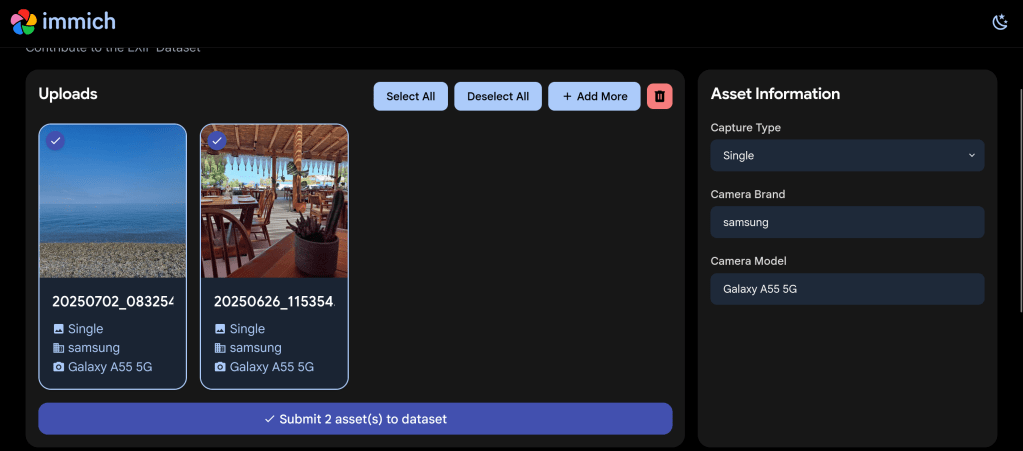
After navigating to the EXIF Dataset project page, you’re greeted with a clean upload interface. I uploaded a couple of photos taken with my Samsung Galaxy A55 5G – a beach landscape shot and a photo from a beachside restaurant.
The clean upload interface showing my first selected photo with its EXIF metadata displayed
The interface immediately displays the extracted EXIF information on the right side, including the capture type (Single), camera brand (Samsung), and camera model (Galaxy A55 5G). This lets you verify that your photos contain the metadata you want to contribute.
Step 2: Select Photos for Submission
You can upload multiple photos at once using the “+ Add More” button. I selected both of my photos for contribution – each showing clearly with a checkmark indicating selection.
Two photos selected and ready to submit to the EXIF Dataset
The interface provides convenient “Select All” and “Deselect All” buttons, as well as a delete option if you change your mind about any uploads.
Step 3: Agree to the CC0 License
When you click “Submit asset(s) to dataset”, a Dataset Agreement dialog appears. This is where the legal side of your contribution is handled transparently.
The Dataset Agreement confirms your photos will be released under the CC0 public domain license
ℹ️ About CC0: The CC0 (Creative Commons Zero) license means you’re releasing your contributed photos into the public domain. This allows the Immich project (and anyone else) to use the images freely for any purpose. Make sure you only upload photos you own the rights to and are comfortable sharing publicly.
The agreement requires you to confirm two things:
You agree to release the uploaded assets under the CC0 license into the public domain
The files have not been modified in any way that would alter their original content or metadata
You also provide a contact email in case the Immich team has any questions about your upload.
Why Should You Contribute?
Contributing to the EXIF Dataset helps improve Immich in several ways:
Better Device Support: By collecting EXIF samples from many different cameras and phones, Immich can improve its parsing for devices that may have quirks or non-standard metadata encoding
Improved Metadata Extraction: The dataset helps identify edge cases and unusual metadata formats that might otherwise go unnoticed
Community-Driven Development: Your contribution directly influences the quality of an open-source project used by thousands of self-hosters worldwide
Supporting Privacy-Focused Software: Immich is a privacy-respecting alternative to cloud-based photo services like Google Photos – your contribution helps make it even better
Tips for Contributing
To make your contribution as valuable as possible:
Contribute from different devices: If you have photos from older cameras, different smartphone brands, or professional equipment, these are especially valuable
Keep metadata intact: Don’t strip or modify the EXIF data before uploading – the original metadata is exactly what’s needed
Consider variety: Photos taken in different conditions (indoor, outdoor, various lighting) may contain different metadata values
Check your ownership: Only contribute photos you’ve taken yourself or have explicit rights to share
About Immich
For those unfamiliar with Immich, it’s a high-performance, self-hosted photo and video management solution that offers features comparable to Google Photos – but with full control over your data. Key features include automatic backup from mobile devices, facial recognition, smart search, timeline views, shared albums, and much more.
Immich is developed under the AGPL-3.0 license and is backed by FUTO, an organization dedicated to developing privacy-preserving technology. The project has grown tremendously, with over 77,000 stars on GitHub, making it one of the most popular self-hosted applications available.
🏠 Self-Host Immich: Get started with Immich at immich.app – available for Docker, TrueNAS, Unraid, and other platforms.
Conclusion
Contributing to the Immich EXIF Dataset is a simple yet meaningful way to support open-source software development. The process takes just a few minutes, and your contribution will help improve photo management for the entire Immich community.
GitHub has officially rolled out the improved “Files Changed” experience as the default for all users. After months in public preview, this redesigned pull request review interface brings significant improvements to performance, accessibility, and overall productivity when reviewing code changes.
Key Improvements Over the Classic Experience
The new interface maintains familiarity for existing users while adding several notable enhancements:
Comment on Any Line
Previously, you could only comment on lines directly surrounding a change. Now you can add review comments to any line in a changed file, making it easier to provide context or point out related code that might need attention.
View PR Description Without Switching Pages
A new Overview panel lets you view the pull request description directly from the “Files changed” page. No more jumping back and forth between tabs to remember what the PR is supposed to accomplish.
Enhanced File Tree
The file tree sidebar is now resizable and includes visual indicators showing which files have comments, errors, or warnings. This makes it much easier to track your progress when reviewing large PRs with many changed files.
Draft Comments That Persist
Comments and replies are now saved locally in your browser. If you accidentally close the tab or refresh the page, your in-progress feedback won’t be lost.
Fewer Page Reloads
Actions like refreshing to pull in new changes, switching between split and unified diff modes, and other common tasks no longer force a full page reload. The interface feels much snappier as a result.
Improved Accessibility
The new experience includes better keyboard navigation, screen reader landmarks, and increased line spacing options to make code review accessible to everyone.
Experimental Mode for Large Pull Requests
One of the most interesting additions is an experimental mode specifically designed for reviewing large pull requests. This mode uses virtualization to reduce the number of DOM elements the browser needs to manage, significantly improving memory usage and page responsiveness—especially on slower machines.
When viewing a large PR, you’ll see a banner offering to try this experimental mode. There are some trade-offs: browser find functionality, text selection across the entire page, printing, and some browser extensions may not work as expected since the full diff isn’t rendered in the DOM. You can switch back to single file mode at any time.
Bug Fixes and Polish
GitHub has also addressed numerous issues including problems with suggested changes being applied incorrectly, comment workflow bugs, interaction lag (especially on Safari), and various UI quirks like scroll positioning and sticky headers behaving unexpectedly.
Opting Out
If you prefer the classic experience, you can still opt out through your settings. However, given the improvements in this new version, it’s worth giving it a fair trial before switching back.
Providing Feedback
GitHub is actively collecting feedback on the new experience. If you encounter issues or have suggestions, you can participate in the “Files Changed” preview feedback discussion on GitHub.
Happy New Year, self-hosters! The Immich team has kicked off 2026 with a bang, releasing version 2.5.0 – aptly named the “90,000 Stars Release” in celebration of reaching this impressive GitHub milestone. This release is packed with long-awaited features that significantly improve both the mobile and web experience. Let’s dive into what’s new.
Free Up Space: Finally Here
This feature has been one of the most requested since the early days of Immich (it has a 3-digit issue ID!). Free Up Space allows you to remove local media files from your mobile device that have already been successfully backed up to your Immich server.
Free Up Space accessible from the user profile panelConfiguration options for Free Up Space
The feature includes smart configuration options:
Cutoff date: Only process photos and videos on or before a specified date
Keep albums: Preserve specific albums (WhatsApp-related albums are kept by default)
Keep favorites: Favorited assets stay on your device
Keep on device: Option to always keep all photos or all videos
Before any files are removed, you’ll see a review screen showing exactly what will be deleted and how much storage you’ll reclaim. Deleted items go to your device’s native Trash, giving you a safety net.
Non-Destructive Photo Editing
Immich now supports non-destructive editing – a major enhancement for anyone who’s hesitated to edit photos for fear of losing the original. Edits are stored in the database while original files remain untouched. You can always revert to the original.
Click the edit icon to enter edit mode
Currently supported editing operations:
Cropping
Rotation
Mirroring
The editing interface with cropping, rotation, and mirroring toolsOpening the editor on an edited asset loads existing edits for adjustment
When downloading an edited asset, you get the edited version by default, but can also choose to download the original. Note that mobile editing still uses the old system for now – the non-destructive approach will come to mobile in a future release.
Web-Based Database Backup and Restore
Database management just got significantly easier. Previously, restoring an Immich instance required command-line access – a barrier for users new to self-hosting. Now, the entire backup and restore pipeline is built into the web UI.
You can restore from two locations:
Restore from the Administration → Maintenance pageRestore from the Onboarding page on a fresh installation
This is particularly valuable if you’ve ever worried about database corruption from power loss or system failures.
Upload Improvements
Foreground uploads on mobile have been significantly improved. The new implementation brings back reliable upload handling while adding concurrent uploads and proper support for assets with missing file extensions (common with DJI and Fusion Camera files).
Improved upload interface with concurrent upload support
A notable improvement for iOS/iCloud users: uploads now send unique metadata to the server for faster checksum retrieval when reinstalling the app. To take advantage of this for existing uploads, go to App Settings → Sync Status and tap “Sync Cloud IDs” once.
Sync Cloud IDs to backfill metadata for existing uploads (iOS/iCloud users)
Visual Refresh
The entire Immich experience has received a visual update across web, mobile, and documentation. A new font improves readability, especially for numbers and smaller text.
Refreshed visual design with improved typography
The UI library has been integrated more deeply into the web app, providing more consistent components and better visual hierarchy.
More standardized and coherent UI components
All icon buttons now include tooltips – no more guessing what a button does.
All icon buttons now show helpful tooltips
Additional Highlights
Star Rating on Mobile
Mobile users can now rate their photos with stars, bringing feature parity with the web application.
Star rating now available on mobile
Disable Admin Setup
New environment variable IMMICH_ALLOW_SETUP=true|false lets you prevent the admin setup page from appearing after initial configuration – useful if your database ever gets accidentally reset.
Fine-Grained API Permissions
New scoped permissions for API keys include: map.read, map.search, and folder.read.
Progressive JPEGs
Image generation settings now include an option for progressive JPEGs, allowing supported browsers to render images progressively as they load.
New progressive JPEG option in image generation settings
Slideshow Loop
Web slideshows can now automatically restart when they reach the end.
New loop option in slideshow settings
Native HTTP Clients
All remote images now use optimized HTTP clients supporting HTTP/2 and HTTP/3. Images load faster, caching is improved, and the offline experience is more responsive with a larger cache size.
Important Notes
Mobile App Update Paused: As of the release, the team has temporarily halted the mobile app release due to some reported migration issues. Check the GitHub release page for the latest status.
Client Compatibility: Mobile clients must be updated to v2.5.0 to view edited versions of assets. Older clients will continue to see original images.
How to Update
Follow the standard update procedure for your deployment method. As always, ensure you have a backup before upgrading.
For the complete changelog including all bug fixes and documentation updates, check the full release notes on GitHub.
Support the Project
If you find Immich helpful, consider supporting the project by purchasing a product key at buy.immich.app or grabbing some merchandise at immich.store.
Unlock insights from your spaced repetition learning journey
If you’re serious about learning, chances are you’ve encountered Anki—the powerful, open-source flashcard application that uses spaced repetition to help you remember anything. Whether you’re studying medicine, languages, programming, or any other subject, Anki has likely become an indispensable part of your learning toolkit.
But have you ever wondered what stories your flashcard data could tell? How your review patterns have evolved over time? Which decks demand the most cognitive effort? That’s exactly why I created ankiR.
What is ankiR?
ankiR is an R package that lets you read, analyze, and visualize your Anki collection data directly in R. Under the hood, Anki stores all your notes, cards, review history, and settings in a SQLite database. ankiR provides a clean, user-friendly interface to access this treasure trove of learning data.
Installation
ankiR is available on CRAN and R-universe, making installation straightforward:
Bug reports: Feel free to open issues on the package repository
Related Projects
If you’re interested in spaced repetition and R, you might also want to check out:
FSRS: The Free Spaced Repetition Scheduler algorithm, which Anki now supports natively
anki-snapshot: Git-based version control for Anki collections
Conclusion
Your Anki reviews represent countless hours of deliberate practice. With ankiR, you can finally extract meaningful insights from that data. Whether you’re a medical student tracking board exam prep, a language learner monitoring vocabulary acquisition, or a researcher studying memory, ankiR gives you the tools to understand your learning at a deeper level.
Give it a try, and let me know what insights you discover in your own data!
ankiR is open source and contributions are welcome. Happy learning!
I’ve released anki-snapshot, a tool that brings proper version control to your Anki flashcard collection. Every change to your notes is tracked in git, giving you full history, searchable diffs, and the ability to see exactly what changed and when.
The Problem
Anki’s built-in backup system saves complete snapshots of your database, but it doesn’t tell you what changed. If you accidentally delete a note, modify a card incorrectly, or want to see how your deck evolved over time, you’re stuck comparing opaque database files.
The Solution
anki-snapshot exports your Anki collection to human-readable text files and commits them to a git repository. This means you get:
Full history: See every change ever made to your collection
Meaningful diffs: View exactly which notes were added, modified, or deleted
Search through time: Find when a specific term appeared or disappeared
Easy recovery: Restore individual notes from any point in history
How It Works
The tool reads your Anki SQLite database and exports notes and cards to pipe-delimited text files. These files are tracked in git, so each time you run anki-snapshot, any changes are committed with a timestamp.
~/anki-snapshot/
├── .git/
├── notes.txt      # All notes: id|model|fields...
├── cards.txt      # All cards: id|note_id|deck|type|queue|due|ivl...
└── decks.txt      # Deck information
Commands
Command
Description
anki-snapshot
Export current state and commit to git
anki-diff
Show changes since last snapshot
anki-log
Show commit history with stats
anki-search "term"
Search current notes for a term
anki-search "term" --history
Search through all git history
anki-restore <commit> <note_id>
Restore a specific note from history
Example: Tracking Changes
After editing some cards in Anki, run the snapshot and see what changed:
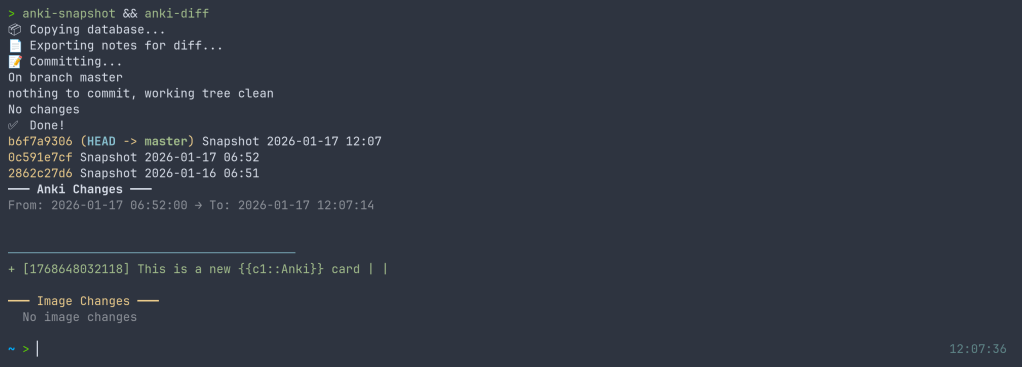
$ anki-snapshot
[main a3f2b1c] Snapshot 2026-01-14 21:30:45
 1 file changed, 3 insertions(+), 1 deletion(-)

$ anki-diff
━━━ Changes since last snapshot ━━━

Modified notes: 2
+ [1462223862805] Which antibodies are associated with Hashimoto...
− [1462223862805] Which antibodies are associated with Hashimoto...

New notes: 1
+ [1767170915030] Germline polymorphisms of the ATPase 6 gene...
Example: Searching History
Find when “mitochondria” was added or modified across your entire collection history:
$ anki-search "mitochondria" --history

commit e183cea7b3e36ad8b8faf7ca9d5eb8ca44d5bb5e
Date:   Tue Jan 13 22:43:47 2026 +0100
+ [1469146863262] If a disease has a mitochondrial inheritance pattern...
+ [1469146878242] Mitochondrial diseases often demonstrate variable expression...

commit 41c25a53471fc72a520d2683bd3defd6c0d92a88
Date:   Tue Jan 13 22:34:48 2026 +0100
− [1469146863262] If a disease has a mitochondrial inheritance pattern...
Integration with Anki
For seamless integration, you can hook the snapshot into your Anki workflow. I use a wrapper script that runs the snapshot automatically when closing Anki:
$ anki-wrapper # Opens Anki, snapshots on close
Or add it to your shell aliases to run before building/syncing your deck.
Installation
The tool is available on the AUR for Arch Linux users:
yay -S anki-snapshot
Or install manually:
git clone https://github.com/chrislongros/anki-snapshot-tool
cd anki-snapshot-tool
./install.sh
Requires: bash, git, sqlite3
Why Not Just Use Anki’s Backups?
Anki’s backups are great for disaster recovery, but they’re binary blobs. You can’t:
See what changed between two backups without restoring them
Search for when specific content was added
Selectively restore individual notes
Track your collection’s evolution over months or years
With git-based snapshots, your entire editing history becomes searchable, diffable, and recoverable.
I’ve just released fsrsr, an R package that provides bindings to fsrs-rs, the Rust implementation of the Free Spaced Repetition Scheduler (FSRS) algorithm. This means you can now use the state-of-the-art spaced repetition algorithm directly in R without the maintenance burden of a native implementation.
What is FSRS?
FSRS is a modern spaced repetition algorithm that outperforms traditional algorithms like SM-2 (used in Anki’s default scheduler). It uses a model based on the DSR (Difficulty, Stability, Retrievability) framework to predict memory states and optimize review intervals for long-term retention.
Why Bindings Instead of Native R?
Writing and maintaining a native R implementation of FSRS would be challenging:
The algorithm involves complex mathematical models that evolve with research
Performance matters when scheduling thousands of cards
Keeping pace with upstream changes requires ongoing effort
Here’s a simple example showing the core workflow:
library(fsrsr)

# Initialize a new card with a "Good" rating (3)
state <- fsrs_initial_state(3)
# $stability: 3.17
# $difficulty: 5.28

# After reviewing 3 days later with "Good" rating
new_state <- fsrs_next_state(
  stability = state$stability,
  difficulty = state$difficulty,
  elapsed_days = 3,
  rating = 3
)

# Calculate next interval for 90% target retention
interval <- fsrs_next_interval(new_state$stability, 0.9)
# Returns: days until next review

# Check recall probability after 5 days
prob <- fsrs_retrievability(new_state$stability, 5)
# Returns: 0.946 (94.6% chance of recall)
Research: Analyze spaced repetition data using R’s statistical tools
Custom SRS apps: Build R Shiny applications with proper scheduling
Simulation: Model learning outcomes under different review strategies
Data analysis: Process Anki export data with accurate FSRS calculations
Technical Details
The package uses extendr to generate R bindings from Rust code. The actual FSRS calculations happen in Rust via the fsrs-rs library (v2.0.4), with results passed back to R as native types.
I recently ran into a performance issue on my TrueNAS SCALE 25.10.1 system where the server felt sluggish despite low CPU usage. The system was running Docker-based applications, and at first glance nothing obvious looked wrong. The real problem turned out to be high iowait.
What iowait actually means
In Linux, iowait represents the percentage of time the CPU is idle while waiting for I/O operations (usually disk). High iowait doesn’t mean the CPU is busy — it means the CPU is stuck waiting on storage.
Under normal conditions, iowait should stay very low (usually under 1–2%). When it starts climbing higher, the system can feel slow even if CPU usage looks fine.
Confirming the issue with iostat
To get a clearer picture, I used iostat, which shows per-disk activity and latency:
iostat -x 1
This immediately showed the problem. One or more disks had:
Very high %util (near or at 100%)
Elevated await times
Consistent read/write pressure
At that point it was clear the bottleneck was storage I/O, not CPU or memory.
Tracking it down to Docker services
This system runs several Docker-based services. Using top alongside iostat, I noticed disk activity drop immediately when certain services were stopped.
In particular, high I/O was coming from applications that:
Continuously read/write large files
Perform frequent metadata operations
Maintain large active datasets
Examples included downloaders, media managers, and backup-related containers.
Stopping services to confirm
To confirm the cause, I stopped Docker services one at a time and watched disk metrics:
iostat -x 1
Each time a heavy I/O service was stopped, iowait dropped immediately. Once the worst offender was stopped, iowait returned to normal levels and the system became responsive again.
Why the system looked “fine” at first
This was tricky because:
CPU usage was low
Memory usage looked reasonable
The web UI was responsive but sluggish
Without checking iostat, it would have been easy to misdiagnose this as a CPU or RAM issue.
Lessons learned
High iowait can cripple performance even when CPU is idle
top alone is not enough — use iostat -x
Docker workloads can silently saturate disks
Stopping services one by one is an effective diagnostic technique
Final takeaway
On TrueNAS SCALE 25.10.1 with Docker, high iowait was the real cause of my performance issues. The fix wasn’t a reboot, more CPU, or more RAM — it was identifying and controlling disk-heavy services.
If your TrueNAS server feels slow but CPU usage looks fine, check iowait and run iostat. The disk may be the real bottleneck.
A journey through packaging Python libraries for spaced repetition and Anki deck generation across multiple platforms.
As someone passionate about both medical education tools and open-source software, I recently embarked on a project to make several useful Python libraries available as native packages for FreeBSD and Arch Linux. This post documents the process and shares what I learned along the way.
The Motivation
Spaced repetition software like Anki has become indispensable for medical students and lifelong learners. However, the ecosystem of tools around Anki—libraries for generating decks programmatically, analyzing study data, and implementing scheduling algorithms—often requires manual installation via pip. This creates friction for users and doesn’t integrate well with system package managers.
My goal was to package three key Python libraries:
genanki – A library for programmatically generating Anki decks
fsrs – The Free Spaced Repetition Scheduler algorithm (used in Anki and other SRS apps)
ankipandas – A library for analyzing Anki collections using pandas DataFrames
Arch Linux User Repository (AUR)
The AUR is a community-driven repository for Arch Linux users. Creating packages here involves writing a PKGBUILD file that describes how to fetch, build, and install the software.
python-fsrs 6.3.0
The FSRS (Free Spaced Repetition Scheduler) algorithm represents the cutting edge of spaced repetition research. Version 6.x brought significant API changes, including renaming the main FSRS class to Scheduler.
genanki allows developers to create Anki decks programmatically—perfect for generating flashcards from databases, APIs, or other structured data sources.
FreeBSD’s ports system is more formal than the AUR, with stricter guidelines and a review process. Ports are submitted via Bugzilla and reviewed by committers before inclusion in the official ports tree.
py-genanki Port
Creating a FreeBSD port required several steps:
Setting up the port skeleton – Creating the Makefile, pkg-descr, and distinfo files
Handling dependencies – Mapping Python dependencies to existing FreeBSD ports
Patching setup.py – Removing the pytest-runner build dependency which doesn’t exist in FreeBSD ports
Testing the build – Running make and make install in a FreeBSD environment
One challenge was that genanki’s setup.py required pytest-runner as a build dependency, which doesn’t exist in FreeBSD ports. The solution was to create a patch file that removes this requirement:
One of the biggest challenges in packaging is mapping upstream dependencies to existing packages in the target ecosystem. For FreeBSD, this meant:
Searching /usr/ports for existing Python packages
Understanding the @${PY_FLAVOR} suffix for Python version flexibility
Discovering hidden dependencies (like chevron) that weren’t immediately obvious from the package metadata
Build System Quirks
Python packaging has evolved significantly, with projects using various combinations of:
setup.py with setuptools
pyproject.toml with various backends (setuptools, flit, hatch, poetry)
Legacy setup_requires patterns that don’t translate well to system packaging
Creating patches to work around these issues is a normal part of the porting process.
Testing Across Platforms
Running a FreeBSD VM (via VirtualBox) proved essential for testing ports before submission. The build process can reveal missing dependencies, incorrect paths, and other issues that only appear in the actual target environment.
Summary
Package
Version
AUR
FreeBSD
python-fsrs / py-fsrs
6.3.0
✅ Published
📝 Submitted
python-genanki / py-genanki
0.13.1
✅ Published
📝 Submitted
python-ankipandas
0.3.15
✅ Published
🔜 Planned
Get Involved
If you use these tools on Arch Linux or FreeBSD, I’d love to hear your feedback. And if you’re interested in contributing to open-source packaging:
If you’re running Arch Linux and trying to build Anki from source, you may have encountered a frustrating build failure related to Python 3.14. Here’s what went wrong and how I fixed it.
The Problem
Arch Linux recently updated to Python 3.14.2 as the system default. When attempting to build Anki from the main branch, the build failed with this error:
error: the configured Python interpreter version (3.14) is newer than PyO3's maximum supported version (3.13)
= help: please check if an updated version of PyO3 is available. Current version: 0.23.3
The issue is that Anki depends on orjson, a fast JSON library written in Rust. This library uses PyO3 for Python bindings, and the bundled version (0.23.3) only supports Python up to 3.13.
Why UV_PYTHON and .python-version Didn’t Work
My first attempts involved setting the UV_PYTHON environment variable and creating a .python-version file in the repository root. Neither worked because Anki’s build runner wasn’t passing these settings through to uv when creating the virtual environment. The build system kept detecting and using /usr/bin/python3 (3.14.2) regardless.
The Solution
The fix is to install Python 3.13 via pyenv and put it first in your PATH so it gets detected before the system Python.
First, install pyenv and Python 3.13:
sudo pacman -S pyenv
pyenv install 3.13.1
Then, for your build session, prepend Python 3.13 to your PATH:
Alternatively, create a simple wrapper script for building Anki that sets the PATH temporarily.
Conclusion
This is a temporary issue that will resolve itself once orjson updates its bundled PyO3 to a version that supports Python 3.14. Until then, using pyenv to provide Python 3.13 is a clean workaround that doesn’t require downgrading your system Python or breaking other applications.
The Arch Linux philosophy of staying on the bleeding edge occasionally runs into these compatibility gaps with projects that have Rust dependencies—something to keep in mind when building from source.








 /root
/root 