



The internal method of unzip() now follows unzip 6.00 in how it handles extracted file paths which contain "../". With thanks to Ivan Krylov.
INSTALLATION
Standalone nmath can be built with early-2025 versions of clang-based compilers such as LLVM clang 20, Apple clang 17 and Intel icx 2025.0.
Tcl/Tk 9 can be used to build package tcltk: this has become the default in some Linux distributions. N.B. several third-party packages currently require Tcl/Tk 8 or even 8.6 without declaring so.
BUG FIXES
Java detection in javareconf could not detect ‘libjvm.*’ in the zero variant of the JDK (PR#18884). All valid variants as of JDK 24u are now supported.
factanal(.., rotation=*) now correctly updates rotmat, fixing PR#18886.
dnbinom(<large>, <muchlarger>, ..) now is 0 correctly, instead of NaN or Inf sometimes.
dbinom(<large>, n=Inf, ..) is 0 now correctly, instead of NaN which also fixes many dnbinom() cases, notably those mentioned in PR#16727 comment #5.
Fixing C level “binomial deviance” bd0() for extreme arguments (preventing under-/overflow) solves more PR#16727 cases and also prevents some full accuracy loss in such cases for dbinom(), dnbinom(), and via dbinom_raw() potentially dgeom(), dhyper(), dbeta(), and df().
signif(1.**e308, digits) no longer truncates unnecessarily (but still to prevent overflow to Inf), fixing PR#18889.
prettyNum(*, zero.print={>=1-char}, replace.zero=TRUE) now works as documented, thanks to Marttila Mikko and Ivan Krylov’s messages on R-devel.
pbeta(x, a,b, ..) for very large a,b no longer returns NaN but the correct values (0 or 1, or their logs for log.p = TRUE). This improves Mathlib’s C level bratio() and hence also pnbinom(), etc..
A C23 compiler (if available) is now selected by default for compilation of R and packages.
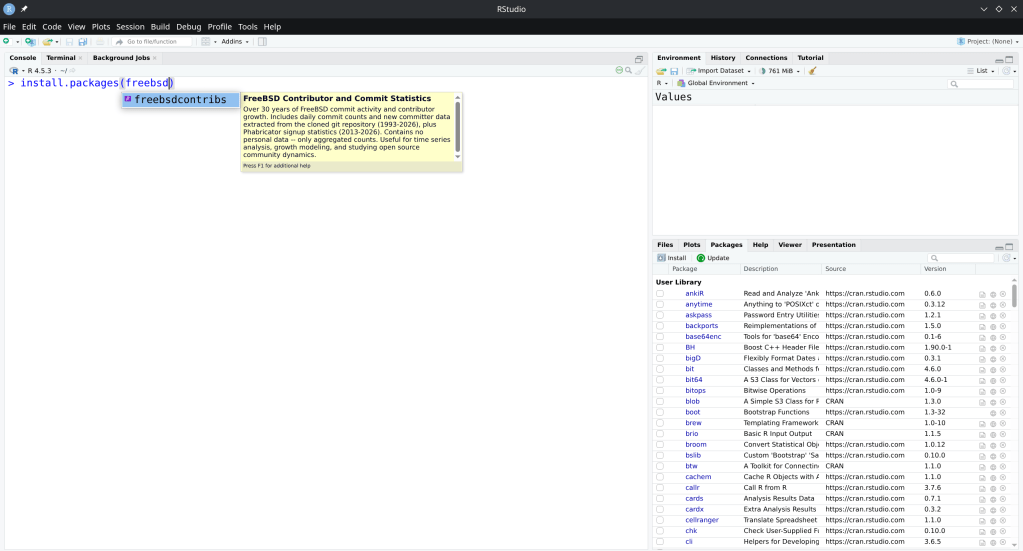
install.packages() now supports parallel downloads
CHANGES IN R 4.5.0:
NEW FEATURES
as.integer(rl) and hence as.raw(rl) now work for a list of raw(1) elements, as proposed by Michael Chirico’s PR#18696.
graphics’ grid() gains optional argument nintLog.
New functions check_package_urls() and check_package_dois() in package tools for checking URLs and DOIs in package sources.
New head() and tail() methods for class "ts" time series, proposed by Spencer Graves on R-devel.
New qr.influence() function, a “bare bones” interface to the lm.influence() leave-one-out diagnostics computations; wished for in PR#18739.
Package citation() results auto-generated from the package metadata now also provide package DOIs for CRAN and Bioconductor packages.
New function grepv() identical to grep() except for the default value = TRUE.
methods(<pkg>:::<genfun>) now does report methods when neither the generic nor the methods have been exported.
pdf() gains an author argument to set the corresponding metadata field, and logical arguments timestamp and producer to optionally omit the respective metadata. (Thanks to Edzer Pebesma.)
grDevices::glyphInfo() gains a rot argument to allow per-glyph rotation. (Thanks to Daniel Sabanes Bove.)
Package tools now exports functions CRAN_current_db(), CRAN_aliases_db(), CRAN_rdxrefs_db(), CRAN_archive_db(), and CRAN_authors_db().
Package tools now exports functions R() and parse_URI_reference().
Package tools now exports functions base_aliases_db() and base_rdxrefs_db().
It is now possible to set the background color for row and column names in the data editor on Windows (Rgui).
Rterm on Windows now accepts input lines of unlimited length.
file.info() on Windows now provides file owner name and domain.
Sys.info() on Windows now provides current user domain.
findInterval() gets new arguments checkSorted and checkNA which allow skipping relatively costly checks; related to PR#16567.
pnorm(x) underflows more gracefully.
get(nam, env) now signals a classed error, "getMissingError", as “subclass” of "missingArgError" where the latter is used also in similar situations, e.g., f <- function(x) exp(x); try(f()) .
The set operations now avoid the as.vector() transformation for same-kind apparently vector-like operands.
md5sum() can be used to compute an MD5 hash of a raw vector of bytes by using the bytes= argument instead of files=. The two arguments are mutually exclusive.
Added function sha256sum() in package tools analogous to md5sum() implementing the SHA-256 hashing algorithm.
The xtfrm() method for class "AsIs" is now considerably faster thanks to a patch provided by Ivan Krylov.
The merge() method for data frames will no longer convert row names used for indexing using I(), which will lead to faster execution in cases where sort = TRUE and all.x and/or all.y are set to TRUE.
The methods package internal function .requirePackage() now calls requireNamespace(p) instead of require(p), hence no longer adding packages to the search() path in cases methods or class definitions are needed. Consequently, previous workflows relying on the old behaviour will have to be amended by adding corresponding library(p) calls.
More R-level messages use a common format containing "character string" for more consistency and less translation work.
available.packages() and install.packages() get an optional switch cache_user_dir, somewhat experimentally.
The sunspot.month data have been updated to Oct 2024; because of recalibration also historical numbers are changed, and we keep the previous data as sunspot.m2014 for reproducibility.
The quartz() device now supports alpha masks. Thanks to George Stagg, Gwynn Gebeyhu, Heather Turner, and Tomek Gieorgijewski.
The print() method for date-time objects (POSIX.t) gets an optional digits argument for fractional seconds, passed to improved format.POSIXlt(); consequently, print(<date.time>, digits = n) allows to print fractions of seconds.
install.packages() and download.packages() download packages simultaneously using libcurl, significantly reducing download times when installing or downloading multiple packages.
Status reporting in download.file() has been extended to report the outcome for individual files in simultaneous downloads.
The Rd \link macro now allows markup in the link text when the topic is given by the optional argument, e.g., ‘\link[=gamma]{\eqn{\Gamma(x)}}’.
If La_library() is empty, sessionInfo() still reports La_version() when available.
seq.int(from, to, by, ....) when ∣by∣=1∣by∣=1 now behaves as if by was omitted, and hence returns from:to, possibly integer.
seq.Date(from, to, by, ....) and seq.POSIXt(..) now also work when from is missing and sufficient further arguments are provided, thanks to Michael Chirico’s report, patch proposal in PR#17672 and ‘R Dev Day’ contributions. The Date method also works for seq(from, to), when by is missing and now defaults to "1 days". It is now documented (and tested) that the by string may be abbreviated in both seq methods. Both methods return or keep internal type "integer" more consistently now. Also, as.POSIXct({}) is internally integer.
duplicated(), unique(), and anyDuplicated() now also work for class expression vectors.
New function use() to use packages in R scripts with full control over what gets added to the search path. (Actually already available since R 4.4.0.)
There is some support for zstd compression of tarballs in tar() and untar(). (This depends on OS support of libzstd or by tar.)
print(summary(<numbers>)) gets new optional argument zdigits to allow more flexible and consistent (double) rounding. The current default zdigits = 4L is somewhat experimental. Specifying both digits = *, zdigits = * allows behaviour independent of the global digits option.
The format() method for "difftime" objects gets a new back compatible option with.units.
A summary() method for "difftime" objects which prints nicely, similar to those for "Date" and "POSIXct".
unique()‘s default method now also deals with "difftime" objects.
optimize(f, *) when f(x) is not finite says more about the value in its warning message. It no longer replaces -Inf by the largest positive finite number.
The documentation of gamma() and is.numeric() is more specific, thanks to the contributors of PR#18677.
New dataset gait thanks to Heather Turner and Ella Kaye, used in examples.
New datasets penguins and penguins_raw thanks to Ella Kaye, Heather Turner, and Kristen Gorman.
isSymmetric(<matrix>) gains a new option trans = "C"; when set to non-default, it tests for “simple” symmetry of complex matrices.
model.frame() produces more informative error messages in some cases when variables in the formula are not found, thanks to Ben Bolker’s PR#18860.
selectMethod(f, ..) now keeps the function name if the function belongs to a group generic and the method is for the generic.
terms(<formula>, specials = *) now treats non-syntactic specials more gracefully, thanks to Mikael Jagan’s PR#18568.
BLAS and LAPACK
The bundled BLAS and LAPACK sources have been updated to those shipped as part of January 2025’s LAPACK 3.12.1.
It is intended that this will be the last update to BLAS and LAPACK in the R sources. Those building R from source are encouraged to use external BLAS and LAPACK and this will be required in future.
This update was mainly bug fixes but contained a barely documented major change. The set of BLAS routines had been unchanged since 1988, so throughout R‘s history. This update introduced new BLAS routines dgemmtr and zgemmtr which are now used by LAPACK routines. This means that BLAS implementations are no longer interchangeable.
To work around this, R can be configured with option –with-2025blas which arranges for the 2025 BLAS additions to be compiled into libRlapack (the internal LAPACK, not built if an external LAPACK is used). This option allows the continuation of the practice of swapping the BLAS in use by symlinking ‘lib/libRblas.*’. It has the disadvantage of using the reference BLAS version of the 2025 routines whereas an enhanced BLAS might have an optimized version (OpenBLAS does as from version 0.3.29).
Windows builds currently use the internal LAPACK and by default the internal BLAS: notes on how to swap the latter via ‘Rblas.dll’ are in file ‘src/extra/blas/Makefile.win’.
INSTALLATION on a UNIX-ALIKE
A C23 compiler (if available) is now selected by default for compilation of R and packages. R builds can opt out via the configure flag –without-C23, unless the specified or default (usually gcc) compiler defaults to C23: gcc 15 will. A C23 compiler is known to be selected with gcc 13–15, LLVM clang 18–20 (and 15 should), Apple clang 15–17 and Intel 2024.2–2025.0 (and 2022.2 should). Current binary distributions on macOS use Apple clang 14 and so do not use C23.
The minimum autoconf requirement for a maintainer build has been increased to autoconf 2.72.
Building the HTML and Info versions of the R manuals now requires texi2any from Texinfo 6.1 or later.
Failures in building the manuals under ‘doc’ now abort the installation, removing any file which caused the failure.
Control of symbol visibility is now supported on macOS (the previous check only worked on ELF platforms).
There is now support for installing the debug symbols for recommended packages on macOS: see ‘REC_INSTALL_OPT’ in file ‘config.site’.
configure is now able to find an external libintl on macOS (the code from an older GNU gettext distribution failed to try linking with the macOS Core Foundation framework).
INSTALLATION on WINDOWS
Both building R and installing packages use the C compiler in C23 mode.
R on Windows by default uses pkg-config for linking against external libraries. This makes it easier to test R and packages with alternative toolchains (such as from Msys2, e.g., testing with LLVM and possibly with sanitizers). It also allows more significant Rtools updates within a single R minor release.
The installer scripts for Windows have been tailored to Rtools45, an update of the Rtools44 toolchain. It is based on GCC 14. The experimental support for 64-bit ARM (aarch64) CPUs is based on LLVM 19. R-devel and R 4.5.x are no longer maintained to be buildable using Rtools44 and it is advised to switch to Rtools45.
DEPRECATED AND DEFUNCT
is.R() is defunct. Environment variable _R_DEPRECATED_IS_R_ no longer has any effect.
Deprecated (for more than 9 years!) functions linearizeMlist, listFromMlist, and showMlist and the "MethodsList" class for S4 method handling were removed from package methods. Deprecated functions balanceMethodsList, emptyMethodsList, inheritedSubMethodLists, insertMethod, insertMethodInEmptyList, makeMethodsList, mergeMethods, MethodsList, MethodsListSelect, and SignatureMethod were made defunct, as were the "MethodsList" branches of functions assignMethodsMetaData, finalDefaultMethod, and MethodAddCoerce.
getMethods(*, table = TRUE) is deprecated.
Building with the bundled (and old) version of libintl is deprecated and now gives a configure warning. This should be selected only if neither the OS’s libc (as on GNU Linux) nor an external libintl library provide suitable functions. Instead install libintl from a recent version of GNU gettext (available for macOS) or use configure option –disable-nls. The ability to use the bundled version may be removed as soon as R 4.5.1.
The deprecated xfig() graphics device has been removed.
PACKAGE INSTALLATION
Packages are now installed using C23 where supported by the OS and R build. Packages using R‘s compiler settings can ask not to use C23 via including USE_C17 in SystemRequirements or can be installed by R CMD INSTALL --use-C17. (Some packages ignore these settings in their configure script or when compiling in sub-directories of ‘src’, as will those using a ‘src/Makefile’.)
Source installs now report the package version in the log.
There is preliminary support for C++26 with GCC >=>= 14, Apple clang++>=>= 16 and LLVM clang++>=>= 17.
C-LEVEL FACILITIES
The non-API and hidden entry points Rf_setIVector, Rf_setRVector and Rf_setSVector have been removed.
The internal code for changing the parent of an environment now signals an error if the new parent is not an environment or if the change would create a cycle in the parent chain.
SET_TYPEOF now signals an error unless the old and new types have compatible memory structure and content. Use of SET_TYPE in package C code should be avoided and may be deprecated in the near future. It is better to allocate an object of the desired type in the first place.
The set of LAPACK (double and complex) routines declared in the headers ‘R_ext/Lapack.h’ and ‘R_ext/Applic.h’ has been extended, mostly to routines actually in use by packages.
Memory allocation messages now use the (non-SI notation) "Mb", "Gb" , …, and "Mbytes" strings as arguments instead of as part of the (translatable format) string. This is one step for PR#18297; from Henrik Bengtsson.
Header ‘R_ext/Constants.h’ (included by ‘R.h’) now always includes header ‘float.h’ or ‘cfloat’ for constants such as DBL_MAX.
Strict R headers are now the default. This removes the legacy definitions of PI, Calloc, Realloc and Free: use M_PI, R_Calloc, R_Realloc or R_Free instead.
The deprecated and seemingly never-used S-compatibility macros F77_COM and F77_COMDECL have been removed from header ‘R_ext/RS.h’.
The enumRboolean defined in header ‘R_ext/Boolean.h’ now has a fixed underlying type of int on platforms whose C compiler supports this. This is a C23 feature (taken from C++11) and also supported in all C standards by some versions of clang (from LLVM and Apple) and (with a warning when using -pedantic) by GCC when in C17 mode. A fair amount of code has assumed this: it may be changed to a smaller type in future. In particular, as standard compilers do not check the validity of assignment to an enum, it has been possible to assign NA_INTEGER to an Rboolean variable, coerce it to int and recover the value. If there were a platform which used an underlying type of a different size this would be an ABI-breaking change (but we are unaware of any such platform).
Header ‘R_ext/Boolean.h’ now ensures that a bool type is available either as a keyword (C23 and C++) or by including the C99 header ‘stdbool.h’. This is being used internally in R to replace Rboolean by bool.
There are new functions asRboolean and asBool, variants of asLogical more suited to converting logical arguments to Rboolean or to bool. They require a length-one input and throw an error if that evaluates to NA.
Header ‘R_exts/Error.h’ now ensures that Rf_error and similar are given a noreturn attribute when used from C++ under all compilers.
Header ‘R_exts/Utils.h’ no longer contains a declaration for F77_SUB(interv). This is intended to be called from Fortran and was wrongly declared: LOGICAL in Fortran corresponds to int * not Rboolean *.
Defining R_INCLUDE_BOOLEAN_H to 0 before including headers ‘R.h’ or ‘Rinternals.h’ (or any other header which includes ‘R_ext/Boolean.h’) stops the inclusion of header R_ext/Boolean.h which ‘defines’ constants TRUE, FALSE, true, false and the type bool which some package maintainers wish to avoid. Note that the last three are keywords in C23 and C++11 so cannot be avoided entirely. However, with commonly-used compilers they can be masked by a macro of the same name, often with a warning.
C-LEVEL API
The ‘Writing R Extensions’ Texinfo source now contains very experimental annotations for more clearly identifying the API status of C entry points. These annotations are used to produce indices for API, experimental API, and embedded API entry points in the rendered versions. This is very preliminary and may be dropped if a better approach emerges. Also for Fortran-callable entry points which are part of the API.
‘Writing R Extensions’ has a new section ‘Moving into C API compliance’ to help package authors move away from using non-API endpoints. This section will continue to be updated as work on clarifying and tightening the C API continues.
New API function R_mkClosure. This checks that its arguments are valid and should be used instead of allocSExp(CLOSXP followed by SET_FORMALS, SET_BODY, and SET_CLOENV.
New API functions R_ClosureFormals, R_ClosureBody, and R_ClosureEnv for extracting closure components. The existing functions R_ClosureExpr and R_BytecodeExpr have also been added to the API.
New API function R_ParentEnv corresponding to R‘s parent.env().
Further non-API entry points have been added to those reported by R CMD check: COMPLEX0, ddfind, DDVAL, ENSURE_NAMEDMAX, ENVFLAGS, FRAME, HASHTAB, INTERNAL, IS_ASCII, IS_UTF8, LEVELS, NAMED, PRSEEN, RDEBUG, REAL0, Rf_findVarInFrame3, SET_BODY, SET_CLOENV, SET_FORMALS, SET_PRSEEN, SET_RDEBUG, STRING_PTR, SYMVALUE, and VECTOR_PTR. Any declarations for these in public header files will be removed in the near future, and they will be hidden where possible.
Some R CMD check ‘NOTE’s on the use of non-API entry points have been upgraded to ‘WARNING’s in preparation for removing declarations and, where possible, hiding these entry points.
Additional non-API entry points have been added to those reported by R CMD check: IS_LONG_VEC, PRCODE, PRENV, PRVALUE, R_nchar, Rf_NonNullStringMatch, R_shallow_duplicate_attr, Rf_StringBlank, SET_TYPEOF, TRUELENGTH, XLENGTH_EX, and XTRUELENGTH.
Enable defining R_NO_REMAP_RMATH and calling Rf_*() as has been documented in ‘Writing R Extensions’ for a while, fixing PR#18800 thanks to Mikael Jagan and Suharto Anggono.
R_GetCurrentSrcref(skip) now skips calls rather than srcrefs, consistent with counting items in the traceback() display. If skip == NA_INTEGER, it searches for the first srcref, starting at the current evaluation state and proceeding through the call stack; otherwise, it returns the srcref of the requested entry from the call stack.
UTILITIES
R CMD INSTALL (and hence check) now compile C++ code with -DR_NO_REMAP. ‘Writing R Extensions’ has been revised to describe the remapped entry points, for with the Rf_ prefix remains optional when used from C code (but is recommended for new C code).
R CMD check --as-cran notes bad parts in the ‘DESCRIPTION’ file’s URL fields.
Since almost all supported R versions now use UTF-8, R CMD check no longer by default reports on marked UTF-8 or Latin-1 strings in character data. Set environment variable _R_CHECK_PACKAGE_DATASETS_SUPPRESS_NOTES_ to a false value for the previous behaviour.
tools::checkDocFiles() notes more cases of usage documentation without corresponding \alias.
R CMD check with a true value for environment variable _R_CHECK_BASHISMS_ checks more thoroughly, including for bash scripts and bashisms in components of autoconf-generated configure scripts.
R CMD check gains option –run-demo to check demo scripts analogously to tests. This includes a check for undeclared package dependencies: it can also be enabled separately by setting the environment variable _R_CHECK_PACKAGES_USED_IN_DEMO_ to a true value (as done by R CMD check --as-cran).
R CMD build now supports –compression=zstd on platforms with sufficient support for zstd.
tools::texi2pdf(..., texinputs=paths) now prepends the specified paths to TEXINPUTS. When building R itself (‘doc/NEWS.pdf’ and base vignettes) or package manuals using R CMD Rd2pdf, it is ensured that this R‘s ‘Rd.sty’ takes precedence over any other (incompatible) versions in default “texmf trees”.
tools::Rd2latex() no longer outputs an ‘\inputencoding{utf8}’ line by default; such a declaration is obsolete since LaTeX 2018-04-01.
BUG FIXES
update_pkg_po() now copies ‘.mo’ files to the translation package even if a ‘DESCRIPTION’ file exists, thanks to Michael Chirico fixing PR#18694.
Auto-generated citation() entries no longer include (additional) URLs in the ‘note’ field (PR#18547).
as.data.frame.list() gets a new option new.names and now preserves NA names, thus fixing the format() method for data frames, and also bug PR#18745. Relatedly, the format() method gets an option cut.names.
stem() formats correctly also in cases where rounding up, e.g., from 9.96 to 10 needs more digits; thanks to Ella Kaye and Kelly Bodwin, fixing PR#8934 during ‘R Dev Day’ at useR!2024. Additionally, stem(x) now works normally also when length(x) == 1.
tools’ toTitleCase() now works better, fixing PR#18674, thanks to Shannon Pileggi, Sarah Zeller, Reiko Okamoto, and Hugo Gruson’s ‘R Dev Day’ effort.
Printing matrices (typically with many rows and or columns) now also omits columns when desirable according to option max.print, or argument max, respectively. This is primarily the work of Lorena Abad, Ekaterina Akimova, Hanne Oberman, Abhishek Ulayil, and Lionel Henry at the ‘R Dev Day’, thus fixing PR#15027.
Sys.setLanguage() now warns about some failures to change the language.
Printing ls.str() now shows "<missing>" even when R‘s language setting is not English.
xyTable() now handles and reports NAs fixing PR#18654. Thanks to Heather Turner and Zhian Kamvar for report and patch.
as(*, "raw") now works as documented, thanks to Mikael Jagan’s PR#18795.
Informational messages of e.g., print(1:1e4, max=1000), now correctly mention max in addition to getOption("max.print").
rowSums(A, dims = dd), colMeans(..), etc, give a more helpful error message when dd is not of length one, thanks to Michael Chirico’s PR#18811.
seq.Date() no longer explicitly coerces results from integer to double, analogously with seq.default(), seq.int() and seq.POSIXt(), resolving a modifiedPR#18782.
axisTicks(usr, ...) documentation clarification for log = TRUE, fixing bug PR#18821 thanks to Duncan Murdoch.
debug() and debugonce(fun) now also accept a string fun when it names an S4 generic, fixing PR#18822 thanks to Mikael Jagan.
debugonce(<S4-simple-body>, signature=*) now works correctly when “called twice”, fixing PR#18824 thanks to Mikael Jagan.
format(dtime, digits=* / format=*) is more consistent when the POSIXt date-time object dtime has fractional (non integer) seconds. Fixes PR#17350, thanks to new contributions by LatinR’s ‘R Dev Day’ participants, Heather Turner and Dirk Eddelbuettel; also fixes more cases, notably when format contains “
options(scipen = NULL) and other invalid values now signal an error instead of invalidating ops relying on a finite integer value. Values outside the range -9 .. 9999 are now warned about and set to a boundary or to the default 0, e.g., in case of an NA.
cbind() could segfault with NULL inputs. (Seen when R was built with gcc-14, LTO and C99 inlining semantics.)
Fix segfault on quartz() from grid.glyph() call with glyphInfo() that describes non-existent font (PR#18784). Thanks to Tomek Gieorgijewski.
format() etc, using decimal.mark = s, by default getting s <- getOption("OutDec"), signals a warning (to become an error in the future) when s is not a string with exactly one character.
When s <- getOption("OutDec") is not a string of one character, a warning is signalled now whenever it is used in internal C code, notably when calling the default methods of format().
pwilcox() and qwilcox() now check for user interrupt less frequently.
summary(<stl>) (which prints directly) finally gets the same digits default as the formatting printing of default summary() method results, and it is documented explicitly.
options(show.error.locations = TRUE) once again shows the most recent known location when an error is reported. Setting its value to "bottom" is no longer supported. Numerical values are converted to logical.
C API function R_GetCurrentSrcref(skip) now returns srcref entries correctly. (Note that there is also a change to the interpretation of skip; see the C-LEVEL API entry above.)
tools::Rd2latex() now removes leading and trailing spaces from \alias entries as documented, fixing indexing and linking hiccups in some PDF manuals.
R CMD Rd2pdf can now render the package manual from a –latex installation also when the help contains figures.
The argument of as.environment() is now named x, not object, as was always documented and shown when printing it; thanks to Gael Millot’s PR#18849.
When R CMD check aims at getting the time+date from a world clock, it is more robust against unexpected non-error results, thanks to Michael Chirico’s PR#18852.
The tools::parseLatex() parser made several parsing errors (PR#18855).
Error messages produced by tools::parseLatex() are now more readable (PR#18855).
R CMD build <pkg> excludes more file patterns when it tars the <pkg> directory, fixing both PR#18432 and PR#18434, for vim and GNU Globalemacs users, thanks to Dirk Eddelbuettel’s patch.
quantile()‘s default method gets an option fuzz to protect against floating point inaccuracy before rounding, thus fixing PR#15811 and, en passant, PR#17683.
Printing arrays now also omits columns, rows and slices when desirable according to option max.print, or argument max, respectively, addressing most of the remaining part of PR#15027, thanks to Sherry Zhang’s patch.
drop.terms(y ~ w, 1) and similar now work, thanks to Benjamin Sommer’s report in PR#18861 and collaboration with Heather Turner improving reformulate().
Many arguments which should be length-1 logical are checked more thoroughly. The most commonly seen errors are in unlink(, recursive), tempdir() and the na.rm arguments of max(), min(), sum(), …. grep(), strsplit() and similar took non-TRUE/FALSE values of their logical arguments as FALSE, but these were almost always mismatches to unnamed arguments and are now reported as NA.
vignette("reshape") is now also available on Windows.
trace(coerce, ..) now works correctly, fixing PR#18823 thanks to Mikael Jagan.
R CMD check now also reports bad symbols in package shared objects linked in from local static libraries (PR#18789).
factanal() now works correctly also, e.g., for GPArotation, oblimin() rotations, fixing PR#18417, thanks to Coen Bernaards and others.
Setting attributes on primitive functions is deprecated now and already an error in the development version of R.
R can be installed using C23 (for example with -std=gnu23 or -std=gnu2x) with recent compilers including gcc 12–14, Apple clang 15–16, LLVM clang 17–20 and Intel icx 2024.2. It can be installed with the upcoming (at the time of writing) gcc 15, which defaults to C23.
C-LEVEL FACILITIES
The functions R_strtod and R_atof now allow hexadecimal constants without an exponent, for compatibility with their C99 versions (PR#18805).
UTILITIES
R CMD build and R CMD check now allow reference output for demo scripts (‘demo/demo.Rout.save’ files) to be shipped with the package, as proposed by Torsten Hothorn in PR#18816.
BUG FIXES
kappa(A, exact=TRUE) for singular A returns Inf more generally, fixing PR#18817 reported by Mikael Jagan.
Fixed URLs of the sun spots (sunspot.month etc) data sets and mention future changes due to recalibration.
The parser now accepts hexadecimal constants with a decimal point without an exponent (taken as p0) as documented in ?NumericConstants (PR#18819).
rbind() now works correctly when inputs include a raw vector and a logical, integer or double vector – previously the inclusion of the latter was garbled.
smooth.spline() checks validity of its arguments df.offset and penalty: it could segfault if they were NULL.
isGeneric(<primitive>, fdef=*, getName=TRUE) now also returns the name instead of just TRUE, fixing PR#18829 reported by Mikael Jagan.
isGeneric(fdef = print) now works, fixing PR#18369 thanks to Mikael Jagan.
sort(x, method = "qsort") made illegal accesses when x has length 0.
dir.create() is protected against being passed an empty string as its path argument.
Silent integer overflow could occur in the ‘exact’ computations for fisher.test() for unrealistic inputs: this is now an error.
Some invalid C-level memory accesses are avoided for loglin(, margin = NULL). loglin(, param = TRUE) no longer gives an error in corner cases such as a one-dimensional input.
dev.capabilities() $ events now reports "Idle" if the device provides it, fixing PR#18836, thanks to Trevor Davis.
arima(.., seasonal = <wrong-vector>) correctly errors now, ditto for arima0(), thanks to Norbert Kuder’s report on the R-devel list.
binomial(<link>)$linkinv(eta) and .. $mu.eta(eta) now also work for "logit" link when is.integer(eta).
as.roman(x) now should work platform independently, also for, e.g., x = "IIIII" (= V) and x = "IIIIII" (= VI).
R CMD Rd2pdf works again on an installed package directory containing LaTeX help (from option –latex), thanks to a report by Peter Ruckdeschel.
Taking full advantage of your CPU multithreading power.
Create a ~/.R/Makevars file and adjust the MAKEFLAGS environmental parameter according to your CPU characteristics. In my case with a 16 core CPU I set: MAKEFLAGS = -j32 for 32 jobs.